
AI Developer Tools in 2026: Mastering Emerging Technologies
Overview
Why ‘Emerging AI Technologies’ Matter for Developers in 2026
The world of Artificial Intelligence is moving super fast in 2026. Every day, it seems like there are new kinds of AI tools and ideas popping up. For people who build software, also known as developers, and their leaders, it is really important to keep up. If you don’t understand these new AI changes, you might miss out on building the best new products. There are already numerous AI systems and categories that developers need to know about.
Think about it like this: just a few years ago, we mostly talked about big AI models. But now, we have agentic AI, which can plan and do many steps on its own. We also see more ideas for personal AI, which could help each of us in our daily lives. Staying updated is key to making your work easier and creating amazing things.

For example, knowing about new AI tools can help you maximize software development efficiency with AI tools.
This article is here to help you make sense of it all. We will show you the many different kinds of AI, like a map. We will talk about how you can use these new AI tools in your projects. We will also look at how to use AI safely and what new things we expect to see very soon. It’s about getting ready for what’s next in the world of AI.
To make sure you’re always in the loop with the latest AI news, consider this helpful resource:
The AI Newsletter Worth Reading
To truly understand the quick changes in AI, it helps to put things into groups. Think of it like organizing a big toolbox. You would not just throw all your tools together. Instead, you put the hammers in one spot, the screwdrivers in another, and so on. This way, you can easily find the right tool for the job. The world of AI is similar, with numerous AI tools, each with its own special use.
In 2026, we can sort the most important AI developer tools into a few main types:
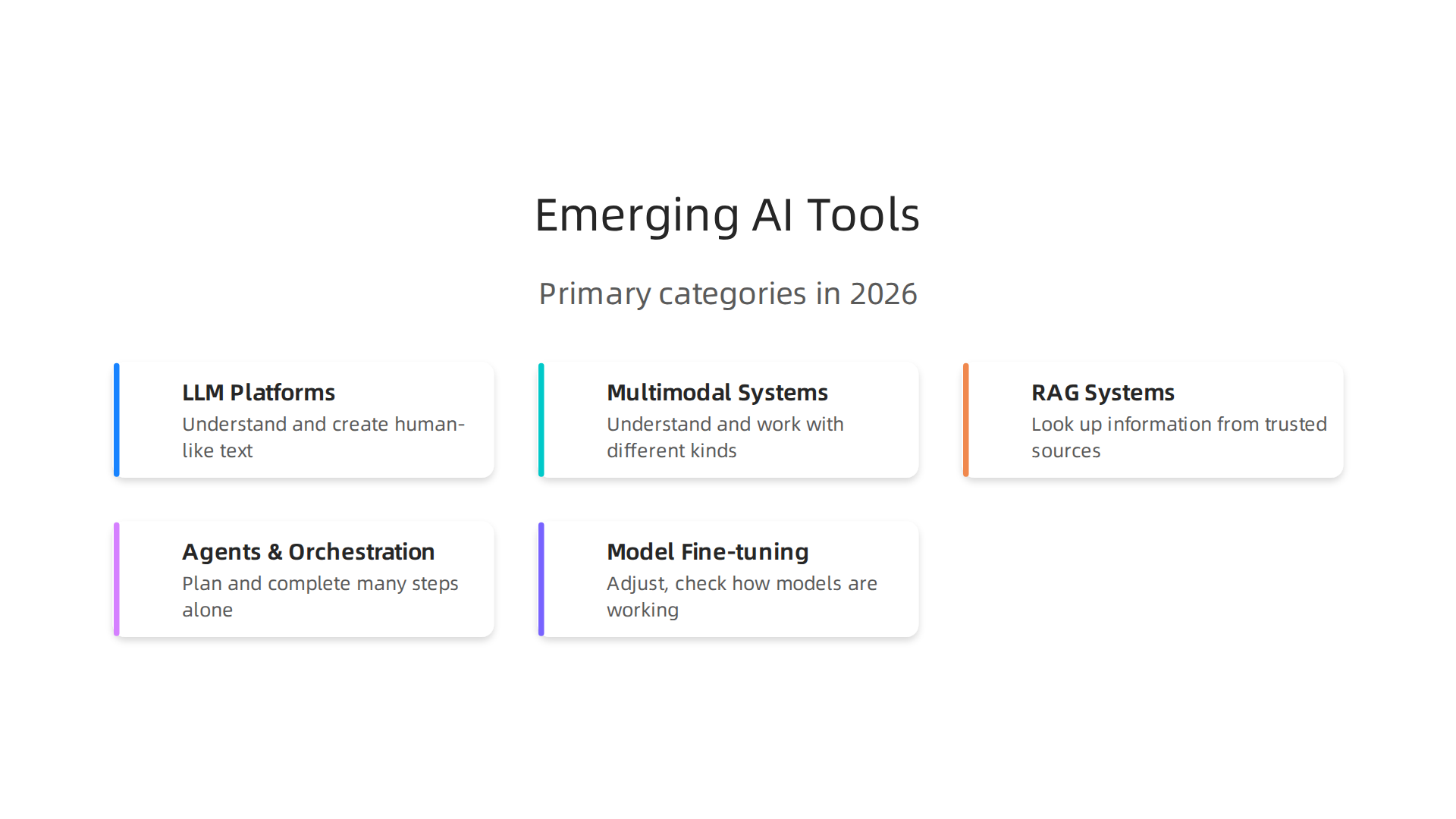
- LLM Platforms (Large Language Model Platforms): These are like the brains of many AI systems. They are powerful computer programs that understand and create human-like text. Developers use them to build apps that can chat, write summaries, or even create new content. For example, if you want your app to answer customer questions in a smart way, you would likely start with an LLM platform.
- Multimodal Systems: These AI tools go beyond just text. They can understand and work with different kinds of information all at once. Imagine an AI that can look at a picture, listen to a sound, and read text, then connect all those pieces. This helps developers build richer apps, like ones that describe images for visually impaired users or create videos from simple text ideas.
- Retrieval-Augmented Generation (RAG) Systems: Sometimes, an AI needs to know specific, up-to-date facts to give truly helpful answers. RAG systems let the AI look up information from a trusted source, like a company’s own documents or a database, before it creates an answer. This makes the AI’s responses much more accurate and less likely to "make things up." It is very useful for applications that need to be factual, like legal tools or customer support.
- Agents and Orchestration Tools: These are AI tools that can plan and complete many steps on their own to reach a goal. Remember how we talked about agentic AI in the last section? These tools help developers make that happen. They can manage complex workflows, like automatically testing new code, helping with data preparation, or deploying a new piece of software. It is like having a smart assistant that can handle a whole project from start to finish. You can apply AI to build software for peak productivity using these types of tools.
- Model Fine-tuning and Evaluation Tools: Even the best AI models sometimes need a little tweak to work perfectly for a specific task. These tools help developers adjust, or "fine-tune," AI models with their own data. They also let developers check how well the models are working and find any problems. This step is key to making sure an AI performs reliably and safely in real-world applications.
These different kinds of AI tools are changing how developers work. They help with everything from writing new code and testing it, to getting data ready, and finally putting new software out for people to use. Knowing these categories helps you decide how to choose the best niche AI developer tools for your team in 2026. In fact, these tools are becoming so important that many companies are using them to make their security, coding, and quality checks better across their projects today according to a 2026 report on Top 12 AI Developer Tools in 2026.
The world of AI is always growing, and one of the most exciting areas is how it helps people write computer code. These special tools are known as LLM-assisted coding and code-generation tools. They are a big reason why developers can now work faster and smarter. It is like having a helpful co-pilot right there with you as you build new software.
Let’s look at the different kinds of these handy code assistants and how they fit into a developer’s daily work.
Types of LLM-Assisted Coding Tools
Think of these tools as having different superpowers:
- Contextual Completions: This is like when your phone suggests the next word you might type. For coding, these tools look at your code and suggest the next lines or parts of code you might need. It helps you write faster and with fewer mistakes.
- Code Synthesis: These tools are more advanced. You can tell them in plain language what you want your code to do, and they will try to write whole blocks of code for you. It is like asking a very smart assistant to draft a report based on your ideas.
- Test Generation: Writing tests for code is very important but can take a lot of time. These AI tools can help create those tests automatically. This makes sure the software works correctly and stays high-quality.
Where These Tools Fit In
These AI tools are not separate programs you have to open all the time. They are usually built right into the places where developers already work:
- IDE Plugins: An IDE (Integrated Development Environment) is the main software developers use to write code. Many AI coding tools come as "plugins" that you add directly to your IDE. This means the AI suggestions pop up right as you type.
- CI Hooks: CI stands for Continuous Integration. This is a process where new code is regularly checked and tested. AI tools can hook into these checks to automatically review code or even help with data preparation before testing.
- API Services: Some AI coding tools are offered as services that developers can connect to using APIs (Application Programming Interfaces). This allows larger systems to use the AI’s power for more complex tasks, like automatically building parts of a website.
Benefits for Developers
The biggest draw of these tools is how much they can boost how quickly and well developers work.

Reports in 2026 show that AI coding tools can make developers complete tasks 30-55% faster in some cases, saving hours each week.

Junior developers often see big jumps in speed, sometimes 21-40% faster with AI help, according to one report on AI Productivity Gains in Software Engineering: 2026 Data. This means teams can build more software, quicker than before, which is great for businesses looking to unlock peak productivity with AI developer tools in 2026.
These tools are part of a trend where numerous AI solutions are changing how we approach software development, making complex tasks simpler and quicker.
Common Problems to Watch Out For
While there are many good things about LLM-assisted coding, there are also some challenges:
- Hallucinations: Sometimes, AI tools can "make up" code that looks correct but does not actually work or contains errors. Developers still need to carefully check what the AI creates.
- License Concerns: When AI generates code, questions can come up about who owns that code, especially if the AI was trained on code with different licenses.
- Quality Checks: Even if the AI code works, it might not always be the best quality or easy for other humans to understand. This means human review is still very important. Actually, some studies in 2026 even suggest that experienced developers might take longer on tasks when using AI tools because they spend extra time fixing AI-generated mistakes or dealing with bad code suggestions, as discussed in Do AI Coding Tools Actually Make Developers Faster? The 2026 ….
- Code Duplication: AI can sometimes create code that is very similar to existing code, leading to more duplicate sections which can make software harder to maintain later.
Despite these challenges, the conversation around tools like spark ai or lightchain ai shows that the focus is still on using AI to make coding better. Many developers believe that with the right approach, a personal AI coding assistant can greatly improve their daily work.
Staying up-to-date with all the fast changes in AI, including how it helps with coding, is super important for any developer.
The world of AI is moving quickly, and it is vital to keep learning about new tools and methods. Get clear daily AI updates. The AI Newsletter Worth Reading.
After developers use LLM-assisted coding tools to create software, the journey for AI doesn’t stop there. Once the code is written and tested, especially for tools that build or use machine learning models, there’s another important step: making sure these AI models work well in the real world. This is where MLOps, Model Hosting, and Observability come in. Think of it as the careful management and upkeep needed to keep your smart AI tools running smoothly.
What is MLOps?
MLOps stands for Machine Learning Operations. It is a set of practices that helps teams build, deploy, and manage AI models reliably and efficiently. Just like how DevOps helps software teams work together better, MLOps does the same for teams working with AI. It helps make sure that the [numerous AI] models created can actually be used and kept up-to-date.
Core Parts of MLOps for Developers
For developers and their teams, MLOps includes several key parts:
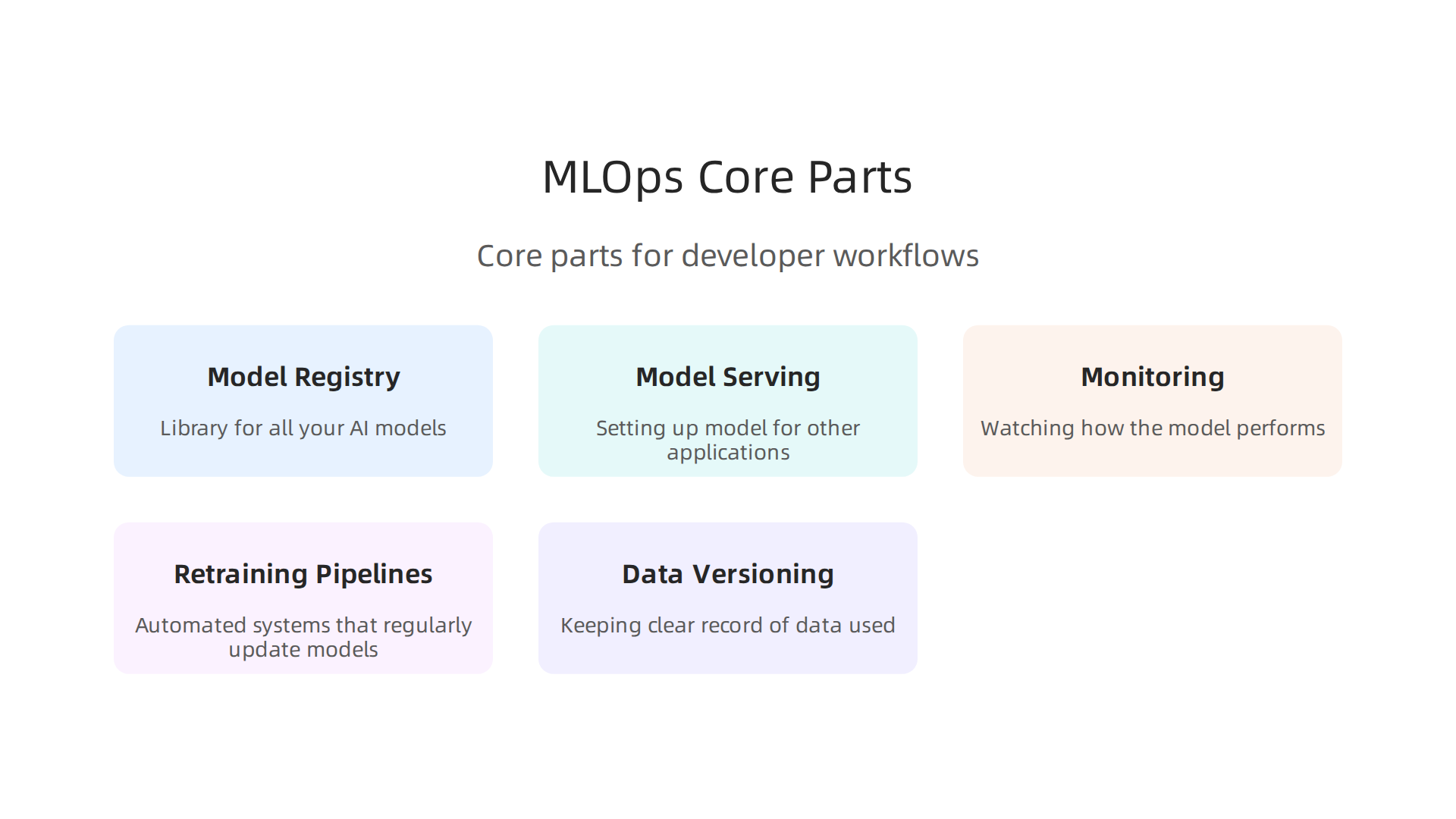
- Model Registry: This is like a library for all your AI models. It keeps track of every model version, who made it, and when. This way, teams always know which model is the latest or best one to use.
- Model Serving: Once a model is ready, it needs a way to actually do its job. Model serving is about setting up the model so other applications can send it data and get predictions back. This could be a tool helping a [personal AI] assistant or a bigger system making business decisions.
- Monitoring: Even the best AI model can run into problems over time. Monitoring means watching how the model performs in the real world. This helps catch issues early. Reports in 2026 highlight that careful monitoring is part of managing AI deployments, which includes watching quality, safety, and cost signals.
- Retraining Pipelines: AI models often need to learn from new data to stay accurate. Retraining pipelines are automated systems that regularly update models with fresh information. This makes sure the models stay smart and relevant. For example, a continuous training (CT) trigger can be set up to start retraining when model drift or performance drops are detected, as detailed in an AI Deployment Automation Guide 2026.
- Data Versioning: AI models are built on data. Data versioning means keeping a clear record of the data used for training each model. This is important because if a model starts to misbehave, you can always go back to the exact data it learned from. This step is crucial for managing AI models, as seen in comprehensive guides for AI Model Deployment Pipelines.
Watching Your AI: Observability
Observability for AI is all about understanding what your AI model is doing in a deeper way. It’s more than just seeing if it’s "on" or "off."
- Model Drift Detection: Over time, the real-world data an AI model sees might change. This can make the model less accurate. This change is called "model drift." Observability tools help spot this drift so you can fix it.
- Input Distribution Monitoring: This means checking if the data being fed into your AI model is still the same kind of data it was trained on. If the input data changes a lot, the model might not work as expected. Checking data quality, like schema validation and distribution testing, is a key part of setting up AI Testing & CI/CD for Machine Learning 2026.
This is different from watching regular apps. For a normal app, you mostly care if it’s running and not crashing. But for AI, you also need to know if it’s still making good decisions and if the world it operates in has changed too much. Being able to truly understand how an AI model is performing helps teams ensure their AI tools are always reliable and effective. Understanding these deeper aspects of AI is also part of choosing the right AI tools for developers to boost productivity.
After understanding how to keep an eye on AI models through MLOps and observability, the next big step is fitting these smart tools into your daily development work. This means making sure AI features are added carefully, tested well, and updated smoothly. Just like regular software, AI needs good pipelines for continuous integration and continuous delivery (CI/CD) to keep everything running great.
Integrating AI into Dev Workflows: CI/CD, Testing, and Tooling
Bringing AI into your development process means more than just writing code. It’s about having a full system to handle every part of an AI tool’s life.

This ranges from trying out new ideas (prototyping) to safely putting new AI features out for everyone to use.
CI/CD for AI Models and Prompts
CI/CD is super important for AI. It helps teams make changes often and reliably. For AI, this means:
- Prompt Versioning: If your AI uses prompts (like asking an LLM a question), you need to save different versions of these prompts, just like you save code. This helps you track what worked best. The guide for AI Deployment in 2026 talks about keeping prompts as code.
- Automated Deployment: When an AI model or prompt is ready, CI/CD helps deploy it without manual steps. This can include "canary rollouts," where only a small group of users gets the new AI feature first to make sure it works well before a full launch.
- Pipeline Readiness: Before anything goes live, an AI pipeline should check itself. This means running quick tests and making sure the AI model meets certain quality goals. An AI Deployment Automation Guide 2026 explains how these checks keep things safe.
These steps help manage the numerous AI tools and features that developers are now building.
Smart Testing Strategies for AI
Testing AI is different from testing regular software. You don’t just check if the code runs; you check if the AI makes good decisions.
- Data Quality Checks: AI models learn from data. So, before you use any data for training or feed it to a live model, you need to check its quality. This means making sure the data has the right format and looks like what the model expects. AI Testing & CI/CD for Machine Learning 2026 highlights how important these checks are.
- Evaluation Suites: These are special test sets that help measure how well an AI model works. They often include "golden sets" of known answers and "safety tests" to make sure the AI does not do anything harmful. Best practices for CI/CD for AI Agents recommend building these.
- Different Kinds of Tests:
- Semantic Tests: Do the AI’s answers make sense?
- Regression Tests: Does a new change break something that used to work? You can run fast, cheap tests on every code change and bigger tests before a final deployment. CI/CD for AI: Regression Testing, Monitoring & Continuous Eval details this.
- Prompt Injection Tests: For generative AI, these tests check if someone can trick the AI into doing something it shouldn’t. You can also use automated fact-checking for generative AI to spot wrong information. CI/CD testing strategies for generative AI apps offers more details on this.
Testing like this helps teams be confident in their AI tools, whether it’s a big system or a personal AI helper. If you want to dive deeper into how to evaluate these smart systems, check out our guide on how to evaluate the smartest AI in 2026.
Guardrails and Automation for Reliable AI
To keep AI reliable, teams need clear rules and automatic checks.
- Security Gates: These stops help prevent bad things from happening. For example, ensuring personal information is hidden (PII redaction) before it goes into an AI system. This is a key part of AI Deployment in 2026.
- Privacy Rules: You must protect the privacy of data used by AI. There are guides explaining the privacy risks associated with the use of generative AI tools in 2026.
- Risk Management: For AI that has a big impact, like making important decisions, there are strict rules to follow to manage risks. For example, the US government has an Artificial Intelligence Compliance Plan for its own high-impact AI uses.
- Access Control: Only certain people should be able to change AI models or their training data. Who can do what needs to be checked and written down. Guidance on ICT Risks in the Use of AI at Financial Entities covers this.
- Compliance: Countries and groups are creating rules for how AI should be used. For instance, in 2026, new AI Governance Frameworks are being updated. Developers need to know about these rules to build AI ethically and legally. Our article on the future standard for AI implementation can provide more information on this topic.
By setting up these guardrails and using automation, developers can make sure their numerous AI tools are not only powerful but also safe and dependable. To stay on top of all the fast changes in AI, make sure you’re reading current news.
Get clear daily AI updates from The AI Newsletter Worth Reading.
Making sure your AI tools are safe, private, and follow rules is a big deal, especially with the [numerous AI] models out there. Even with guardrails and tests, there are still special worries when you use AI. This is true whether you build your own AI or use tools from other companies.
Security, Privacy, and Compliance for AI Tools

When we talk about AI, security means keeping your data and systems safe from bad actors. Privacy means protecting personal information. Compliance means following all the laws and rules. These three things are super important for any AI system, from a large enterprise solution to a [personal AI] helper.
Keeping AI Secure: What to Watch Out For
Using AI means being extra careful about certain risks:
- Data Leakage: This happens when secret information accidentally gets out. If you use a third-party AI platform, your sensitive data might be sent to their servers. You need to make sure your AI tools protect information like health records or financial details. The Third-Party AI Risk and Supply Chain Transparency Guide helps you ask the right questions about security controls.
- Prompt Logging: When you ask an AI a question (a "prompt"), that question and the AI’s answer might be saved. If these logs are not kept private, someone could see your sensitive conversations or data.
- Model Poisoning: Bad people might try to trick an AI model by feeding it wrong or harmful data. This can make the AI give bad answers or even work against your goals. This is a sneaky way to attack AI, and it’s something experts are always working to prevent. For example, new guidance from several cybersecurity agencies warns about the risks of AI services and how to adopt them carefully, as detailed in the CISA Agentic AI Guidance: A Practitioner’s Roadmap.
You need to make sure any AI software development tools you use have strong security built in. Looking into selecting AI software development tools for your 2026 team can help you pick tools with these protections.
Following the Rules: Privacy and Compliance
Beyond security, AI also brings important rules about privacy and compliance.
- Data Residency: This means where your data is stored. Some countries have laws that say certain data must stay within their borders. If your AI uses data, you need to know where that data lives. This is a key part of Data Privacy AI Regulatory and Compliance Update 2026.
- User Consent: Before a [spark AI] or [lightchain AI] model uses a person’s information, you often need their permission. This is especially true for personal data. Rules about how to get this permission are always changing. For instance, the IRS has its own Privacy for Artificial Intelligence (AI) guidelines.
- Auditability: For important AI systems, you need to be able to show how they make decisions. This means keeping good records so you can check if the AI is fair and correct. Governments, like China, are even releasing new standards on China’s cybersecurity standard on AI agent deployment that require clear lifecycle-based security frameworks for AI agents.
To keep everything in order, engineering teams should:
- Encrypt Data: Scramble data so only authorized people can read it.
- Limit Access: Only let certain people see or change AI models and data.
- Check Vendors: If you use outside AI tools, make sure they follow strict security and privacy rules too.
- Stay Informed: Laws and best practices for AI are always updating. You can learn more about important trends in Data Privacy, Cybersecurity, AI developments shaping 2026.
By putting these practices in place, teams can build AI systems that are not just smart, but also trustworthy and respectful of privacy and laws.
After making sure our AI tools are safe and follow the rules, it’s time to look ahead. The world of AI is always changing, and many new and exciting things are coming. This part will show you what experts are looking at right now and how new AI tools might change how we work.
Where the Field Is Headed: Research Hotspots and Adoption Trends
The AI field is moving super fast. What’s new today might be old news tomorrow. But some big ideas are shaping where we’re going, especially for the tools developers use.
New Ideas and Big Changes in AI
One of the biggest new ideas is Agentic AI. Think of it as AI that doesn’t just answer questions, but can plan out many steps and do tasks all by itself. It’s like having a smart assistant that can not only tell you how to do something but can also go ahead and do it for you. This is a big change from just talking to an AI, as many experts see it as a top trend for developers in 2026, according to a report on The AI Revolution in 2026: Top Trends Every Developer Should Know.
Another hot area is composable models. This means building AI by putting together smaller, ready-made AI pieces, kind of like building with LEGOs. This makes it easier and faster to create new AI tools. We’re also seeing more multimodal AI, which means AI that can understand different kinds of information, like pictures, sounds, and text, all at once. This opens up many new ways for developers to build smarter systems. Looking at the big picture of different AI types can show just how much is out there, as detailed in The Complete AI Systems Landscape — Interactive Chart (2026).
Many developers are already using AI tools daily. In fact, by January 2026, a large number of developers, about 90%, were regularly using at least one AI tool for coding and development tasks, showing how much AI is being used in software creation. This high usage is highlighted in research about Which AI Coding Tools Do Developers Actually Use at Work?. This shows how important it is to keep up with the numerous AI tools available.
What’s Driving AI Growth?
Many smart people think that making things work better and faster will be the main goal for AI in 2026. After some doubt, companies are now seeing how AI can help them do business in new ways. Open-source models and agents are pushing the limits, especially for big company AI needs. You can learn more about these changes and the trends that will shape AI and tech in 2026.
The way we build AI (the "AI stack") is also changing. It’s not just about how big an AI model is anymore. Instead, it’s about making sure your AI stack has good memory, reusable parts, ways to track changes, and organized steps. This makes sure your AI stays stable and useful after you first start using it.
A Smart Way to Adopt New AI Capabilities
With so many new AI tools and ideas, how do you decide what to use? Here’s a simple checklist for your team:
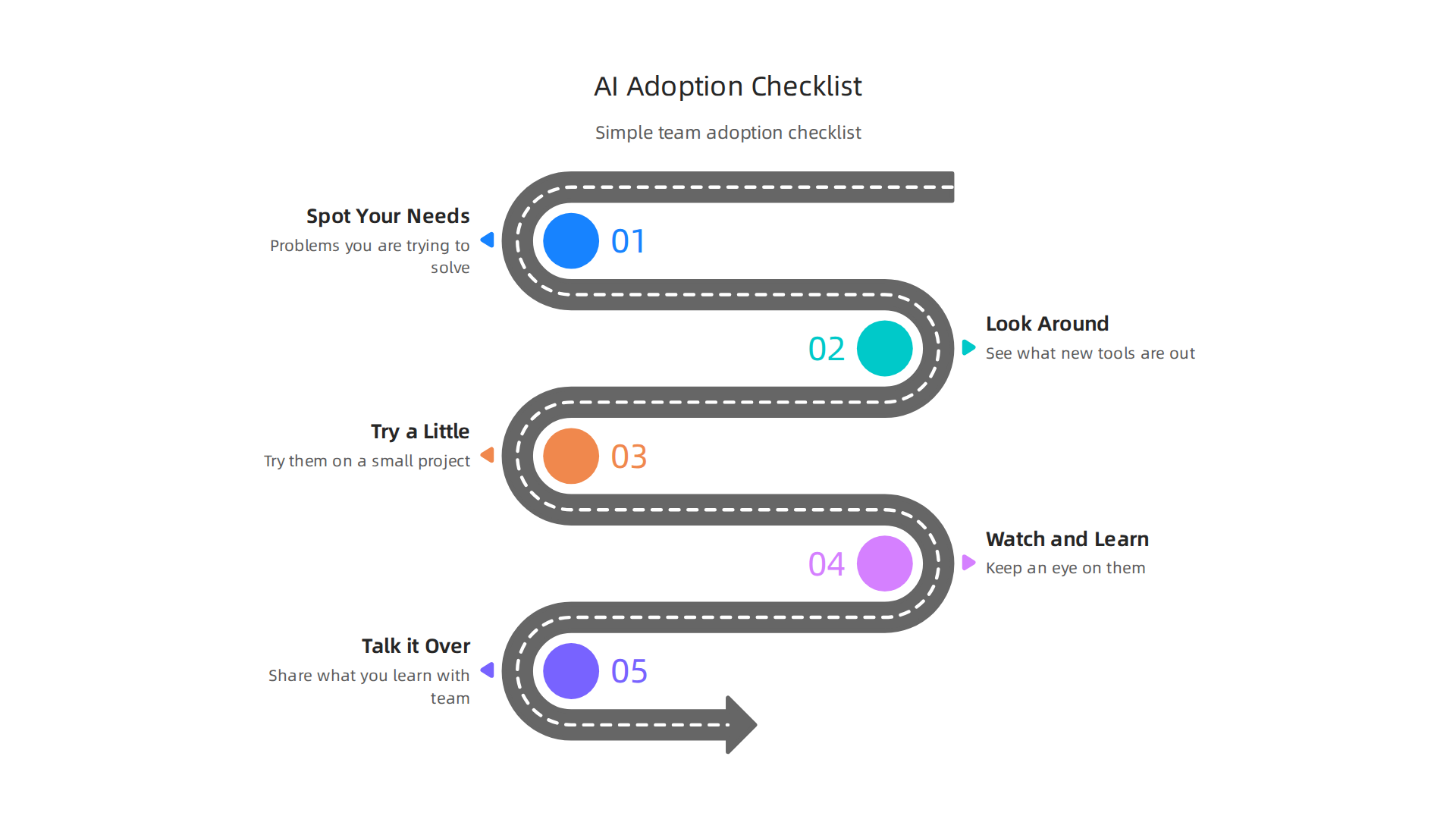
- Spot Your Needs: What problems are you trying to solve? Do you need to speed up coding, improve testing, or something else?
- Look Around: See what new tools are out there. Maybe a new personal AI assistant could help, or a spark AI model for quick tasks, or even a lightchain AI for smaller, faster needs.
- Try a Little: Don’t go all in at once. Pick one or two new tools and try them on a small project. See how they work for your team. This will help you learn how to evaluate the smartest AI in 2026.
- Watch and Learn: For other new things, just keep an eye on them. You don’t have to use every new tool right away. Some might be better to adopt later when they are more proven. Staying updated on new developments can help you decide when the time is right, as discussed in The Tech Sideline: Trends Driving AI Innovation in 2026.
- Talk it Over: Share what you learn with your team. Decide together which new AI capabilities are truly helpful and worth using more widely.
By using this approach, your team can carefully choose the right AI tools to help you work better and faster, without getting lost in all the new developments. To keep up with all the fast-paced changes in AI, a good resource is essential.
Get clear daily AI updates. The AI Newsletter Worth Reading.
Summary
This article explains why emerging AI technologies are critical for developers in 2026 and lays out a practical guide to the tools, workflows, and risks you need to know. It defines major AI categories—LLM platforms, multimodal systems, RAG, agents, and model fine‑tuning—and shows how LLM-assisted coding tools (completions, synthesis, test generation) fit into IDEs, CI, and APIs. The piece also covers MLOps and observability (model registry, serving, monitoring, retraining), CI/CD and testing strategies for prompts and models, and the guardrails required for security, privacy, and compliance. You’ll learn common failure modes like hallucinations and licensing issues, how to set up automated pipelines and safety gates, and a simple checklist to evaluate and adopt new AI capabilities safely and effectively. By reading this, developers and their leaders should be able to pick the right AI tools, integrate them into workflows, and manage operational and regulatory risks.