
How to Evaluate the Smartest AI in 2026
Overview
What Defines the Smartest AI?
What makes an AI the smartest in 2026? A few years ago, the answer was simple. A high score on one benchmark was enough. But that is no longer true. A new wave of AI models and gadgets is redefining what "smart" really means. It is not just about test scores anymore. Real world usefulness and openness matter just as much. Tools from companies like xAI and Wave AI, along with the latest tech gadgets, are proving that being helpful in daily tasks can be more important than topping a leaderboard.
This shift creates a paradox for developers and builders. The most powerful models often come from big companies with closed systems. They are incredible but you cannot see how they work or change them. At the same time, open source innovation is moving faster than ever. The gap between closed and open models is small. According to the 2026 AI Index Report, the top closed model leads the top open model by only 3.3% as of March 2026. That is up from 0.5% in August 2024. So while closed models still have an edge, open models are catching up fast.
So how do you pick the smartest AI for your work? You need to look beyond a single number.

You have to consider benchmarks, real world performance, cost, and how easy the tool is to use.
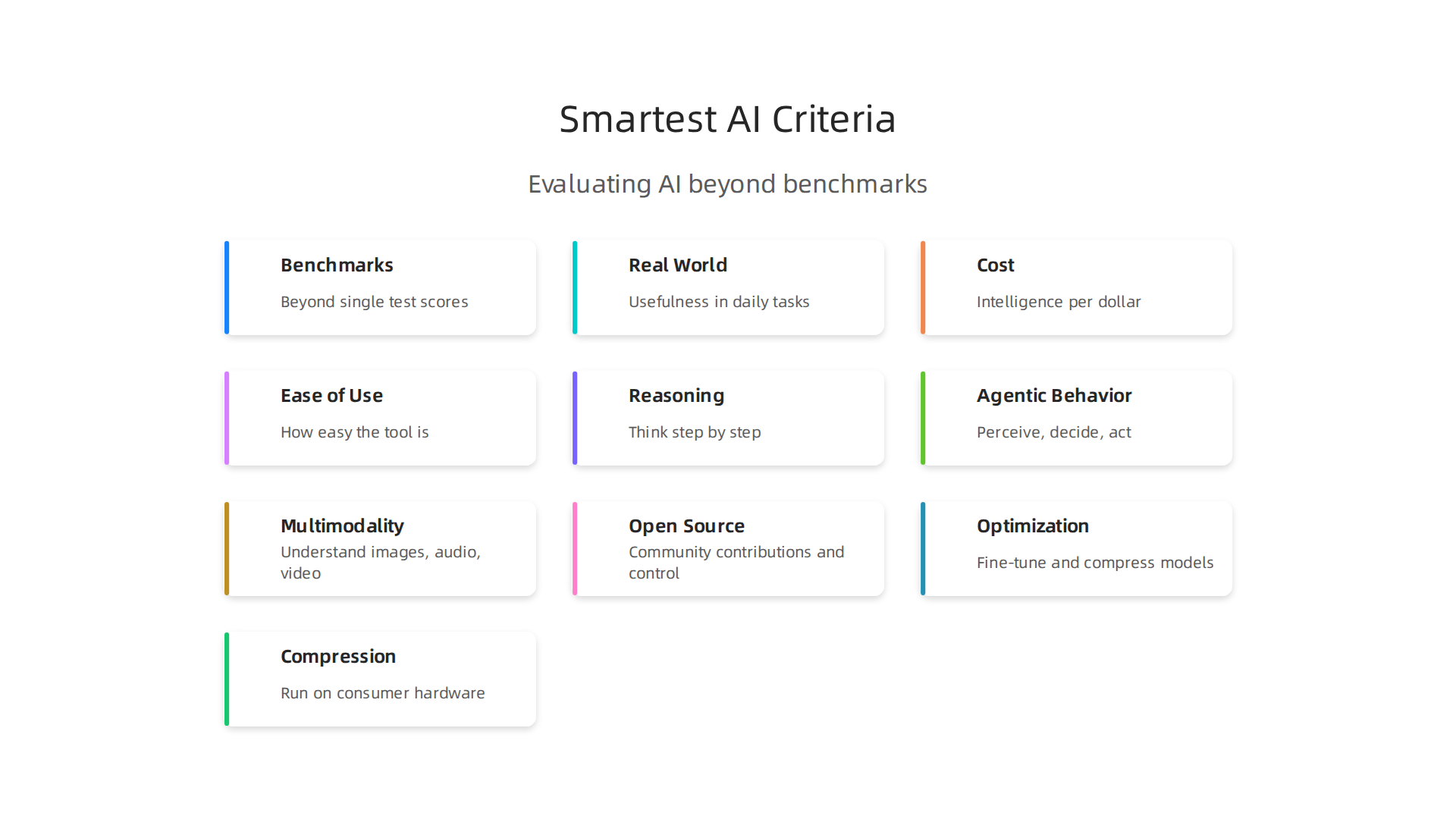
For example, you can compare GPT, Claude, Gemini and open source models to see which one fits your specific project.
This article will help you make that choice. We will break down the key criteria for evaluating the smartest AI in 2026. Then we will give you a practical roadmap for using these technologies in your own work. Whether you are a solo developer or leading a team, you will walk away with a clear framework for finding the right tool.
The AI world changes weekly. To keep up without getting overwhelmed, consider subscribing to The AI Newsletter Worth Reading. It delivers clear daily updates straight to your inbox so you never miss a big shift.
Benchmarking Intelligence: How We Measure the Smartest AI
So how do you actually measure which model is the smartest AI? It is not as simple as looking at one test score. The field has moved past that. In 2026, benchmark suites have grown to test models on harder, more practical tasks.
You have probably heard of MMLU, GSM8K, and HumanEval. These are the old standards. They test general knowledge, math, and coding. But here is the thing. Top models now score near perfect on them. So they no longer separate the best from the rest. The real action has shifted to newer, tougher benchmarks.
Take SWE-bench Verified for example. It tests models on real GitHub issue resolution. Not made up problems. Real bugs in real codebases. According to a detailed AI model benchmarks 2026 comparison, Claude Opus 4.6 leads SWE-bench Verified at 80.8%. Meanwhile, GPT-5.4 xHigh leads SWE-bench Pro public at 59.10%. That is a big difference. It shows that no single model dominates everything.
Another benchmark gaining traction is GPQA Diamond. It tests expert level science questions. GPT-5.4 Pro scores 94.4% there. But on ARC-AGI-2 Verified, which tests novel abstract reasoning puzzles, that same model scores 83.3%. Different strengths for different tasks.
The 2026 AI Index report from Stanford already confirmed something important. The gap between closed and open models is shrinking fast. That trend shows up in these new benchmarks too. Open models from Alibaba and DeepSeek now compete directly with top tier closed models on many tests. As the top closed model leads by only 3.3%, the race is tighter than ever.
This matters for you as a developer. If you pick a model based on one leaderboard, you might miss the right tool for your specific job. A model that crushes coding benchmarks might struggle with multilingual reasoning. One that excels at abstract reasoning might cost too much per call.
To make the smart choice, you need to understand what each benchmark actually measures. Then match that to your use case.

If you are building a coding assistant, look at SWE-bench scores. If you need a general purpose chatbot, check GPQA Diamond and MMLU-Pro. If cost matters, look at the Artificial Analysis leaderboard which ranks models by intelligence per dollar.
New platforms like LiveBench and BenchLM now track hundreds of models across dozens of benchmarks. They make it easier to compare apples to apples. But remember, benchmarks are not everything. They measure one capability at one moment. Real world performance depends on your specific data, prompts, and workflow.
Understanding the full spectrum of AI capabilities starts with knowing the different types. You can explore the differences between narrow, general, and superintelligence by reading a full types of AI explained for developers guide. It helps frame why benchmarks matter and where each model fits.
The takeaway is simple. No single model is the smartest AI across the board. But by learning how to read benchmarks, you can find the smartest AI for your work. And that is the only ranking that matters.
The Open Future: Why Open-Source Models Are Winning
Here is something that surprised many developers in 2026. Open source AI models now match or beat the best proprietary models on many tasks. The gap is tiny. According to the Stanford HAI 2026 AI Index, the top closed model leads the top open model by only 3.3 percent. That is almost nothing. And six of the top ten models on the Arena Leaderboard are now open source. The race is real.
So why are open models catching up so fast? Two reasons stand out.
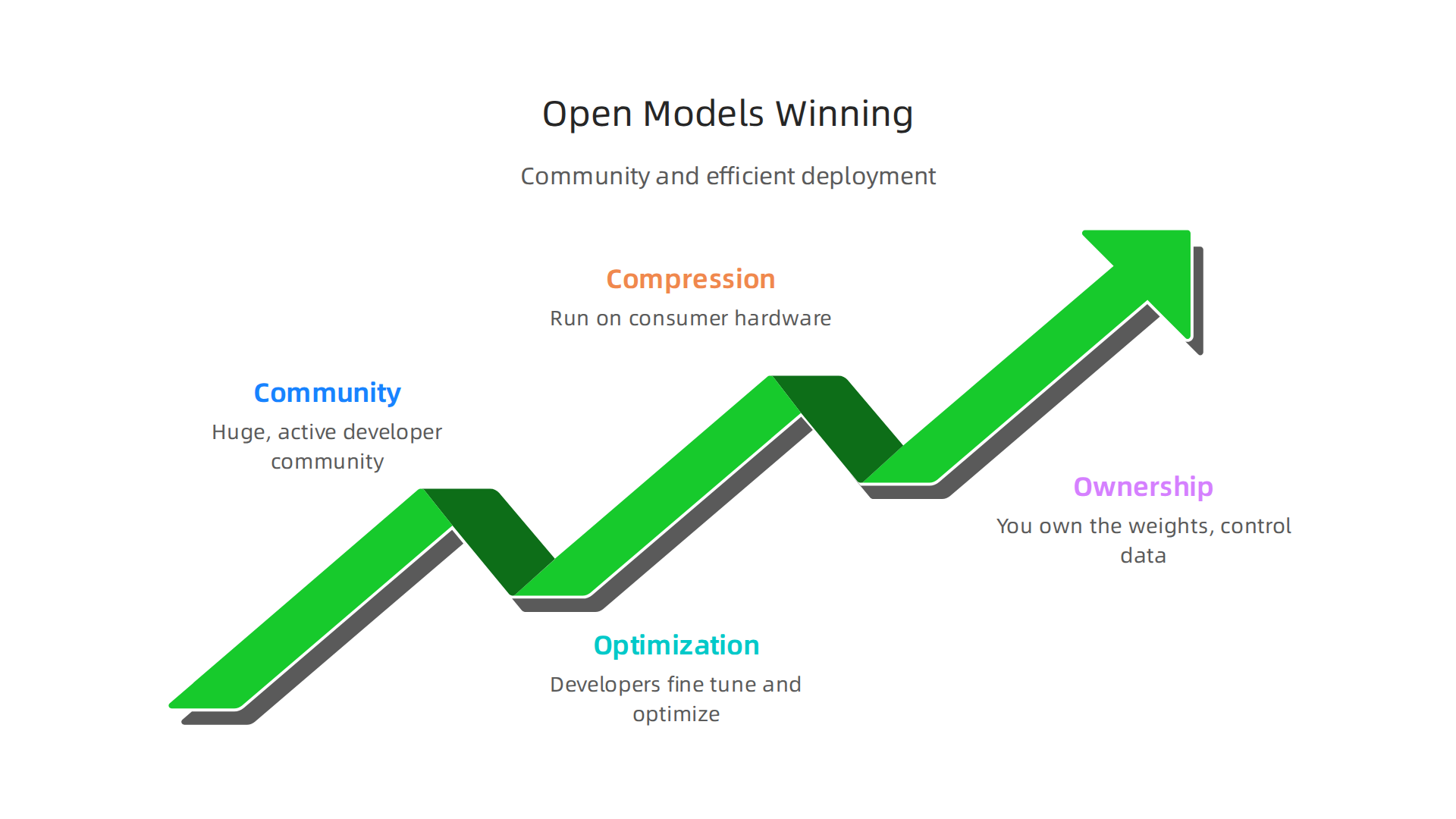
First, the community behind these models is huge and active. Developers around the world fine tune and optimize open models for specific tasks. They share improvements publicly. This creates a flywheel where every improvement helps everyone. Models like DeepSeek V3.2, GLM-5, and Kimi K2.5 now score over 70 percent on SWE-bench Verified. That puts them right next to Claude Opus 4.6. The same review of the best open source LLMs in 2026 shows these models are not just close. They are genuinely competitive.
Second, breakthroughs in model compression and distillation let you run powerful open models on consumer hardware. A model like Llama 4 Scout fits on a single NVIDIA H100 GPU while offering a 10 million token context window. That means you can run a top tier model on your own machine, with no API bills and no data leaving your control. For many developers, that changes everything.
Here is the thing. The smartest AI for your project may not be a closed model behind a paywall. It might be an open model you can download, customize, and deploy yourself. You own the weights. You control the data. You decide when to update. That freedom matters when you are building a product that depends on AI.
If you want to see how different open models stack up against each other and against proprietary leaders, check out this detailed AI model comparison for 2026. It covers GPT, Claude, Gemini, and the best open source options side by side.
The wave ai movement is not just a trend. It is a practical shift. Developers who master open models gain flexibility, lower costs, and full ownership. For many teams, that is the definition of the smartest AI.
The landscape changes fast. To stay on top of the latest model releases, benchmark upsets, and deployment tips, consider subscribing to a daily newsletter that cuts through the noise. The AI Newsletter Worth Reading delivers clear, practical updates straight to your inbox every morning.
Emerging AI Capabilities: Reasoning, Agents, and Multimodality
The open models we just discussed are powerful, but raw text generation is no longer the whole story. What really defines the smartest AI in 2026 is the ability to think step by step, use tools, and understand images, audio, and video all at once. These three shifts — reasoning, agentic behavior, and multimodality — are turning AI from a chatbot into something much closer to an autonomous teammate.
Let’s start with reasoning. New models use a technique called chain-of-thought reasoning combined with self-refinement. They break complex problems into smaller steps, check their own work, and correct mistakes. The results are staggering. According to the Top 13 Agentic AI Trends to Watch in 2026, recursive language models like DeepSeek R1 show 2 to 3 times improvement on complex reasoning tasks compared to earlier versions. Small models are also catching up — MIT researchers built a model that outperforms its base version by 28.3 percent on long-context tasks, even approaching GPT-5 quality while being 50 times smaller. That means you don’t need a massive budget to get advanced reasoning.
Now add agentic behavior. The latest AI systems can perceive their environment, decide on actions, and carry out multi-step tasks with minimal human input. A developer can give an agent a goal like "analyze this codebase, find three security vulnerabilities, and write a patch for each." The agent then uses tools, searches documentation, tests its solutions, and delivers results. This is not a demo anymore. The AI agent frameworks landscape for 2026 lists over 120 tools and frameworks, from LangChain to AutoGen, that let you build these agents yourself. For many teams, this ability to act independently is what makes the smartest AI worth adopting.
Finally, multimodality is becoming the new minimum. Models like Gemini 3, GPT-5.5, and Claude Opus process text, images, audio, and video in one unified pipeline. You can upload a screenshot, ask a question about a chart, and get an answer that references specific data points. You can record a meeting, have the model transcribe and summarize it, then generate action items. This convergence means developers no longer need separate tools for each data type. The smartest AI handles everything in one place.
Together, these three capabilities push AI beyond just generating words. The smartest AI now reasons like a junior engineer, takes initiative like an assistant, and understands the world through multiple senses. That is a big leap from last year. If you want to get the most out of these evolving systems, you need to know how to guide them effectively. Our deep dive into advanced prompt engineering techniques can help you design prompts that make reasoning and agentic workflows work reliably for your specific use case.
The open future is exciting, but these emerging capabilities are where real power lives. Developers who embrace reasoning, agents, and multimodality will build products that feel less like tools and more like partners.
The Rise of AI-Powered Gadgets and Edge Intelligence
Reasoning, agents, and multimodality are impressive. But there is a catch. Most of that power lives in the cloud, waiting for an internet connection. That is changing fast. The smartest AI is starting to come offline, packed into devices you can wear, hold, or set on your desk.

AI-first hardware is exploding in 2026. Smart glasses like the Ray-Ban Meta Gen 2 let you capture what you see, ask questions hands-free, and get real-time translation without pulling out your phone. Wearable assistants like the Bee or Plaud NotePin listen to your day and build summaries, reminders, and insights automatically. And devices like the Rabbit R1 act as a tiny AI companion you can talk to anytime. According to an expert roundup on 9 Life-Changing AI Wearable Devices in 2026, these gadgets are becoming genuinely useful for everyday productivity and memory support.
What makes them work is on-device intelligence. Small but capable models like Llama-3.2-1B and Gemma 2B run directly on the hardware. No cloud call needed. That means real-time responses, total privacy, and no subscription fees for inference. You can ask your glasses to translate a sign while hiking in a remote area, and it just works.
The implications for developers are huge. Building for edge AI means optimizing for limited compute, tiny memory, and battery life. But the payoff is a device that feels intelligent, not dependent. If you are exploring which small models to deploy on hardware, our AI model comparison for 2026 can help you compare open-source options that fit on a chip.
Here is the thing. The smartest AI may not live in a data center much longer. It might live in your pocket, on your wrist, or clipped to your shirt. It will understand your day without uploading everything to the cloud. And it will be there when the internet drops.
The open future is heading local. And that shift is already happening in the gadgets you can buy today. Want to stay on top of every new AI gadget and trend as they drop? The AI Newsletter Worth Reading delivers clear daily updates so you never miss a breakthrough.
Developer Tools and Infrastructure for the Smartest AI
Building AI into gadgets is exciting. But if you are a developer, the real challenge starts after the idea. You need to take that prototype and turn it into something reliable, scalable, and safe. That is where the tooling ecosystem matters most. In 2026, the smartest AI is not just about models anymore. It is about the infrastructure that lets you ship them fast.
The landscape of MLOps and LLMOps has grown up quickly. A few years ago, deploying an LLM meant stitching together scripts and hoping for the best. Now you have dedicated platforms that handle everything from training to monitoring. According to a detailed guide on the top MLOps tools in 2026, tools like MLflow, Kubeflow, and LangSmith are becoming standard in production pipelines. They give you model versioning, prompt management, and cost tracking out of the box.
But the real shift in 2026 is around agents. The smartest AI often relies on multiple models working together. Agent frameworks give you the structure to do that. LangChain remains the most popular starting point, with over 126,000 GitHub stars.

CrewAI lets you build multi-agent teams that take on different roles. And Microsoft’s AutoGen handles multi-agent conversations. On the data side, vector databases like Pinecone and Weaviate are essential for giving your agents memory and context. They let you search through thousands of documents in milliseconds.
What does this mean for you as a builder? The gap between prototype and production is shrinking. A single developer can now spin up a RAG pipeline with tracing, evaluation, and guardrails in a weekend. The open future AI community shares more tools every month, making it easier to start without a big budget.
If you want to stay sharp on which tools actually matter, you need a steady signal. The AI Newsletter Worth Reading delivers clear daily updates on the latest tools, frameworks, and best practices. It is a simple way to keep your finger on the pulse of the wave AI that is reshaping how we build.
Trust, Safety, and Governance in an AI-First World
But building fast is only half the equation. The other half is making sure that what you build is actually safe. The smartest AI in the world is worthless if it cannot be trusted.

In 2026, that trust is tested every day.
Bias, factual grounding, and resistance to jailbreak attacks are no longer nice-to-have features. They are core quality metrics. If your AI model tells users something wrong or dangerous, the damage is fast and public. According to the Stanford HAI Responsible AI Index 2026, almost all leading model developers report scores on capability benchmarks like MMLU. But reporting on responsible AI benchmarks remains sparse. That gap is a red flag for anyone shipping AI into the real world.
One real example: when tested with jailbreak attempts using adversarial prompts, the safety performance of frontier models dropped across the board. Training techniques that improved one responsible AI dimension often hurt another. This is a hard problem. And it is exactly why trust cannot be an afterthought.
Regulatory pressure is accelerating the shift. The EU AI Act begins phased enforcement of high-risk AI system obligations in August 2026. It requires audit trails, explainability, and ethical standards that go far beyond what a static benchmark score can show. As explained in the AI benchmarks guide in 2026, frameworks like the NIST AI Risk Management Framework also help organizations structure governance around four functions: Govern, Map, Measure, and Manage. These frameworks force teams to think about safety as a continuous process, not a one-time test.
Internal governance policies are becoming standard, even for smaller teams. If you run a development shop, you need documented safety evaluations, bias mitigation plans, and human feedback loops. A single developer building a RAG pipeline should still ask: how do I know my outputs are reliable? The teams that invest in these practices early will be the ones that earn user trust later.
Open source software offers a path to higher trust through transparency. Anyone can inspect the code, verify the data, and reproduce results. That is the spirit of the open future AI movement. But open source also introduces new attack surfaces. Publicly available models can be fine tuned for harmful purposes. Attackers can study the code to find weaknesses. The trade off between transparency and security is one every team must navigate for themselves.
The smartest AI in 2026 is not just the most capable model. It is the one that is most responsibly built. That means bias checks, grounding against verified sources, and governance structures that catch failures before they reach users. If your team needs a clear starting point for implementing these rules, check out this guide on clear rules for AI implementation to get your governance framework in place.
Summary
This article explains what it takes to call an AI the "smartest" in 2026 by moving beyond single benchmark scores to a multi‑dimensional view of capability, usefulness, cost, and openness. It covers how modern benchmarks have evolved (SWE‑bench, GPQA Diamond, ARC‑AGI‑2), why open‑source models are rapidly closing the gap with proprietary leaders, and which emerging capabilities—reasoning, agentic workflows, and multimodality—now define practical intelligence. The piece also surveys the rise of on‑device and edge AI in consumer gadgets, the developer tools and MLOps needed to ship reliable systems, and the governance and safety practices required by regulators and users. Readers will learn how to map benchmarks to real use cases, when to choose open versus closed models, what infrastructure and agent frameworks simplify production, and which trust steps to bake into deployments. The goal is a clear, usable framework that lets solo developers and teams pick and operate the smartest AI for their specific projects.