
Unlock Peak Productivity with AI Developer Tools in 2026
Overview
It feels like new AI tools for developers pop up every single day in 2026. This fast change makes it tough for teams to keep up.

Many studies show that over 90% of developers now use at least one AI tool for their work, with many using them every day AI Tools Hit 90% Developer Adoption: The Real Data – Noqta, AI Coding Assistant Adoption Rates 2026: Complete Stats. This means being "web smart" and "tech smart" is more important than ever.
But with so many choices, like GitHub Copilot, Claude Code, and Cursor, how do teams know which ones are truly best? Research shows that most developers use a mix of three different tools, not just one AI Coding Tool Adoption 2026: Developer Survey Results. This can lead to a lot of new tools coming out all the time, making it hard to find what really helps. For anyone in information technology, figuring out the best tools can feel like sifting through a huge pile of information.
That’s why teams need a clear, helpful plan. This guide will give you a simple way to look at, pick, and use AI developer tools. It will help you improve how much work you get done without adding more problems. We’ll show you how to make smart choices that truly help your team, like the ones you read about in good engineering blogs. To stay on top of all the new tools and news, you can Get clear daily AI updates from The Deep View Newsletter. Understanding how to make these choices is key to selecting AI software development tools for your 2026 team and ensuring you use technology for good.
To truly make smart choices for AI developer tools, your team needs a clear plan.

This means figuring out what you want to achieve and what rules or limits you have. Let’s look at how to build this plan.
Setting Your Goals and How to Measure Them
Before you pick any AI tool, ask yourself: What big goals do you want to reach? These are like your finish line. For example, maybe you want your team to build new software faster. This is called "speed-to-prototype." Or perhaps you want your code to be better, with fewer mistakes, which is "code quality." Another goal could be making developers happier with their work, known as "developer experience."
Once you know your goals, you need a way to check if you’re actually hitting them. These are called "success metrics." They are like scorecards.
- For speed-to-prototype: You might track how long it takes to finish a project, from start to end. Or how often new code is sent out for others to use.
- For code quality: You could look at how many bugs are found in new code or how long it takes to fix those bugs. Measuring things like how to quantify the effect of AI on code quality can help.
- For developer experience: You might measure how much time developers spend waiting for code reviews, or how easy it is to get their changes approved. A good measure is to track "time to PR ready" and "review time," which helps understand how to measure developer experience (DevEx) in the AI era.
These metrics help you see if an AI tool is really helping your team be more web smart and tech smart. They show if your investment in new tools gives you real results, as outlined in guides like AI productivity tools for developers.
Understanding Your Limits and Rules
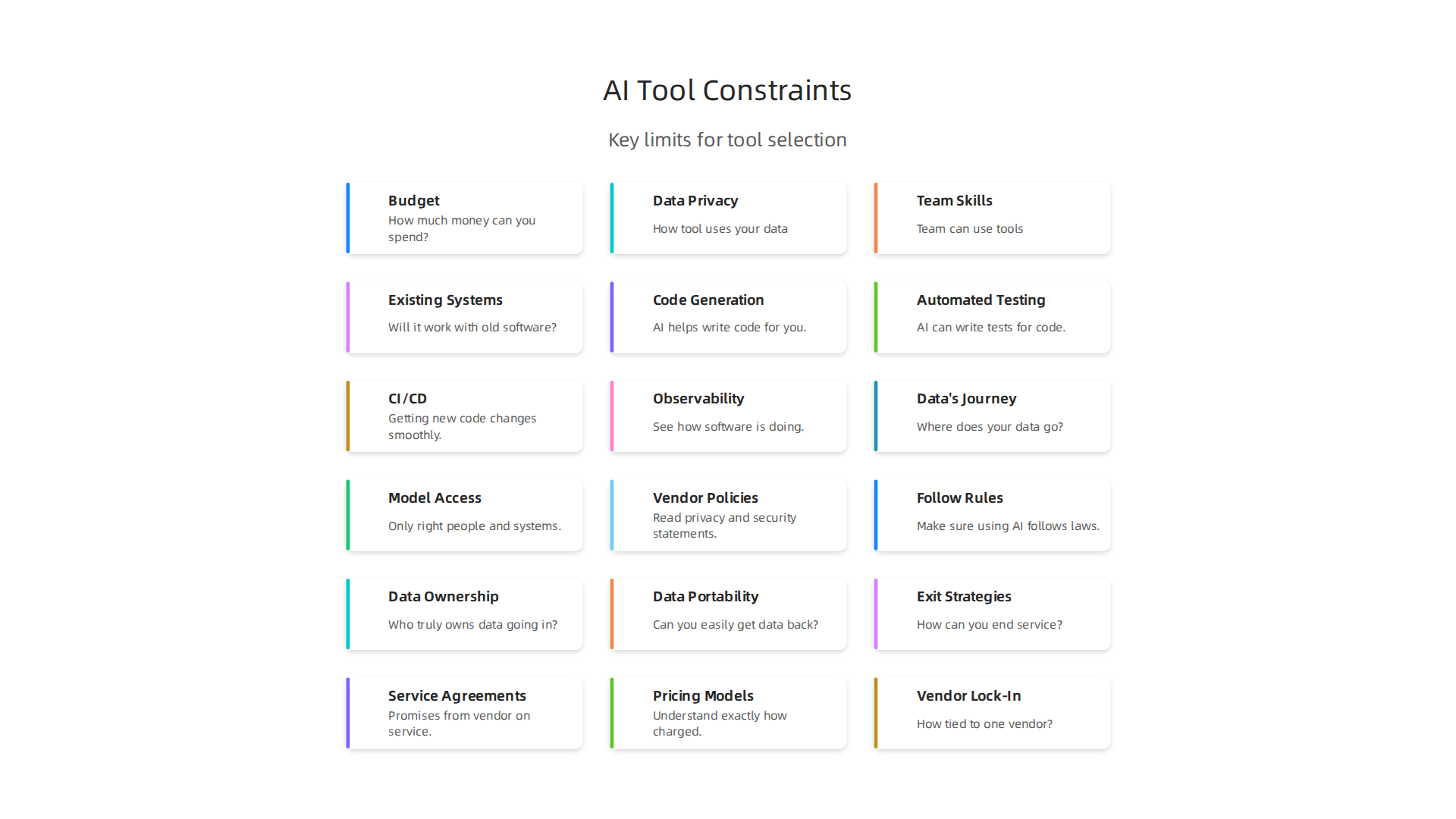
Every team has limits, or "constraints," that affect which AI tools they can choose.
Thinking about these early helps avoid problems later.
- Budget: How much money can you spend on new tools? Some AI tools are free, others cost a lot. Make sure the tools fit your financial plan.
- Data Privacy and Rules: This is super important, especially for organizations dealing with sensitive information. You need to know how an AI tool uses your company’s data. Does it keep your secrets safe? Does it follow all the privacy laws? It’s wise to ensure your contracts prevent your data from being used to train the AI model without your clear permission, as suggested by AI vendor lock-in mitigation strategies. Always ask about data export rights and how to avoid LLM vendor lock-in before you commit.
- Team Skills: Does your team already know how to use these new AI tools? Or will they need to learn new skills? If so, you need to plan for training, maybe through AI courses online free for developers.
- Existing Systems: Your company might have old software systems that are hard to change. Will the new AI tool work well with these old systems? Sometimes, new tools don’t play nicely with older "legacy architecture," making it tough to use them.
By looking at your goals and limits clearly, you can choose AI tools that truly help your team. This way, you use technology for good, making sure it fits your specific needs and helps everyone grow in the world of information technology.
Choosing the right AI tools also means knowing the different types that can help your team. This is how you become truly web smart and tech smart. Let’s look at some important categories of AI tools that are making a big difference for web-first teams in 2026.
Tool Categories that Matter for Web-First Teams (Codegen, Testing, CI/CD, Observability)
Many different AI tools are out there, but some are super helpful for making software, especially for websites and apps. These tools fit into a few main groups:
Code Generation (Codegen)
This is where AI helps write code for you. It’s like having a smart helper that can quickly type out parts of your program. Tools like GitHub Copilot, Claude Code, and Cursor are widely used. Actually, 90% of developers use at least one AI tool regularly for coding tasks in 2026, which is a big jump in how we do things in information technology AI Tools Hit 90% Developer Adoption: The Real Data. And about 41% of all new code today is made with AI help AI-Generated Code Statistics 2026.
- How AI Helps: It writes common code parts, finishes sentences as you type code, or even creates whole functions. This saves a lot of time, especially for "boilerplate" code that is always the same. This can greatly boost how productive your team is, as many generative AI tools for developers in 2026 show.
- Good Things: Your team can build new features much faster. Developers spend less time on repetitive tasks and more time on tricky problems. This helps them be more efficient and feel happier with their work.
- Things to Watch Out For: Sometimes the AI might suggest code that has small mistakes or isn’t the best way to do something. So, humans still need to check the code carefully to make sure it’s good and secure.
Automated Testing
After writing code, you need to make sure it works without bugs. AI can help here too. It can write tests for your code or even find problems you didn’t know were there.
- How AI Helps: AI tools can look at your code and automatically create tests that check if everything is working right. They can also find bugs or security flaws. Automated test generation and execution are common uses for AI, according to a developer survey State of Code Developer Survey report.
- Good Things: Catching bugs early means fewer problems for users later. It also helps improve the overall quality of your software.
- Things to Watch Out For: AI tests are good, but they might not cover every single case. A human touch is still needed to make sure critical parts are tested well.
CI/CD (Continuous Integration/Continuous Delivery)
This is about getting new code changes from a developer’s computer to the live website or app smoothly and often. It’s a key part of modern software development.
- How AI Helps: AI can watch your CI/CD process. It can spot if a new change is causing problems, predict if a deployment will fail, or even help fix issues automatically.
- Good Things: Faster updates for your users, fewer delays, and a smoother flow of work for your team. This means less stress and more time for creative work.
- Things to Watch Out For: Setting up AI in CI/CD can be complex. You need to make sure the AI truly understands your system to avoid accidental problems.
Observability
Once your software is running, observability tools help you see how it’s doing. Are users having problems? Is something running slow?
- How AI Helps: AI in observability can look at huge amounts of data from your running software. It can quickly find strange patterns that might mean a problem is starting, or tell you exactly why a problem happened.
- Good Things: You can fix problems much faster, sometimes even before users notice. This keeps your users happy and your software reliable. This makes your team even more web smart.
- Things to Watch Out For: These tools generate a lot of data. Making sense of it all can be tricky without clear goals and good setup.
By understanding these tool categories, your team can make smart choices about how to use AI. This helps you build better software, faster, and with fewer headaches. To keep up with all the new AI tools and trends, staying informed is key.
Get clear daily AI updates from The AI Newsletter Worth Reading.
Using AI tools helps you be very efficient, but being truly web smart means also knowing how to use them safely. When you bring new AI tools into your work, especially in a team that focuses on websites and apps, it’s super important to think about security, privacy, and following the rules. This is part of being tech smart in 2026.
Security, privacy, and compliance checklist for integrating AI tools
Bringing AI into your information technology work is exciting, but it also means new responsibilities. You need to make sure your data is safe, people’s private information is protected, and you are following all the necessary laws and guidelines. This isn’t just about avoiding problems; it’s about building trust with your users and making your team stronger.
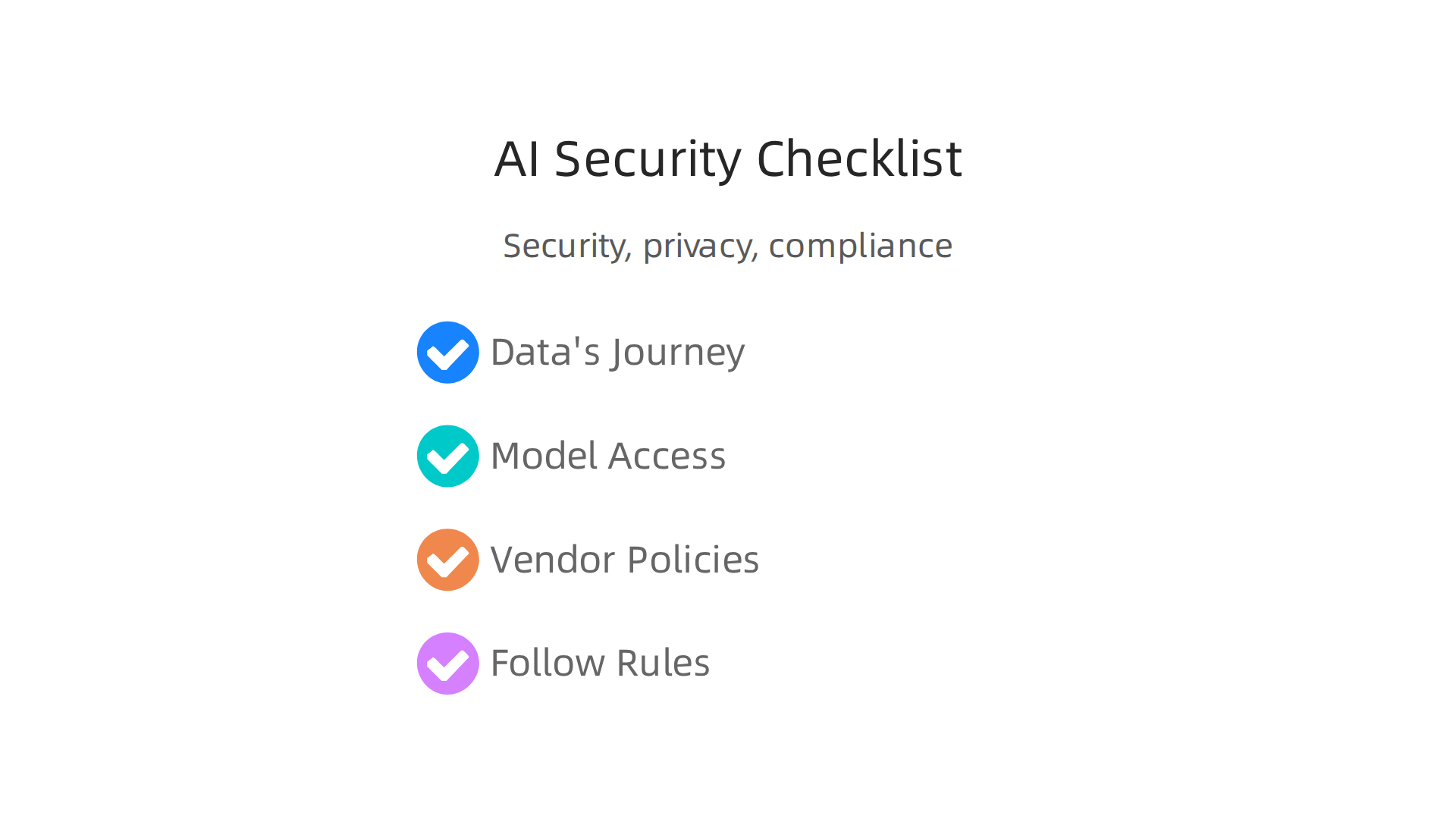
Here’s a simple checklist to help your team think through these important points:
Practical Checklist for Your AI Tools
- Understand Your Data’s Journey: Where does your data go when you use an AI tool? Does it stay on your computers, or does it get sent to the AI company’s servers? It’s important to know the "data flows" so you can spot any risks. You should also be clear about who owns the data that AI creates, especially if it uses private information. Organizations should use security controls for sensitive and privacy data assets, and ensure the integrity of AI components, as outlined in recent guidance AI Guidance.
- Who Can Access the AI? Make sure only the right people and systems can use your AI tools. This means setting up clear rules for "model access" and making sure everyone knows them. This helps prevent unwanted access or misuse.
- Check Vendor Policies: What are the rules and practices of the companies that make your AI tools? Read their privacy policies and security statements. Do they protect your data in a way you’re comfortable with? The more you know about what your AI partners do, the better.
- Follow the Rules (Compliance): There are many rules about data privacy and how technology should be used. For example, some rules protect personal information. Your team needs to make sure using AI tools helps you follow these rules, not break them. Regularly evaluating AI models and integrating AI into existing security plans is key for compliance Principles for Secure AI Integration. Some experts recommend strong frameworks to manage these risks Artificial Intelligence Risk Management Framework.
Keeping Your Data Safe: Risk Mitigation
Even with a good checklist, you need ways to lower risks. Here are some smart techniques:
- Input/Output Filtering: Imagine a gatekeeper for your AI tool. "Input filtering" means checking the information before it goes into the AI. "Output filtering" means checking what the AI gives back before it’s used or seen by others. This helps catch bad data or unexpected results.
- Encryption for Secrecy: Think of encryption as scrambling your data so only someone with a special key can read it. Using encryption for sensitive data, both when it’s stored and when it’s moving, is a strong way to keep it private. This is especially important for protecting any "personally identifiable information" (PII) Artificial Intelligence – Research Data. Implementing Privacy by Design in all AI and data is a good practice Framework for Data Protection in AI.
- Least-Privilege Architectures: This means giving AI tools (and people) only the minimum access they need to do their job. If an AI tool only needs to read certain files, it shouldn’t have permission to write or delete them. This limits the damage if something goes wrong. For example, using "low-privilege" API keys in isolated environments can protect district resources AI Memo Safety and Security. Developer and system owners must also protect artifacts and logs, and monitor for privacy leakage Privacy for Artificial Intelligence (AI).
By carefully thinking about these security and privacy points, your team won’t just be building great software; you’ll be building it responsibly and making your whole approach more web smart. Staying up-to-date on best practices is crucial for securing your systems, especially as AI tools evolve rapidly, and resources like guidelines for secure AI system development can help. To learn more about getting your team ready for the future of AI in development, consider checking out resources on selecting AI software development tools for your 2026 team.
Once you understand the important safety steps, the next big question is how to actually bring new AI tools into your daily work. This means moving them from just a cool idea (a prototype) to something that truly helps your team every day. It’s about setting up a clear path for using AI in your information technology projects, making sure everything runs smoothly and securely.
Moving AI Ideas to Real-World Use
Taking an AI tool from a test idea to something used by many people requires careful steps. Here’s how you can do it:
-
Sandboxing for Safe Tests: Think of sandboxing as giving a new AI tool its own special playpen. In this safe, separate area, your team can test the AI without worrying about it affecting your main systems or important data. This is where you figure out if it works as expected and iron out any problems. It’s a smart way to let innovation happen without taking big risks, especially for tools that act on their own ai-memo-safety-and-security-may-2026- ….
-
Automated Testing for AI Models: Just like you test other software, you need to test AI models. Automated testing means using computers to check the AI over and over again. This helps make sure the AI gives good results every time and doesn’t do anything unexpected. This step is key for building trust and reliability in your AI tools before they go live. Many teams use tools like generative AI tools for developers in 2026 to help with testing and development.
-
Monitoring and Rollback Strategies: After an AI tool is up and running, you need to watch it closely. This is called monitoring. It means keeping an eye on how well the AI is working, if it’s using too many resources, or if it’s causing any issues. If something goes wrong, a "rollback strategy" is your plan B. It’s a way to quickly switch back to an older, working version of the software. This helps fix problems fast and keeps your systems stable. Many organizations watch AI performance and impact closely Q1 2026 Artificial Intelligence Usage Report.
Keeping AI Operations Smooth
Once your AI tools are in production, there are ongoing tasks to make sure they keep working well for your web smart team:
- Observability: This means making sure you can "see" what your AI models are doing at all times. It’s about having clear dashboards and alerts that show you their performance, health, and any strange behaviors. This helps your team quickly understand and fix problems.
- Model Versioning: AI models are always changing and getting better. Model versioning is like keeping different editions of a book. It helps you keep track of which version of an AI model you’re using, what changes were made, and which version performed best. This is important for fixing issues and making improvements.
- Cost Controls: AI tools can sometimes cost a lot to run, especially if they use powerful computing resources. Setting up cost controls means keeping a close watch on how much money your AI tools are spending and finding ways to use them more efficiently.
- Developer Workflow Ergonomics: This simply means making it easy and comfortable for developers to work with AI tools. If the tools are hard to use or fit poorly into existing workflows, developers won’t use them effectively. Good design helps your tech smart team be more productive.
By following these patterns, your team can confidently move AI projects from early tests to powerful tools that truly enhance your work.
Get clear daily AI updates from The AI Newsletter Worth Reading.
When your team successfully brings new AI tools into daily work, the next step is to truly understand if they are making a difference. It’s not enough to just use them; you need to measure their real impact. This helps your web smart team know what’s working and what needs to change.
Measuring What Matters: KPIs for AI Tools
To see if AI tools are helping, we use Key Performance Indicators (KPIs).

These are like scorecards that show how well things are going. For engineering and information technology teams using AI, here are some important things to measure:
-
Engineering Productivity:
- Cycle Time Reduction: This measures how much faster tasks are completed from start to finish. If AI helps developers write code quicker or move projects along, you should see this time go down. Teams often look at "time to merge" or "PR cycle time" to see how AI speeds up development How to measure AI’s impact on developer productivity.
- Fix Acceptance Rate: This looks at how often fixes or new code suggested by AI are actually accepted by humans. A higher rate means the AI is giving useful suggestions.
- Completed Issues: Tracking the number of tasks or "issues" your team completes can show if AI is boosting overall output. You might also look at the "throughput of completed issues" to see how efficiently work is flowing AI Productivity Metrics for Engineering Teams.
-
Code Quality:
- Defect Density: This counts the number of errors or "bugs" in the code. If AI helps catch mistakes early or writes cleaner code, this number should go down. It’s often measured as bugs per amount of code or per feature How to Quantify the Effect of AI on Code Quality.
- Pre-Review Fix Rate: This is about how many issues AI catches and helps fix before a human reviewer even sees the code. It shows AI preventing problems early.
- Rework Frequency: If AI tools reduce how often code needs to be rewritten or fixed after it’s been submitted, that’s a sign of improved quality.
By keeping an eye on these kinds of numbers, your tech smart team can understand the true value that AI brings to your projects. If you want to learn more about tools that can help with this, check out our guide on AI productivity tools for developers.
Designing Experiments and Avoiding Measurement Traps
Just looking at numbers after you start using AI isn’t always enough. Sometimes, other things might be happening at the same time that make it hard to tell if the AI is truly responsible for changes. These are called "confounders."
To get a clearer picture, smart teams use experiments:
- A/B Testing: This means having two groups. One group uses the new AI tool (Group A), and the other group doesn’t (Group B). Then you compare their KPIs over time to see if Group A performs better because of the AI.
- Incremental Rollout: Instead of giving the AI tool to everyone at once, you give it to a small part of your team, then a bigger part, and so on. This lets you watch the impact slowly and make adjustments along the way.
By setting up these controlled experiments, you can be more certain that any changes you see are actually due to the AI tools and not just other things happening in your business. It helps make sure your measurement of AI’s impact is accurate and meaningful.
When teams bring in new AI tools, it’s not just about using them and measuring results. A big part of making AI work well is making sure everyone on the team has the right skills and is ready to use these tools.

This helps close the "adoption gap" so that AI can truly help your team shine.
What Skills Do Teams Need for AI Tools?
Even if your team is already very tech smart, new AI tools bring new needs. Here are some common skills that might be missing:
- Understanding AI: People need to know how AI tools work, what they are good at, and what they cannot do. This helps them use the tools the right way.
- Prompt Engineering: This means knowing how to give clear instructions to AI so it gives you the best answers. It’s like learning to talk to the AI effectively.
- Data Skills: AI often works with lots of data. Team members might need to learn how to prepare data for AI or understand the results it gives.
- MLOps Basics: For teams building or managing AI models, understanding MLOps (Machine Learning Operations) helps keep AI projects running smoothly.
Training Your Team to Be AI-Ready
To fill these skill gaps, teams can use different training pathways. Many places offer courses to help developers, QA experts, and DevOps teams learn about AI. You can find many options, from paid programs to free online courses. For example, there are many AI courses online free for developers in 2026 that can help. These courses can help your team understand the new world of Software Developer Roadmap 2026.
Practical Steps for Bringing AI Tools Onboard
Bringing new AI tools into your daily work should be a smooth process. Here are some ways to help your team get ready:
- Internal Learning Sessions: You can have "brown-bag" lunches where team members share what they learn about new AI tools. This helps everyone learn from each other.
- Work with Tool Makers: Sometimes, the companies that make the AI tools can offer special training or paired sessions. This lets your team work directly with experts to learn how to use the tools best.
- Ramp Plans (Like 30-60-90 Day Plans): For new tools or new team members, a structured plan can make a big difference. These plans break down what someone needs to learn and do over their first 30, 60, or 90 days. For instance, a Developer Onboarding Plan Template for 2026 can guide developers, while an AI Engineer Onboarding Playbook for 2026 offers specific steps for AI experts. There are also many general 30-60-90 Day Plan Templates that you can use. These plans help make sure everyone gets the right support as they start using AI in their projects.
By focusing on teaching new skills and having clear steps for using new tools, your information technology teams can make sure AI helps them do their best work.
Want to stay informed about all the new developments in AI and technology? Get clear daily AI updates from The AI Newsletter Worth Reading.
After training your team, the next big step is to pick the right AI tools and manage them well over time. This choice is super important because it affects how your team works every day and for years to come. Being truly tech smart means making good decisions about who you get your tools from.
Picking the Right AI Vendors
Choosing an AI vendor is more than just liking a tool’s features.
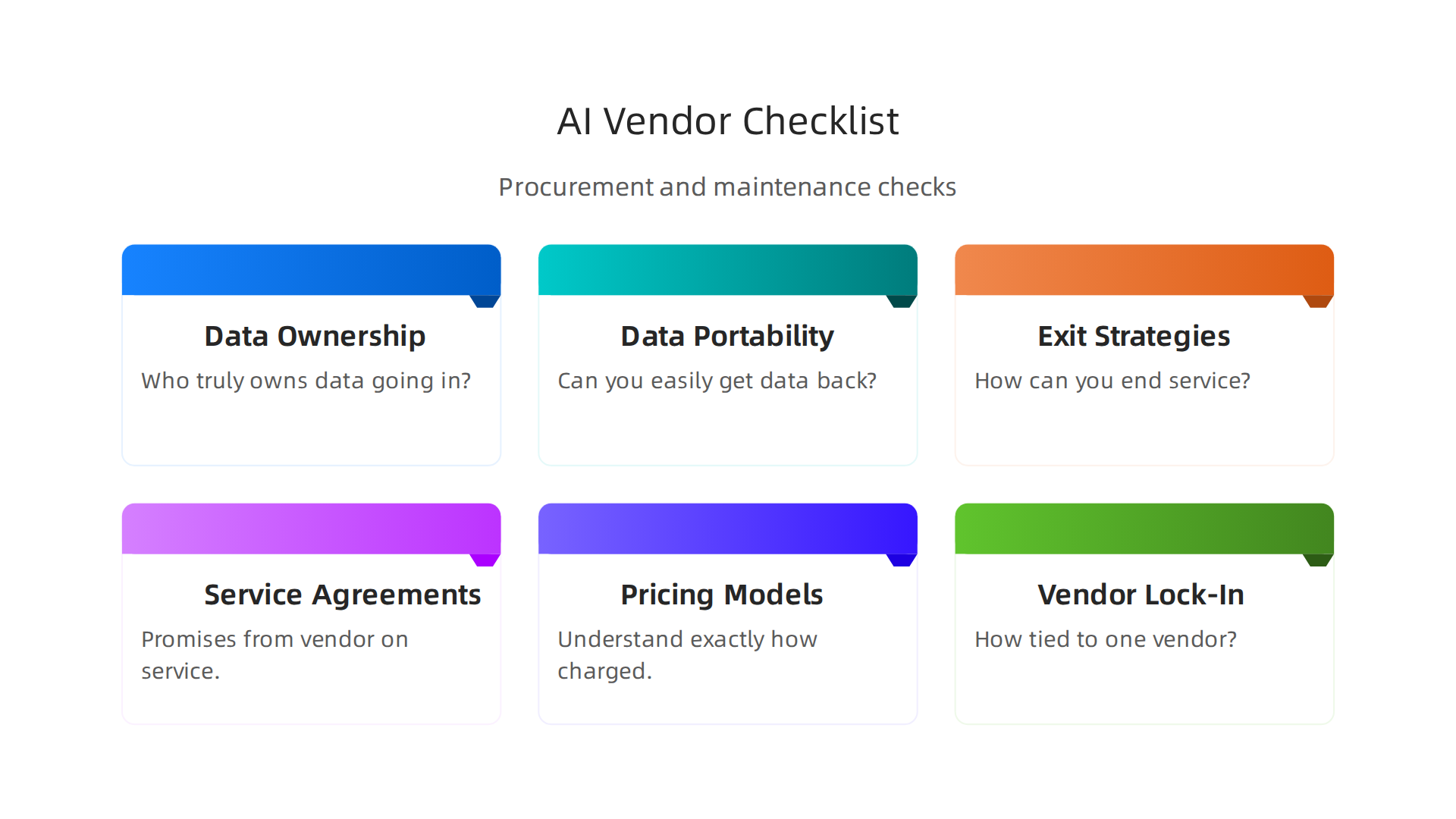
It’s about looking at the big picture. Here’s a checklist to help your team evaluate vendors carefully:
- Data Ownership: Find out who truly owns the data that goes into the AI tool and what happens to it. You need to know if the vendor can use your data to train their own AI models without your clear permission, which is a key part of avoiding vendor lock-in strategies for CIOs and CTOs ("AI Vendor Lock-In: Mitigation Strategies for CIOs and CTOs").
- Data Portability: Can you easily get your data back if you decide to stop using a vendor’s tool? Contracts should state that you can export your data in common formats like JSON or CSV Procurement AI Vendor Lock-In: Risks & Mitigation. This is very important for software vendor lock-in Software vendor lock-in: why AI platforms make an already expensive problem harder to escape | Corsair Media Group.
- Exit Strategies: What if the tool doesn’t work out? Make sure your contract explains how you can end the service without a lot of trouble. This includes rules about deleting your data after a set time The Vendor Lock-In Risk in AI QA Tools: How to Evaluate Portability ….
- Service Level Agreements (SLAs): These are promises from the vendor about how well their service will work. They cover things like how much uptime you can expect and how quickly problems will be fixed. These agreements should also include rules about how you can move your data if needed Avoiding Vendor Lock-In in AI Procurement.
- Pricing Models: Understand exactly how you’ll be charged. Are there hidden fees? Does the price change as you use the tool more? Clear pricing helps you avoid unexpected costs, like the hidden costs of vendor lock-in for AI infrastructure The Hidden Costs of Vendor Lock-In for AI Infrastructure.
- Vendor Lock-In Risk: Always think about how tied you might become to one vendor. A good AI vendor due diligence checklist for 2026 can help you ask the right questions before you sign anything AI Vendor Due Diligence Checklist for 2026: What to Ask …. Evaluating vendor lock-in risk for AI customer service platforms is a good example of this AI Customer Service Vendor Lock-In Risk: How to Evaluate – Fin.
When you’re being web smart about new tools, these points are key.
Smart Ways to Bring in New Tools
Beyond the checklist, some best practices can make the process even smoother for your information technology team:
- Prototyping Clauses: Ask if you can try out the AI tool with a small project first. This helps you see if it truly fits your needs without making a big commitment. It’s smart to test the data export process before you fully commit to a vendor Own vs Orchestrate: The 2026 Enterprise Guide to Avoiding AI ….
- Security Reviews: Make sure the AI tool is safe and protects your data. Your team should review its security features to prevent any risks.
- Ongoing Vendor Performance Reviews: Don’t just "set it and forget it." Regularly check in with your vendor to make sure the tool is still working well and meeting your team’s needs. This helps keep things running smoothly in the long term.
By carefully selecting vendors and having clear steps for procurement, your team can choose the best AI developer tools 2026 to boost productivity.
Summary
This guide shows engineering and IT teams how to choose, secure, deploy, and measure AI developer tools so they actually improve productivity without adding risk. It explains how to set goals (speed, code quality, developer experience), define measurable KPIs, and map constraints like budget, data privacy, and existing systems. The article walks through the most useful tool categories—code generation, automated testing, CI/CD, and observability—and gives practical security and compliance checks such as input/output filtering, encryption, and least‑privilege architectures. It also covers safe rollout patterns (sandboxing, automated model tests, rollout/rollback), ongoing operations (observability, model versioning, cost controls), and vendor selection to avoid lock‑in. After reading, teams will know how to run experiments, train staff, pick the best tools for web‑first workflows, and measure real impact.