

VAST AI GPU Power and R Technology for AI Projects 2026
Overview
Building AI tools and projects in 2026 can be tricky. There are so many options for computing power and software tools. It’s like being in a huge store with endless shelves, and you need to pick just the right things to build your project. For teams working on AI, it’s super important to know how to choose wisely. Without clear rules for picking tools, it’s easy to waste time and money.
One big part of building AI is having strong computers, especially Graphics Processing Units (GPUs).
These are like the brains that do the heavy lifting for AI tasks. Finding affordable and powerful GPUs is a common challenge for developers. This is where a service called VAST AI comes in. VAST AI is a known marketplace where people can rent out their powerful GPUs to others who need them for AI work. It acts like a two-sided marketplace, connecting those who have GPUs to rent (hosts) with those who need to rent them (renters) for tasks like training AI models or running programs 🚨 CRITICAL: The following CTA is to be implemented. Pay close attention to the anchor text and ensure it is an EXACT match. 🚨 The AI Newsletter Worth Reading.
Beyond the hardware, you also need to pick the right programming language and software tools. While many languages exist, R technology continues to be a strong choice for people working with data and machine learning. R is known for its ability to handle complex data, making it useful for many AI tasks.
This article will help you understand why VAST AI is a great option for getting the computing power you need, and why R technology remains a viable and powerful language for your machine learning projects in 2026.
Making smart choices about your AI developer tools is key to success, and understanding options like VAST AI can help you boost productivity.

If you’re looking for more ways to make good choices, consider reading about choosing the right AI tools for developers to boost productivity.

Overview: What VAST AI-style GPU marketplaces offer
VAST AI is a great example of a GPU marketplace. Think of it like a big online store where people who own powerful graphics cards (GPUs) can rent them out to others who need them for AI tasks. These owners are called "hosts," and the people who rent are "renters" Concepts – Vast.ai Documentation: Affordable GPU Cloud Marketplace. This system helps everyone, because hosts can earn money from their unused computing power, and renters can get the power they need without buying expensive hardware.
One of the best things about these marketplaces, including VAST AI, is their pricing.
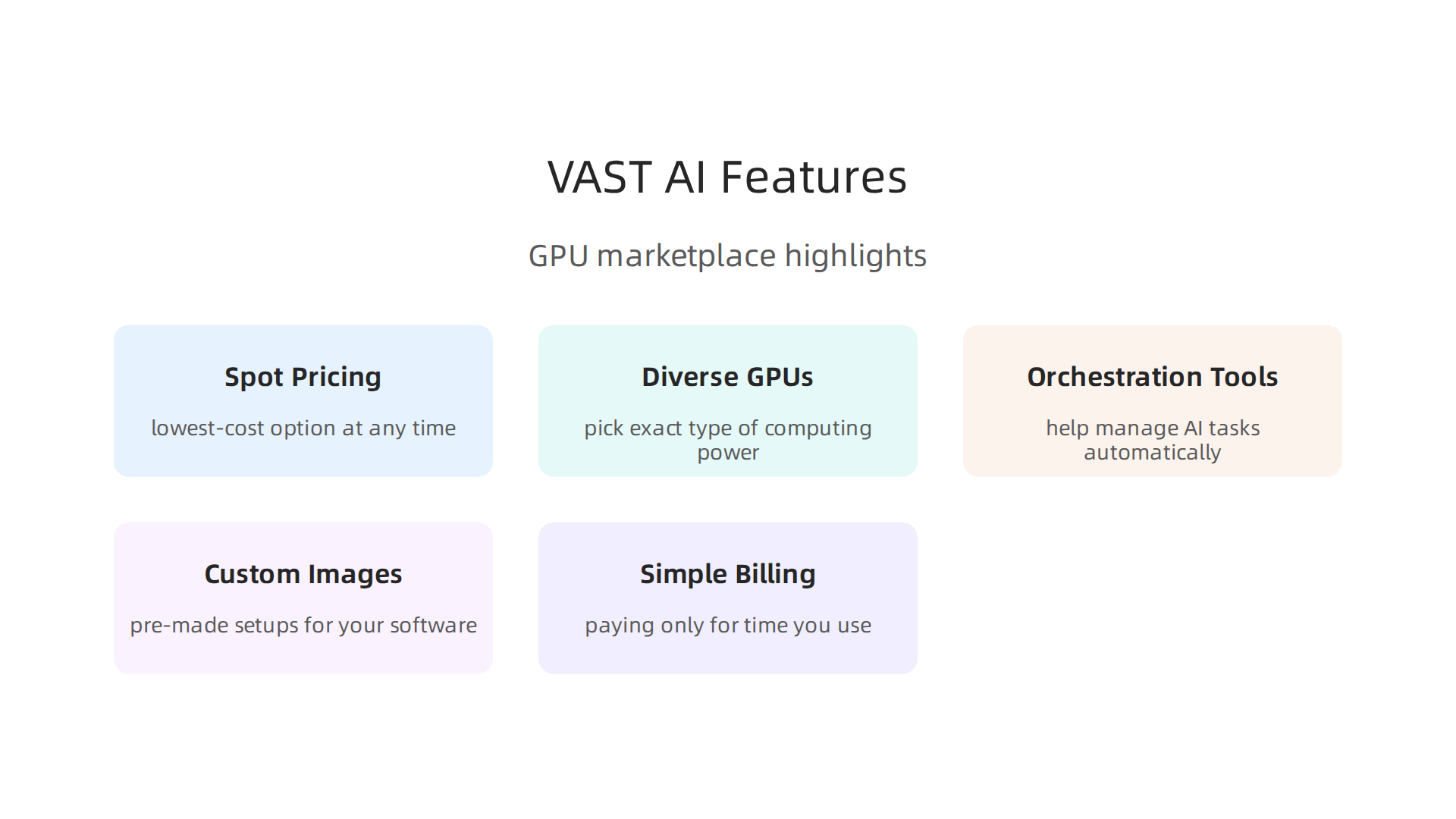
They often use a "spot-style" pricing model. This means prices can change based on how many GPUs are available and how many people want to rent them. It helps renters find the lowest-cost option at any given time, getting the best deal on powerful resources AI Business Frontline #023 | Deep Dive into Vast.ai. Also, these marketplaces offer many different kinds of GPUs, not just one brand or model. This means you can pick the exact type of computing power that works best for your specific AI project, whether it’s for training complex AI models or running data analysis.
Beyond just renting GPUs, VAST AI-style marketplaces come with helpful features that make building AI projects easier. They often include tools for "orchestration integrations." This sounds fancy, but it just means the system can help manage your AI tasks automatically, making sure they run smoothly on the rented GPUs. You can also use "custom images," which are like pre-made setups for your software. This lets you quickly start your projects with all your favorite tools, like Docker containers, already installed. Plus, many offer simple billing models, such as paying only for the time you use, down to the second Vast.ai: Rent GPUs. This way, you only pay for what you need. Understanding these marketplace features is key to selecting AI software development tools for your 2026 team and making smart choices that save money and boost productivity.
How it works: provisioning, networking, and orchestration on VAST AI
To really understand how a platform like Vast.ai helps with AI projects, let’s look at the "how."
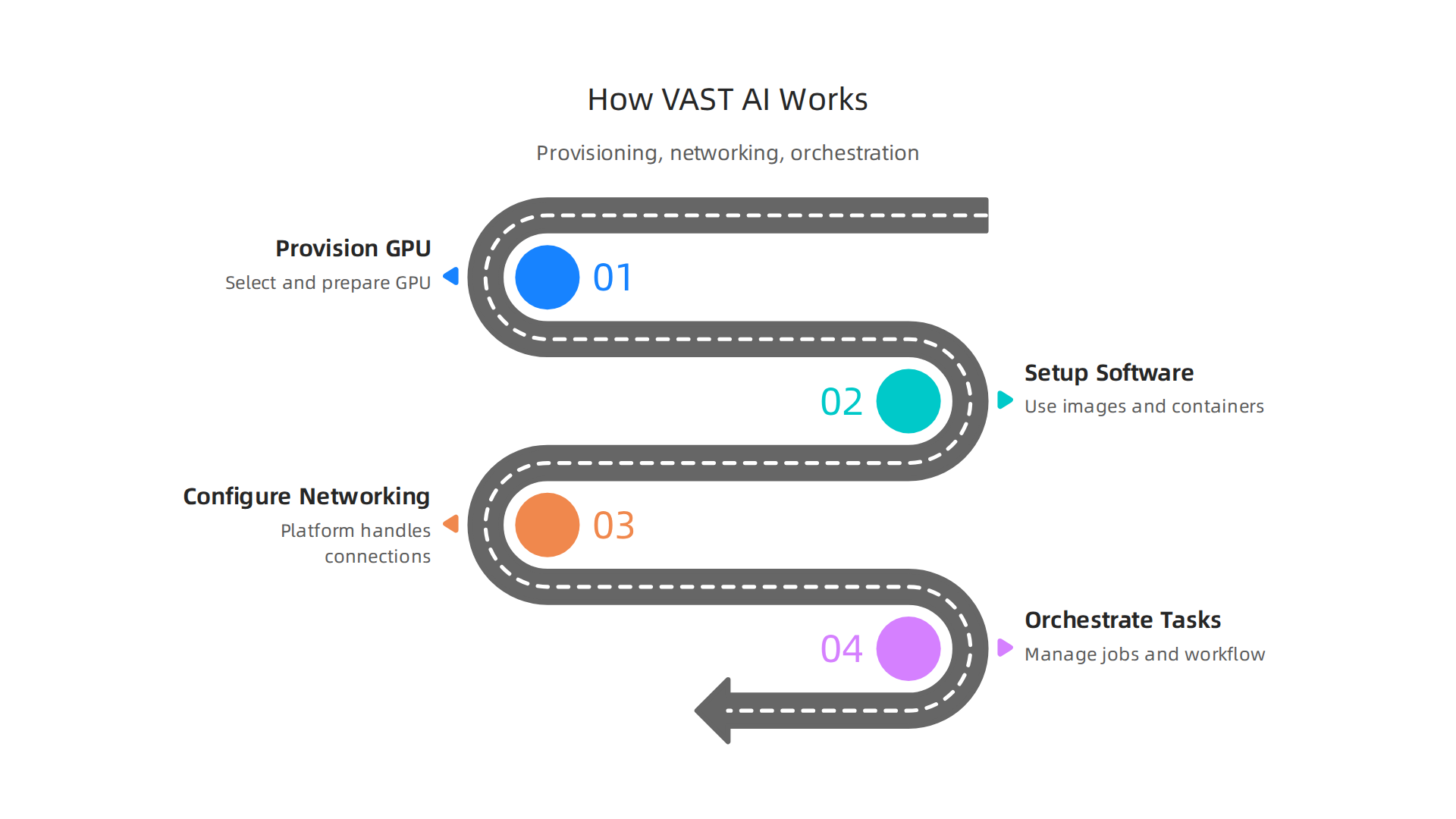
It’s all about getting the right computing power, setting up your tools, and making sure everything runs smoothly.
Getting Your GPU Ready: Provisioning
When you need a GPU on Vast.ai, you "provision" it. This just means you pick the GPU you want from the marketplace and get it ready for your work. You’re actually creating something called an "instance." Think of an instance as your own private workspace inside a computer, powered by a GPU. These instances are special because they are set up as Docker containers, which are like little packages that hold all your software ready to go Overview – Vast.ai Documentation: Affordable GPU Cloud. Each instance gives you full control over the GPU, and you only pay for the time you use it. This way, you get the exact power you need without owning the expensive hardware yourself.
Setting Up Your Software: Images and Containers
A big part of what makes Vast.ai easy to use is how it handles software. Because instances are Docker containers, you can use "custom images." An image is like a blueprint for your software environment. It has all the programs, libraries, and settings you need for your AI project already installed. This means you don’t have to spend hours setting things up every time. You can quickly start your work, whether you’re dealing with complex machine learning models or using specific software for data analysis, like tools that use R technology. This makes it simple to jump right into tasks such as training a generative AI model or practicing advanced prompt engineering techniques for reliable AI systems.
Making Connections: Networking for AI Jobs
When your AI job runs on a Vast.ai instance, the platform handles the networking for you. This means your computer can talk to the rented GPU, and the GPU can do its work without you worrying about the complicated connections. It’s like plugging your computer into an outlet without needing to understand how electricity travels through the wires. The system is built to make sure your machine learning tasks, from simple data processing to complex simulations that might power a "genie ai" application, run efficiently.
Guiding Your Tasks: Orchestration Patterns
Orchestration is a fancy word for managing all the different parts of your AI project to make sure they work well together. Vast.ai helps you do this in several ways:
- Standalone Jobs: For simple tasks, you can just run one job on an instance. It’s like doing a single task on your home computer.
- Serverless Workflows: For more complex needs, Vast.ai has a serverless architecture. This means it can manage many GPU workers automatically to run your applications efficiently Architecture – Vast.ai Documentation: Affordable GPU Cloud. It can even help you deploy large language models for inference tasks quickly.
- MLOps and Advanced Projects: For bigger companies, Vast.ai resources can fit into larger MLOps (Machine Learning Operations) systems. MLOps helps teams manage the whole life cycle of AI models, from testing to putting them into daily use. This includes things like managing data and model versions, making sure experiments can be repeated, and handling continuous training An Empirical Evaluation of Modern MLOps Frameworks. This way, Vast.ai can support everything from a single developer’s experiment to a big company’s important AI services, making it a flexible choice for almost any AI need.
Staying updated on these powerful tools and AI advancements is crucial for anyone in the field.
The AI Newsletter Worth Reading
Pricing and TCO: estimating costs and where savings happen
Now, let’s talk about money. When you use tools like vast ai for your projects, knowing how much it will cost is really important.

This isn’t just about the hourly rate for a GPU. It’s about the "Total Cost of Ownership," or TCO, which looks at all the costs added together.
What Makes Up the Cost?
Several things can change how much you pay:
- Type of GPU: Just like cars, some GPUs are more powerful and cost more. For example, a super strong NVIDIA H100 GPU costs more per hour than other types because it can do much more work. In 2026, an H100 GPU might cost around $3.00 per hour on a big cloud platform, but often less on a specialized marketplace Cloud GPU Providers Compared (2026): Lambda, CoreWeave ….
- How Easy It Is to Get: If a GPU is very popular and hard to find, its price might go up. Vast.ai uses many different providers, which means you often have more choices and better prices.
- Moving Your Data: Sometimes, moving your project data to and from the GPU instance can add a small cost. This is called data transfer.
- Storing Your Work: You’ll need a place to keep your code and models. This storage space also has a cost, but it’s usually small compared to GPU time.
- Managing Everything: The time you spend setting up, checking, and updating your project is also a cost. Platforms like vast ai help lower this "management overhead" by making things easy to use.
Comparing the Real Costs: Marketplaces vs. Big Clouds
Here’s where vast ai and similar services really shine. When you look at the total cost of ownership, specialized GPU marketplaces are often much cheaper than the big cloud companies like Amazon Web Services (AWS), Google Cloud Platform (GCP), or Microsoft Azure.
Many reports show that specialized GPU cloud providers can be 60% to 85% cheaper than these larger providers for the same GPU hardware GPU Cloud Comparison 2026: RunPod, Vast.ai & Thunder vs AWS. For example, in 2026, an H100 GPU might cost around $6.88 per hour on AWS, but on specialized platforms, you can find it for much less, sometimes starting around $2.01 per hour GPU Cloud Pricing Comparison 2026: H100 From $2.01/hr.
This big difference in price means that for AI startups and developers, choosing a platform like vast ai can lead to huge savings. These savings let you do more work, try more ideas, and train more complex models without breaking the bank. It’s about making your budget go further, which is a smart move when you’re selecting AI software development tools for your 2026 team.
By using a marketplace model, vast ai connects you with many different GPU owners, which helps keep prices competitive. This is different from traditional cloud providers that own all their hardware and often charge more. If you’re comparing enterprise AI platforms compared, these cost differences are very important for long-term project planning.
When you understand how much these services can save you, the next big question is: when should you actually use a platform like vast ai?

It’s not always the best fit for every kind of project. But for certain tasks, vast ai-style marketplaces truly shine because of their flexibility and cost.
When Marketplaces Like Vast AI Work Best
Marketplaces that offer GPU power are great for projects that need a lot of computing strength for short periods, or when you need to be smart with your money.
- Quick Training Bursts: Imagine you’re teaching an AI model something new. Often, you need powerful GPUs for a few hours or days to quickly train the model. vast ai is perfect for these "bursts" of work. You can get strong GPUs like the NVIDIA H100 for a short time without paying for a long-term contract. Many providers offer competitive pricing, sometimes starting from around $2.01 per hour for an H100 GPU GPU Cloud Pricing Comparison 2026: H100 From $2.01/hr.
- Trying Out New Ideas (Spot-Training Experiments): AI development often means trying many different things to see what works best. This is called experimenting. With vast ai, you can grab cheap, unused GPU time to run these tests. This helps you figure out the best approach without spending a lot of money. It’s especially useful for
google prompt engineeringtasks where you’re testing many prompts to get the best AI response. - Handling Lots of Requests (Large-Batch Inference): Once an AI model is trained, it needs to process new information. This is called inference. If you have a huge amount of data to process at once, vast ai lets you get many different types of GPUs to do the work quickly. You can easily scale up or down based on how much work you have, like what Creatix Technology did to support 200,000 daily users Case Studies. This kind of technology helps with things like generative AI tools for developers in 2026 that need to create many outputs at once.
- Saving Money on GPUs: Because vast ai connects you to many different GPU owners, prices are often much lower than big cloud providers. This means you can get more computing power for your budget. This is a big win for startups and small teams who want to make the most of their AI developer tools. For more comparisons, you can check out some of the cheapest cloud GPU providers.
When Marketplaces Might Not Be the Best Choice
While vast ai is great for many tasks, it’s not always the perfect fit.
- Projects That Run All the Time (Long-Running Stateful Services): Some AI projects need to run non-stop and keep track of information over a long time. These are called "stateful" services. Because vast ai uses a marketplace model, the exact GPU you are using might not always be available for very long periods, which can make these kinds of projects tricky. For such needs, a dedicated server or a traditional cloud provider might be better.
- Very Strict Rules (Compliance Needs): Certain industries, like healthcare or finance, have very strict rules about data security and privacy. They need to know exactly where their data is stored and who can access it. While vast ai helps verify hardware, the distributed nature of the marketplace might not meet the toughest compliance requirements. In these cases, you might need a service with stricter controls and agreements, sometimes called MLOps, which involves carefully managing the lifecycle of AI models and data An Empirical Evaluation of Modern MLOps Frameworks.
Understanding these different use cases helps you decide when vast ai can be a powerful tool for your AI technology needs.
Get clear daily AI updates from The AI Newsletter Worth Reading.
Beyond figuring out the right computing power for your AI projects, choosing the right programming language and tools is also key. In 2026, R continues to be a top choice for many teams working with AI. Even with new tools coming out all the time, R holds its ground because it’s great for certain kinds of tasks.
R for AI: Modern Tooling, Packages, and Why Teams Still Choose R
R is a programming language that has been around for a long time, especially for statistics and data analysis. But it has grown a lot and now offers powerful ways to build AI technology too. Modern R has many packages that help with machine learning, from building complex models to getting them ready for real-world use.
Modern R Packages for Machine Learning
One of the biggest changes in R for AI is the arrival of torch for R. This package lets you build and train deep learning models, much like PyTorch in Python, but you can do it all natively in R. The torch package helps with advanced math needed for neural networks and can even use powerful GPUs to make calculations faster CRAN: Package torch – R Project.
It doesn’t need Python to work, as it’s built on a C++ library. Many experts in 2026 agree that Neural Networks in R Remain Viable in 2026.
The torch ecosystem also includes other helpful packages:
luz: Makes it easier to train models by providing high-level training steps.brulee: Helps quickly build simple neural networks for table-like data.mlr3torch: A framework that helps define, train, and test neural networks for different types of data, including images mlr3torch: A Deep Learning Framework in R based on mlr3 and torch.whisper: Brings speech-to-text features using OpenAI’s Whisper model directly into R whisper.pdf.
For working with large language models, the chatAI4R package also offers support for various model APIs, like OpenAI and Gemini, right from R 2 R Packages – Large Language Model tools for R. Besides these, packages like those in the Tidyverse are essential for cleaning and organizing data, which is a big part of any AI project R Packages for AI and Machine Learning.
Why Teams Still Choose R
R has several strengths that make it a great choice for AI development:
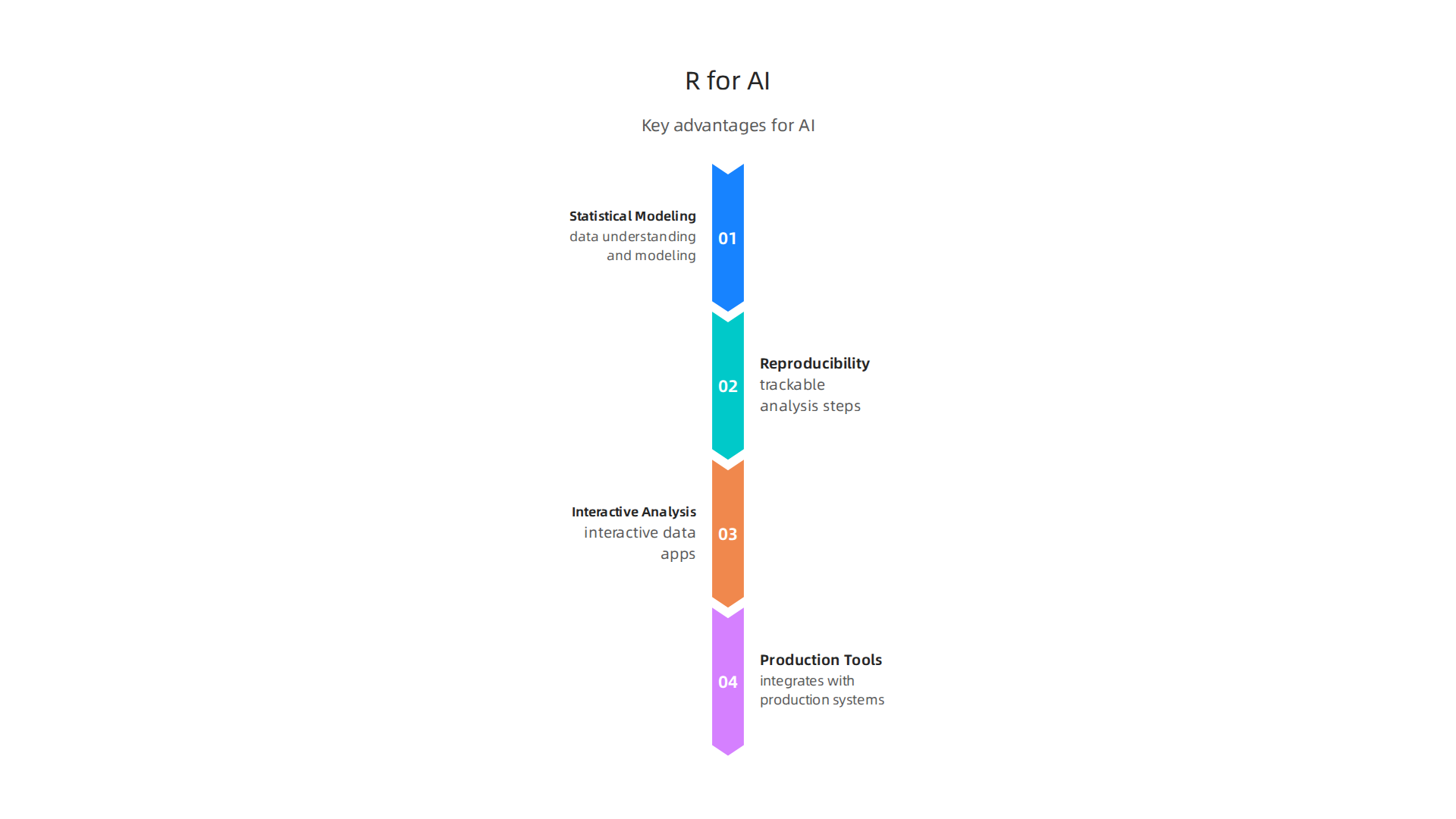
- Strong for Statistical Modeling: R was built for statistics. This means it has excellent tools for understanding data, testing ideas, and building models that rely on deep statistical insights. This is very important for making sure AI models are fair and accurate.
- Good for Repeating Work (Reproducibility): R makes it easy to keep track of your steps and share your code. This means that other people can get the same results you did, which is very important in science and business.
- Interactive Analysis: With tools like Shiny, R lets you create apps that people can use to play with data and models themselves. This helps make AI more understandable and useful to everyone, not just coders.
- Fits with Production Tools: R has gotten much better at connecting with other software. This means you can build your AI models in R and then easily use them within bigger systems and applications. This helps teams integrate their AI developer tools 2026 into a smooth workflow.
In short, R offers a rich environment for developing AI solutions, especially for tasks needing strong statistical foundations or quick model prototyping. To keep up with all the new AI technology, it’s a good idea to consider best computer science courses for AI development in 2026 that include R.
After you have developed powerful AI models using R, the next big step is to make sure they can run fast and efficiently, especially when they need a lot of computing power.

This is where using GPUs and cloud platforms comes in. Many teams are now looking at ways to put their R-based AI models onto GPU marketplaces like vast ai to get the speed they need without buying expensive hardware.
Putting R on GPU marketplaces: integration patterns and deployment options
To run R AI projects on powerful machines, you first need to package them up. Think of it like putting all your project’s ingredients and instructions into a neat box. This "box" is often called a container, and Docker is a popular tool for making these. When you package your R workload into a container, it means your R code, along with all the special R packages it needs (like torch for R technology), can run the same way no matter where you move it. This is super helpful for both training new models and using them to make predictions.
GPU marketplaces like vast ai let you rent powerful Graphics Processing Units (GPUs) for short periods. This is great for when your R AI project needs a lot of crunching power, like for deep learning tasks, but you don’t want to own the hardware yourself. You can upload your R container image to these platforms. Then, you can start up a virtual machine with the right GPUs, load your R project, and get your AI models working.
Making R Projects Ready for Deployment
Getting your R AI project from your computer to a vast ai server involves a few smart steps:
- Continuous Integration/Continuous Deployment (CI/CD): This is a fancy way to say "automatic building and shipping." With CI/CD, every time you make changes to your R code, a system can automatically build a new container image for your project. Then, it can automatically send this new container to the GPU marketplace. This saves a lot of time and makes sure your deployed R technology is always up-to-date.
- Reproducible Environments: Using containers is key here. It means that the R environment on your desktop, with all its specific packages and settings, is exactly the same as the one running on a
vast aiGPU. This helps avoid problems like "it worked on my machine!" ensuring your R AI models perform consistently. - Orchestration Hooks: For bigger projects, your R AI model might be just one part of a larger system. Orchestration tools help manage all these different parts. R projects can have special "hooks" or connections that let these tools start, stop, or manage your R container automatically. This helps your R technology fit smoothly into complex setups. When choosing your tools for these complex setups, it’s wise to consider selecting AI software development tools for your 2026 team carefully.
Keeping Things Secure on GPU Marketplaces
When you use external platforms for your R AI projects, keeping your data and models safe is very important. Always follow good security practices. For example, vast ai offers ways to keep your information safe, and it’s good to read their Security FAQ to understand how to best protect your work. Other important steps include making sure your API keys are strong and changed often, and that only the right people can access your deployed models. You can also find help with Vast.ai Security Basics to set up a secure environment.
To stay on top of new developments in AI and get daily updates, consider subscribing to The AI Newsletter Worth Reading.
When you run your special R AI projects on powerful platforms like vast ai, it’s super important to keep your information safe and follow all the rules. This is called security, privacy, and compliance. Let’s look at what you need to think about.
What to Look for in a GPU Marketplace
Think of it like choosing a safe place for your important things. You want to know:
- Where Your Data Lives (Data Residency): This means where your project’s data is actually stored on the internet. Different places have different privacy rules. Make sure the location works with your company’s rules. For example, some places might need your data to stay in a certain country. You can check a platform’s official Compliance information for these details.
- Keeping Secrets Safe (Encryption): Your R technology and models hold important information. Encryption is like scrambling your data so only you can read it. You want to make sure your data is encrypted both when it is stored (at rest) and when it is being sent from one place to another (in transit). Using strong data governance policies helps keep your sensitive data safe.
- Your Own Space (Tenant Isolation): On platforms like vast ai, many different users are running their projects. Tenant isolation means your R AI project and data are kept completely separate from everyone else’s. This stops others from accidentally seeing or using your work.
- Trusting the Platform (Vendor Trust): Before you use any external service for your R technology, make sure you trust them. Do they have a good history? Do they openly share their security steps? This is a big part of your "due diligence."
A Simple Safety Checklist
Here’s a quick list to help you check if a GPU marketplace, like vast ai, is right for your AI projects:
- Data Location: Does the platform let you choose where your AI data will be kept?
- Data Protection: Is all your important data, including your R project files, encrypted at all times?
- Separation: Does the platform keep your project separate from other users’ projects?
- Official Rules: Does the marketplace clearly follow privacy and data protection rules? It’s important to understand the future standard for AI implementation as these rules keep changing.
- AI System Safety: What steps does the platform take to keep the AI models themselves safe from attacks or misuse? This includes following Guidelines for secure AI system development.
- Watching for Problems: Does the platform let you watch for any strange activity with your data or models?
Even when using helpful tools like Genie AI or when working with important tasks like Google prompt engineering, these safety steps are always needed. Being careful upfront will save you a lot of trouble later on.
Summary
This article explains how GPU marketplaces like VAST AI help AI teams access affordable, powerful compute without buying hardware, and why R remains a strong language for machine learning in 2026. It covers how provisioning works (instances as Docker containers), the benefits of custom images and orchestration (standalone jobs, serverless workflows, MLOps), and practical deployment patterns for putting R workloads on rented GPUs. The piece breaks down pricing drivers and TCO—showing why specialized marketplaces can be far cheaper than major cloud providers for burst training, experiments, and large-batch inference—and explains when marketplaces are not ideal (long-running stateful services or strict compliance needs). You’ll also get a short guide to modern R tooling (torch, luz, mlr3torch, whisper) and steps to containerize and secure R models for GPU use. Finally, it provides a simple security and compliance checklist to evaluate any GPU marketplace before you deploy production workloads.