

Unlock AI Success with Core Computer Science Concepts for AI Development
Overview
Why a concise, practical map of core CS concepts matters for AI development teams
The world of AI development moves really fast in 2026. This quick pace means that engineering teams often find it hard to keep up. They need to learn new tools and ideas all the time. Sometimes, there are big gaps in what people know, which can slow down making new AI products. It’s tough to bring new AI tools into existing projects when the team isn’t clear on the basic building blocks.
That’s where understanding the many types of computer science comes in. To build great AI, you need a strong foundation. Think of it like this: if you want to build a tall, strong house, you need to know about the soil, the beams, and how they all fit together. The same is true for AI. Without a clear map of core computer science ideas, teams can struggle to pick the right tools or solve tough problems.

For example, a good computer science degree curriculum often highlights foundational math and programming coursework Computer Science Degree Curriculum Guide 2026.
This guide is here to help. We’ll give you a simple, practical map of the most important computer science concepts. We will explain how these foundational topics connect directly to the work AI development teams do every day. You’ll learn what skills are most important right now and how to make learning them a priority. Whether you’re thinking about an online engineering degree or just want to boost your team’s knowledge, this map will help you understand the core ideas better. It will show you how to reduce skill gaps and make your AI tool integration much smoother.
Want to stay on top of all the latest AI developments daily?
The AI Newsletter Worth Reading
Foundations: Algorithms, Data Structures, and Complexity
Building on a strong computer science base is key, especially for AI teams in 2026. Two big ideas that are super important are algorithms and data structures. Think of them as the basic tools every AI developer needs in their toolbox.

They are some of the most important types of computer science you can learn.
Why Algorithmic Thinking Matters for AI
First, let’s talk about algorithms. What’s an algorithm? It’s simply a step-by-step recipe for solving a problem. For example, when you tell a computer how to sort a list of names, you’re giving it an algorithm. In AI, algorithms are everywhere. They are the brains behind how AI models learn, how they make decisions, and how they process huge amounts of data.
When you’re building advanced AI systems, like those that handle many users or massive data sets, you need algorithms that are not just correct but also fast and efficient. This is called algorithmic thinking, and it’s vital for designing "scalable AI pipelines." This means making sure your AI can grow and handle more work without breaking down or slowing to a crawl. Good algorithmic design helps AI process information quickly and use computing power wisely. Learning about fundamental data structures, algorithms, and software development practices is a core part of many computer science programs Computer Sciences (COMP SCI) – Guide.
Key Data Structures for AI Developers
Now, let’s look at data structures. These are special ways to store and organize information in a computer so it can be used efficiently. Imagine trying to find a book in a library where all the books are just piled up randomly. It would be hard, right? A library that organizes books by author or topic makes it much easier to find what you need. Data structures do the same for computers. They help AI developers choose the best way to keep data so algorithms can work on it quickly.
Here are some important data structures AI developers should know:
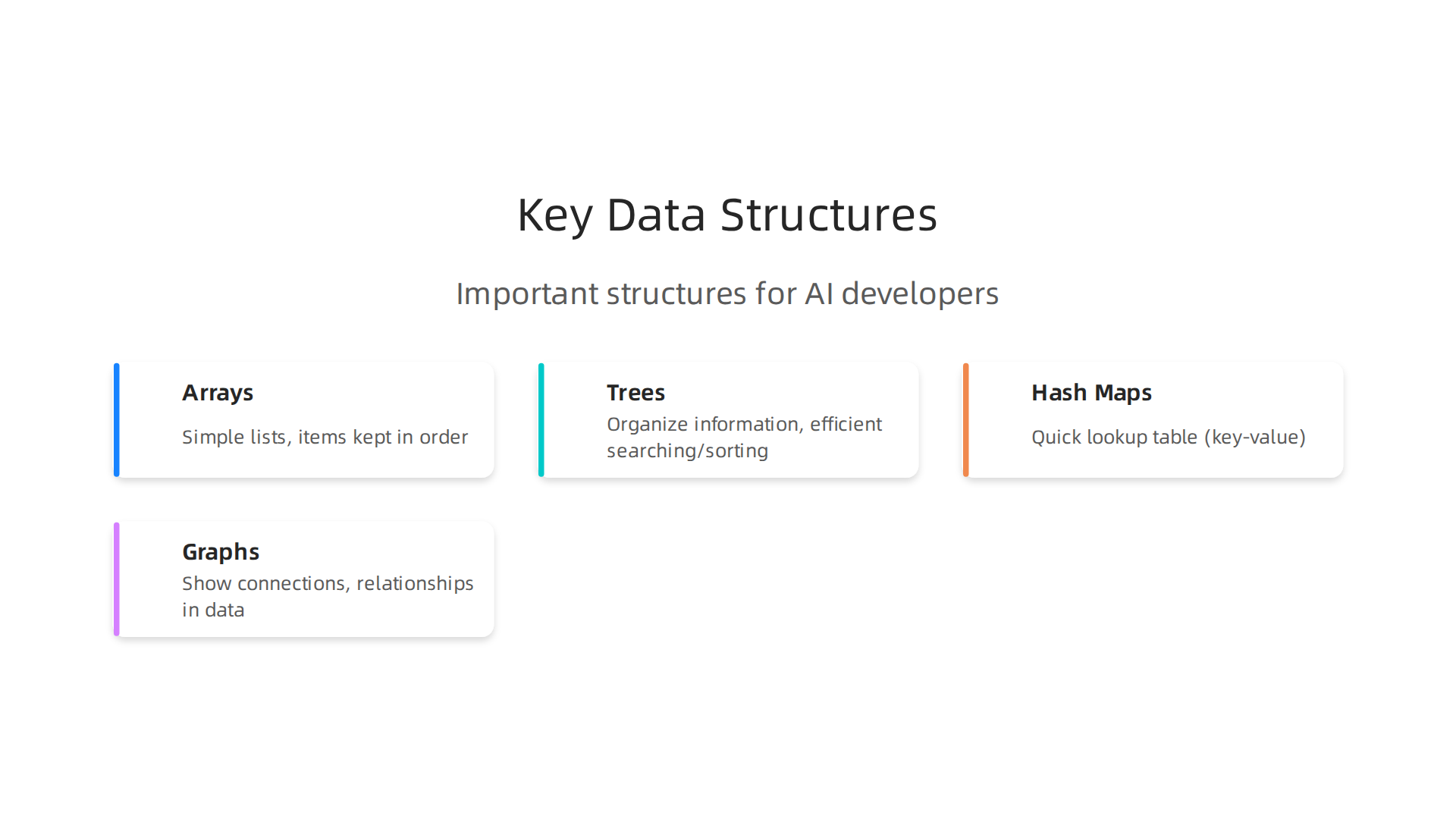
- Arrays: These are like simple lists where items are kept in order. They are good when you know exactly how much data you’ll have and need to get to any item very fast.
- Trees: Think of a family tree, but for data. Trees help organize information in a way that makes searching and sorting very efficient. They are often used in AI for things like decision-making processes.
- Hash Maps (or Dictionaries): These are like a quick lookup table. You give it a key (like a word), and it instantly gives you the value (like its definition). Hash maps are great for quickly finding data without searching through a whole list.
- Graphs: These are like maps with cities and roads connecting them. Graphs are perfect for showing how different pieces of information are connected. In AI, graphs are used in social networks, recommendation systems, and understanding relationships in complex data.
Many computer science degrees make sure students learn about these foundational structures. For example, common courses cover Arrays, Linked Lists, Stacks, Queues, and Trees. Understanding these different data structures helps you pick the right one for your AI task. This means your AI tools can run faster and smarter. To dive deeper into these core topics, consider exploring the best computer science courses for AI development available in 2026.
Learning about algorithms and data structures is a strong start, but to make sure your AI tools are not just fast but also always correct and reliable, you need another important part of computer science: discrete mathematics and logic. Think of these as the math tools that help you prove your code will work right every time.
Why Discrete Math is Important for AI
Discrete mathematics is the study of separate, distinct items, not continuous ones. For example, it deals with whole numbers, lists of things, or networks. This kind of math helps solve problems that involve steps and choices, which is exactly what AI does. Many college programs for computer science, including those for an online engineering degree, include discrete mathematics as a core subject.
Here are some key topics in discrete mathematics that are very helpful for AI developers:

- Logic (Propositional and First-Order): This is about telling if statements are true or false and how they connect. It teaches you to think in a very clear, step-by-step way. In AI, logic helps us design systems that follow rules precisely, making their behavior predictable and correct. Learning about predicate and first-order logic and logic-based proofs is a fundamental part of many computer science programs.
- Set Theory: This is all about groups of items. For example, all the different pictures an AI might look at can be thought of as a set. It helps organize data and understand how different pieces of information relate to each other.
- Graph Theory: While we talked about graphs as a data structure, discrete mathematics gives you the deeper mathematical rules for how graphs work. It explores how to connect points (nodes) in different ways and understand pathways, which is vital for AI tasks like planning or social network analysis. Topics like graphs are detailed in the CS Computer Science and Information Technology GATE 2026 syllabus.
- Combinatorics: This is the math of counting. How many ways can you arrange things? How many different choices does an AI have? This helps in tasks where an AI needs to explore many possibilities, like in games or when figuring out different solutions. These foundational counting and probability topics are often covered in discrete mathematics courses.
Building Reliable AI Systems with Logic
In the world of AI, mistakes can lead to big problems. This is where logical reasoning and formal thinking truly shine. By using these tools from discrete mathematics, AI engineers can prove that their algorithms will always work as intended. This helps reduce unexpected problems and bugs in complex AI systems. It’s like having a blueprint that guarantees every part will fit perfectly.
A strong grasp of these mathematical foundations is essential for ensuring that AI systems are reliable, trustworthy, and behave predictably. This kind of deep understanding is a critical part of a complete Computer Science and Engineering degree. It moves you beyond just making things work, to making things work correctly, every single time. To stay updated on all the latest AI advancements and how they impact development, you should get The AI Newsletter Worth Reading.
Making sure your AI systems work correctly is one thing, but making them work fast and efficiently requires understanding the very building blocks of a computer. This is where computer architecture and systems thinking come into play. It’s about knowing how the hardware actually works, which is a key area within the many types of computer science studies.
Core Hardware for AI
Think of computer architecture as looking inside the machine to see how its parts are built and how they talk to each other. For AI, two main hardware parts are super important:
- CPUs (Central Processing Units): These are like the general brains of a computer. They handle all sorts of tasks one after another. While good for many things, they can be slow for the huge math problems AI often needs to solve.
- GPUs (Graphics Processing Units): These are specialized brains, much better at doing many simple calculations all at the same time. This "parallel processing" is exactly what AI tasks like training big models need. Modern AI systems, especially those using large language models, greatly rely on GPUs to perform their tasks quickly and efficiently, making GPUs central to discussions around topics like "computer engineering vs electrical engineering" and system optimization. GPUs have many processing elements and a complex memory hierarchy to manage data.
For an AI developer, understanding how these processors work, especially the inner workings of GPUs, helps you write code that runs faster. Learning more about this can be part of an engineering technology degree or a specialized computer science program.
The Memory Hierarchy
Beyond the main processors, how a computer stores and accesses information is also very important. This is called the "memory hierarchy." It’s a system of different memory types, each with its own speed and size:
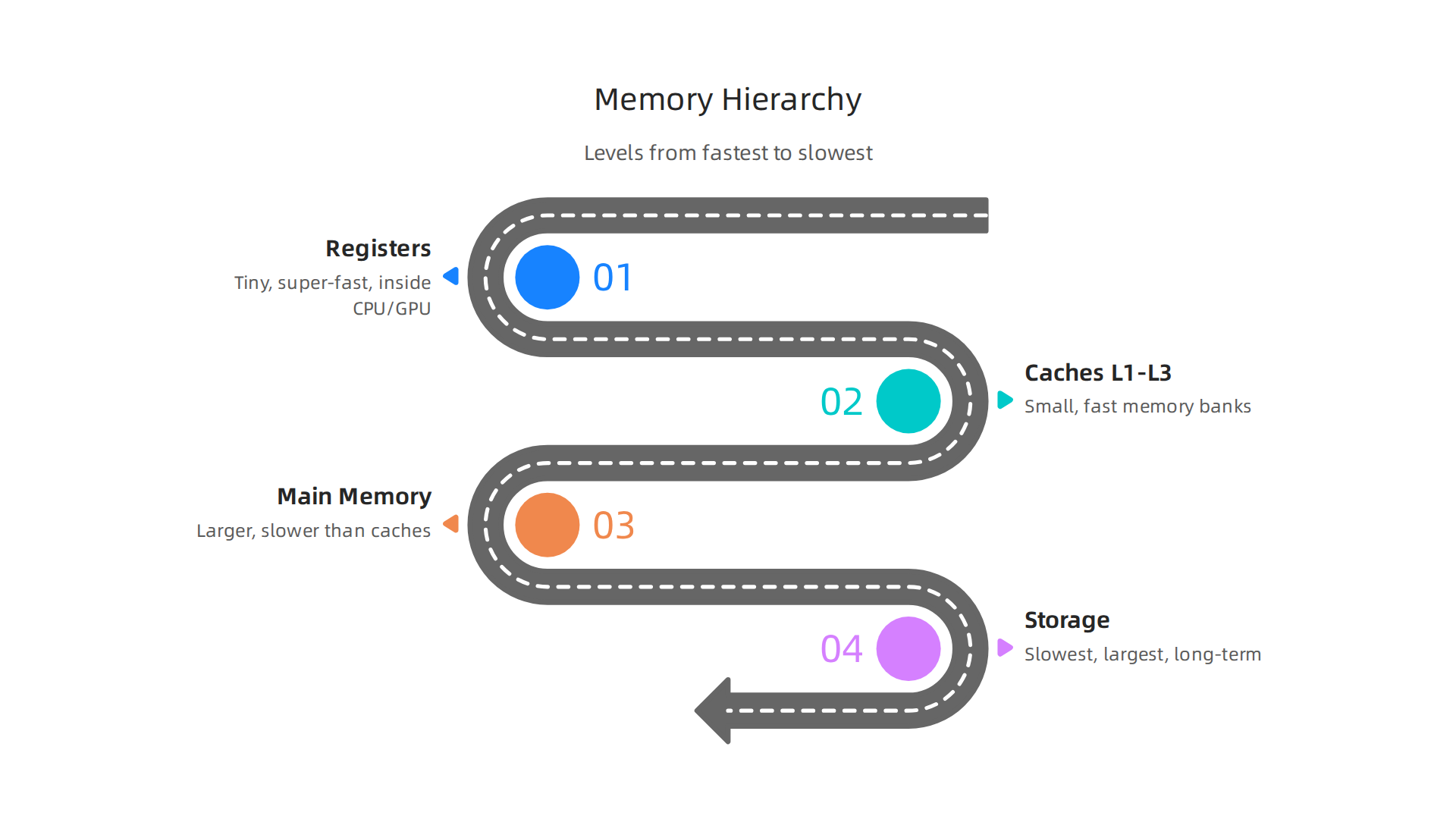
- Registers: These are tiny but super-fast storage spots right inside the CPU or GPU, used for calculations happening right now.
- Caches (L1, L2, L3): These are small, fast memory banks closer to the processor. They store data that the processor might need again very soon, helping to speed things up. Both CPU and GPU systems use cache hierarchies to filter memory accesses.
- Main Memory (RAM): This is larger and slower than caches, but still much faster than disk storage. It holds the data and programs currently in use.
- Storage (SSD/HDD): The slowest but largest memory, used for long-term storage of all your files and programs.
For AI, moving data efficiently through this memory hierarchy is key. For example, a GPU has its own special memory hierarchy with different tiers, from fast, limited registers to slower, larger global memory. Developers who understand this can write programs that keep important data in the faster parts of memory, reducing delays. This is especially true for large AI models that need to process huge amounts of data, where GPU memory hierarchy greatly influences performance.
Balancing Computation, Memory, and I/O
When building AI models, developers constantly face trade-offs:
- Computation: How much raw processing power do you need?
- Memory: How much data can the system hold and access quickly?
- I/O (Input/Output): How fast can the system get data in and send results out?
These three factors are always balanced. For example, a very complex AI model might need a lot of computation and memory. If the data movement (I/O) is too slow, the powerful processors will sit idle, waiting for data. Knowing these relationships helps you pick the right hardware and design your AI solutions to be as efficient as possible. This kind of deep understanding is vital for mastering various types of computer science in the context of AI. To learn more about how computers handle these operations, explore resources on computer systems technology explained.
Knowing about the hardware is a great start. But a computer also needs a manager to make all the parts work together smoothly. That manager is the operating system, often shortened to OS. Understanding how an OS works, especially with many tasks at once, is another key area in the types of computer science.
Operating Systems, Concurrency, and Performance Tuning
An operating system helps organize everything. For AI, it needs to manage how different parts of your AI program run at the same time. This is called "concurrency."
-
Threads and Processes: Think of a "process" as a whole program running. Inside that program, there can be many smaller "threads" doing different bits of work. For AI, especially when you’re training models with lots of data or serving many users at once, you want these processes and threads to work in parallel. This way, your powerful GPUs and CPUs don’t sit idle. For instance, smart ways to schedule tasks can greatly improve how quickly AI models like DLRM get trained on both CPUs and GPUs Sophisticated Orchestrating Concurrent DLRM Training on CPU-GPU Platforms.
-
Scheduling: The OS decides which task gets to use the CPU or GPU and for how long. Good scheduling means the most important AI tasks get the resources they need, when they need them. This is super important for speeding up both training and using AI models.
Tuning AI Performance
Once you understand how the OS manages things, you can "tune" your AI system for better performance. This is like making small adjustments to an engine to make it run faster and more smoothly. Performance tuning helps make sure your AI models are not just correct, but also quick and efficient, which is a big part of AI Systems Performance Engineering.

- Common Tuning Levers: These are the things you can change to improve speed. For AI, this might mean adjusting the "batch size" (how much data the AI processes at once) or how much memory is set aside for a task.
- Observability Signals: To tune well, you need to see what’s happening. These are the "signals" that tell you how your system is doing. You might watch how much of the CPU or GPU is being used, how much memory is left, or how fast data is moving. These signals help you find bottlenecks, which are like traffic jams in your system that slow everything down.
Mastering these ideas helps you build AI systems that run really well. It’s a key part of an advanced education, whether you pursue an online computer science degree program or another specialized path in computer engineering.
When you build AI systems, choosing the right tools to write your instructions is just as important as knowing how the computer’s parts work. These tools are programming languages. They let AI engineers tell the computer exactly what to do. Picking the right language affects how fast your AI program runs, how safe it is from errors, and how quickly you can create it. This is a big part of the types of computer science that deals with making AI work in the real world.
How Language Choice Impacts AI Projects
Different programming languages are good for different things.
- Python: This is a popular choice for AI because it’s easy to learn and has many ready-to-use libraries. These libraries are like toolkits that make it much faster to build and test AI models. This helps with "developer velocity," meaning you can get things done quickly.
- C++ and Rust: For parts of AI programs that need to be very fast or very secure, languages like C++ or Rust are often used. These languages give developers more control over the computer’s memory, which can lead to better performance.
- Safety: Some languages are built with "memory safety" in mind. This means they are designed to prevent common errors that can make programs crash or open them up to security risks. For example, using memory-safe programming languages can block a large number of dangerous security attacks, helping to keep your AI systems more secure Building More Secure Software with Memory-Safe Programming Languages. When choosing a language, there’s often a trade-off between how fast you can write the code and how safe or fast the final program is Typing Disciplines: Performance vs. Safety – Grasp.
- Developer Velocity: This is about how quickly engineers can write, test, and update code. Languages that are simpler and have good tools can greatly speed up how fast an AI project moves from idea to a working program. If you want to dive deeper into improving how fast you develop software, explore resources on maximize software development efficiency with AI tools.
Programming Paradigms for AI Engineers
Beyond just the language, there are different ways of thinking about how to write programs. These are called "programming paradigms."
Knowing them helps AI engineers pick the best approach for different tasks.
- Imperative Approach: This is like giving a recipe with step-by-step instructions. You tell the computer exactly what to do and in what order. Many common programs use this style.
- Functional Approach: With this, you focus on what a program should compute, rather than how it should do it. It uses mathematical functions and avoids changing data, which can make programs easier to understand and test.
- Concurrent Approach: We talked about concurrency with operating systems. This paradigm helps you write programs that can do many things at the same time. This is very important for AI, where you often have many calculations happening together.
- Declarative Approach: Here, you describe the desired result without explaining every single step. For example, when you tell a database "get me all users named John," you’re using a declarative approach. The database figures out the best way to do it.
Understanding these languages and programming styles is vital for anyone pursuing a path in computer science or computer engineering vs electrical engineering. It’s a key part of how you build smart systems, whether you’re working toward an online engineering degree or simply want to master your skills as a developer.
For daily insights into the fast-changing world of AI and technology, consider subscribing to The AI Newsletter Worth Reading. It offers clear updates to keep you informed.
After you understand how to pick programming languages and different ways to write code, the next big step in building smart AI systems is managing the information they use. This is where databases, storage, and how you design your data become very important. It’s a key part of the many types of computer science that focus on making AI work well in the real world.
Databases, Storage, and Data Modeling for AI Workflows
AI models need a lot of data to learn and make decisions. How you set up your data and where you keep it can greatly change how fast and accurate your AI system is. This is all about data modeling and storage strategies.
Smart Data Modeling for AI
Data modeling means deciding how your information is organized. For AI, these choices affect three main things:
- Training Data Pipelines: This is how you prepare data for your AI to learn from. Good data modeling makes it easier to clean, transform, and feed huge amounts of data to your models.
- Feature Stores: Think of a feature store as a special database for all the important pieces of information (features) your AI models use. It helps keep these features ready and consistent for both training and when the AI is working in real time. For instance, a simple feature store can store both past data for training and live data for making decisions right now Feature Store implementation, which provides both historical and real-time feature serving capabilities for machine learning models..
- Real-Time Inference: This is when your AI uses what it learned to make a decision or prediction very quickly. If your data is well-organized, the AI can find the information it needs almost instantly.
Storing Data for AI
AI systems often need two main types of storage because they have different needs:
- Offline Storage: This is for very large datasets used to train your AI models. It needs to hold a lot of data and be good at reading it all at once. Data warehouses or data lakes are common for this. Columnar storage is often used here because it’s great for analyzing large sets of data, where features are like separate columns Bullion: A Column Store for Machine Learning.
- Online Storage: This is for giving your AI model quick pieces of data when it’s making real-time decisions. It needs to be super fast to look up single items. Low-latency databases like key-value stores are perfect for this, offering very quick lookups Low Latency Online Feature Store Architectures. Key-value stores are simple databases that link a key to a value, which is very efficient for fast retrieval Welcome to the PADS Blog!.
Many AI setups use a "dual-storage" approach with both offline and online stores. The offline store is best for training with big batches of data, while the online store is built for quick lookups when the AI is making live predictions Feature Stores: Managing ML Features at Scale. This dual system is important for managing features at scale and helps balance different needs for speed and storage The Foundation of Production ML Feature Management.
Learning how to manage and store data well is a crucial skill for anyone wanting to build advanced AI systems. It’s a big part of what makes an online engineering degree or any computer science path useful in 2026. If you want to dive deeper into how to build efficient AI systems, learning about practical implementation strategies can be very helpful for engineering success. You can learn more about how to Build AI Systems Master Implementation.
After you understand how to handle data well, the next big step is learning about machine learning itself. This part is about teaching computers to learn from all that data you’ve prepared. It’s a key area within the many types of computer science that makes AI so powerful in 2026.
Machine Learning Fundamentals for Developers
Every developer looking to build smart AI systems needs to grasp some basic machine learning ideas. These concepts are the building blocks of how AI learns and makes choices.
Key Learning Styles for AI
Think of machine learning as teaching a very smart student. There are two main ways we teach AI:
- Supervised Learning: This is like teaching with flashcards. You show the AI many examples where you give it both the input (like a picture of an animal) and the correct answer (like "this is a cat"). The AI learns by finding patterns that link the inputs to the right answers. Most AI models today use this method to learn from labeled data, as explained in the Machine Learning: Lifecycle, Types & Best Practices from Snowflake.
- Unsupervised Learning: Here, you give the AI lots of information, but you don’t tell it the answers. Instead, the AI tries to find its own patterns, groups, or hidden structures in the data. It’s like giving a child a pile of toys and asking them to sort them into groups that make sense to them, without telling them what those groups should be. This helps AI discover new insights.
Model Power and Common Problems
Once an AI starts learning, two important ideas come up:
- Model Capacity: This is like the "brainpower" of your AI model. A model with low capacity can only learn simple rules. A model with high capacity can learn very complex and detailed patterns. Choosing the right capacity is crucial.
- Overfitting: This happens when an AI model learns the training data too well. It memorizes every little detail, even the mistakes or "noise" in the data, instead of learning the general rules. When you give an overfit model new data it hasn’t seen before, it often performs poorly because it didn’t truly understand the subject. It’s like a student who memorizes a test without understanding the lessons; they’ll fail a different test. Preventing overfitting is a big part of making AI models reliable.
How Software Engineering Fits In
For software developers, understanding these basics is just the start. You also need to make sure your AI models work well in the real world. This brings in several software engineering concerns:
- Testing: After an AI model learns, you need to test it thoroughly. You use new data (data the AI has never seen) to check how well it actually works. Good testing includes using methods like cross-validation to ensure your AI can handle different kinds of real-world inputs, as noted in Machine Learning: The Engineer’s Ultimate Handbook 2026.
- Reproducibility: This means that if you run the same AI training steps with the same data, you should get the same results every time. It’s important for trust and fixing problems. Tools and practices for "MLOps" (Machine Learning Operations) help make sure everything from data to models is tracked and can be recreated, which are crucial Machine Learning Operations Best Practices for 2026 Teams.
- Deployment: Once your AI model is ready and tested, you need to put it into action. This means setting it up so it can be used by people or other systems, often in real time. This step is about packaging, testing, and making the model available, a core part of a Practitioners guide to MLOps. Making sure your deployment is smooth can greatly help maximize software development efficiency with AI tools.
Learning these fundamental machine learning ideas and how they connect to good software engineering practices is essential for anyone on an online computer science degree program or building AI systems in 2026.
Want to keep up with the fast-moving world of AI and how it impacts development? Get clear daily AI updates from The AI Newsletter Worth Reading.
After learning the basics of machine learning, it’s just as important to know how to check if your AI model is doing a good job and if it’s fair to everyone. These checks help make sure that when you put your AI to work, it behaves the way you want it to.
Model Evaluation Beyond Simple Numbers
When an AI model is built, we need to know how well it performs. This is called model evaluation. You might look at simple numbers like "accuracy" to see how many times it guessed correctly. But actually, just looking at one number isn’t always enough. For example, an AI might seem accurate on average, but fail often for a small group of people.
In 2026, good evaluation means checking your model against many different situations, not just the easy ones. It’s about ensuring your AI works well in the real world, not just in your lab. This often means having clear ways to check your model with data it has never seen, following guidelines for developing high-quality ML solutions. Understanding how to truly measure an AI’s performance is key, and you can learn more about how to do this by exploring how to evaluate the smartest AI in 2026.
Dealing with Bias in AI
One big problem AI can have is bias. This happens when an AI model treats certain groups of people unfairly. Why does this happen? Usually, it’s because the data used to train the AI wasn’t balanced or fair to begin with. If your training data mostly shows one type of person for a certain job, the AI might learn to unfairly prefer that type of person.
To fix this, you need to actively look for bias. This means carefully checking your input data and testing the AI model to see if it shows unfairness towards any group.

A key step is to keep out any information from your data that could lead to unfair choices, as part of engineering best practices for Machine Learning. Building fair AI systems is a big part of responsible software development, connecting to many types of computer science.
Putting AI to Work and Watching It Closely
Once your AI model is ready, tested, and seems fair, the next step is deployment. This means making it available for real use. But the job isn’t over then. You need to "instrument" your models. This simply means adding tools that let you watch how the AI is performing in the real world, all the time.
You’ll want to monitor things like:
- Data quality: Is the new data the AI is seeing similar to what it learned from?
- Drift: Is the world changing in a way that makes your AI’s old knowledge less useful?
- Performance: Is the AI still making good choices for real users?
This continuous watching, or monitoring, helps you catch problems quickly. If the AI starts making bad decisions or showing new biases, you’ll know right away. This way, you can fix it before it causes bigger issues. This constant evaluation after deployment ensures the AI remains effective and fair over time, which is crucial for Machine Learning Engineering. Making sure your AI systems are implemented properly and kept up to date is essential for success in 2026, and you can learn more about how to build AI systems and master implementation for engineering success.
Summary
This article provides a concise, practical map of core computer science concepts that AI development teams need in 2026, linking foundational topics directly to everyday engineering work. It covers why algorithmic thinking and key data structures matter for scalable AI pipelines, how discrete mathematics and logic ensure correctness, and why understanding computer architecture and memory hierarchies improves performance. The guide explains operating system roles, concurrency, and common tuning levers, then walks through language and paradigm trade-offs for developer velocity and safety. It outlines data modeling, offline/online storage strategies and feature stores for reliable training and real-time inference. The piece also summarizes essential machine learning fundamentals—capacity, overfitting, testing—and shows how to evaluate, detect bias, and monitor models in production. After reading, engineers and managers will know which skills to prioritize, how to pick the right tools, and how to design, tune, and maintain robust AI systems.