

Context Engineering in 2026: Definitions, Techniques, and Tools for AI
Overview
Why context engineering matters now — framing the problem and the promise
In 2026, artificial intelligence (AI) has become a huge part of how we build things, especially in computer science and engineering. Many people think working with AI is just about typing a good question, also known as a prompt. But actually, getting AI to work its best is much more than that. Sometimes, even with a great prompt, AI might not give you the helpful answers or actions you expect. This creates a gap between what we want AI to do and what it can do with just a simple request.

This is exactly why context engineering is so important right now. It is a new field focused on carefully designing and managing all the information you give an AI system so it can make smart decisions and give useful results. Think of it this way: if you ask someone to build a house, you don’t just say "build a house." You give them plans, materials, a budget, and tell them where it will be built. Context engineering is like giving the AI its full set of plans and background details. It’s about looking beyond just the prompt to everything else the AI needs to understand its task deeply.
Experts agree that context engineering is a necessary skill in 2026. It’s a formal way to make sure AI agents have all the right information at the right time to do their job well, not just what you type in a chat box. It includes things like the specific instructions for the AI, examples of what good answers look like, rules it needs to follow, and even older conversations it should remember. This careful setup changes how the AI responds across different parts of a task, from understanding your first question to retrieving more information it needs, and even how the whole AI system is built. For any software engineer or integration engineer working with AI, understanding how to control this informational environment is key to success.
To learn more about the latest trends and insights in AI, make sure you’re getting the best information. You can get clear daily AI updates and more by subscribing to The AI Newsletter Worth Reading. It’s a great way to stay informed about this fast-changing field.
This practice goes far beyond simple prompt writing. It’s about creating a complete informational world for the AI. By doing this, we can guide AI to act in ways that truly match what we want to achieve. According to a paper introducing this field, context engineering is about "designing, structuring, and managing the entire informational environment in which an AI agent makes decisions" in 2026, becoming its own important area of study Context Engineering: – arXiv. This means choosing the right facts, past interactions, and tools, then giving them to the AI in a way it can easily use. Building this skill can even help you accelerate your career with free IT courses online in 2026.
What is context engineering? Definitions, scope, and core concepts
Now that we know why context engineering is important, let’s break down what it actually means. In simple terms, for AI, "context" is all the information an AI system needs to understand your request and do its job well. Think of it as the AI’s background knowledge for a specific task. This includes things like:
- The problem you want to solve.
- Any rules the AI must follow.
- Examples of what a good answer looks like.
- Past conversations or data that are important.
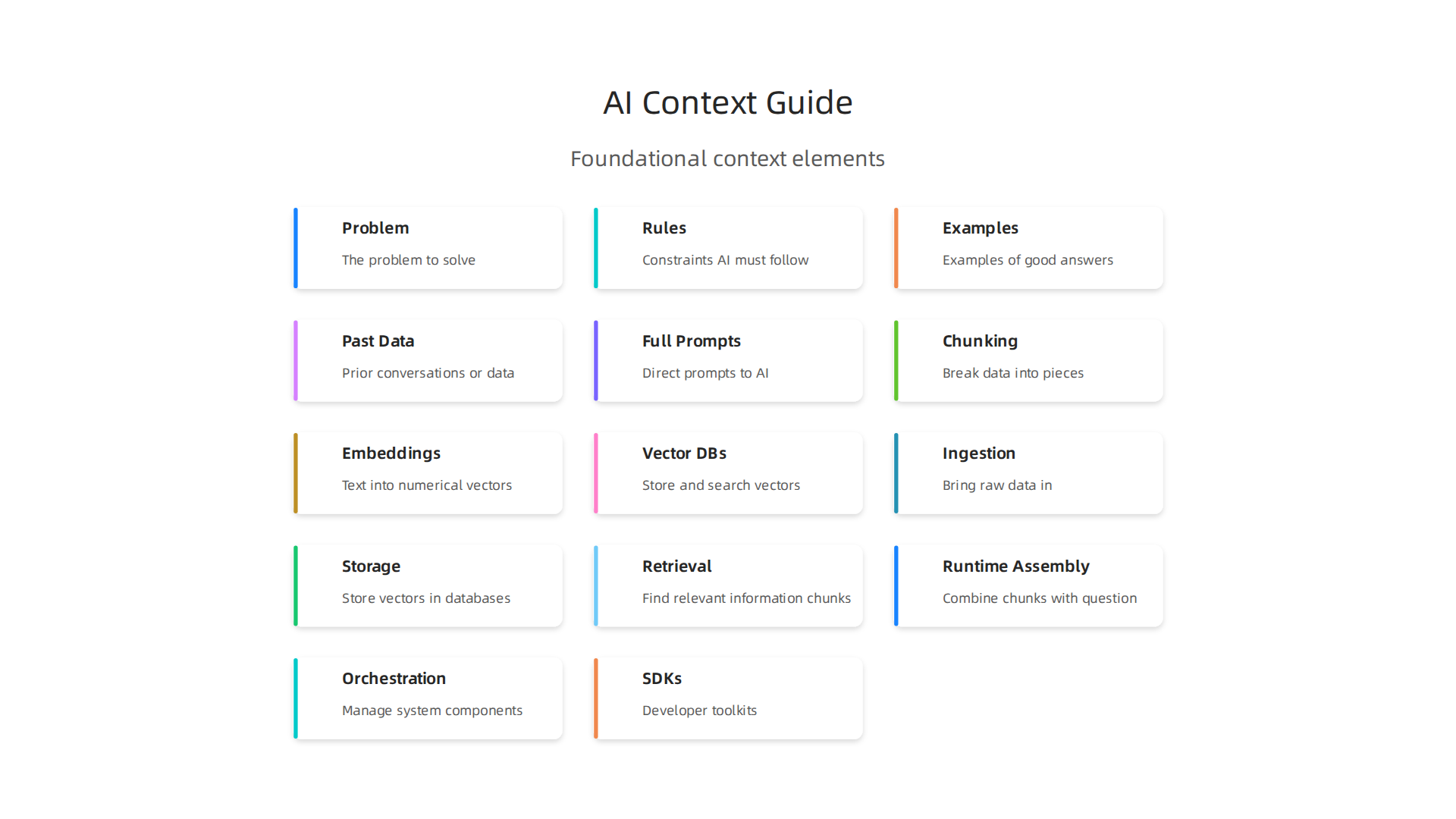
An AI’s "context window" is like a temporary notepad where it holds all this information. It’s the limited space where the AI can "see" and "think" about the context you provide at any given moment. Keeping this window filled with the right information is crucial for the AI’s performance.
So, what is context engineering? It’s the careful way of choosing, putting together, and managing all the information that goes into an AI’s context window. It makes sure the AI has exactly what it needs to make smart choices and give helpful results. Experts describe context engineering in 2026 as a discipline focused on designing what an AI agent "should see at each step of a task, including which facts, records, past interactions, and from which systems to retrieve them all," then delivering it in a usable form The state of context engineering 2026. Another view is that it’s the "delicate art and science of filling the context window with just the right information for the next step" Context Engineering.
How Context Engineering Differs from Other Fields
It is easy to mix up context engineering with other related areas. Let’s make it clear:

-
Prompt Engineering vs. Context Engineering: Prompt engineering is about writing the best possible question or command for an AI. It’s a key part of context engineering, but it’s not the whole story. Context engineering is bigger; it sets up the entire environment around the prompt. You might think of prompt engineering as choosing the right words, while context engineering is like building the whole library the AI can pull those words from. To truly master advanced AI systems, you need to go beyond just prompts. You can learn more about advanced prompt engineering 2026 techniques.
-
MLOps vs. Context Engineering: MLOps is about managing the entire life cycle of machine learning models, from building and training them to putting them into action and keeping them running smoothly. Context engineering fits within MLOps, especially when we talk about how AI models are used in real life. While MLOps deals with the broader system that handles AI models, context engineering focuses specifically on the information environment of those models during their use. Professionals in computer science and engineering often work with both MLOps and context engineering.
The Scope of Context Engineering
For a software engineer or an integration engineer, context engineering means taking charge of:
- Data Selection: Deciding which pieces of information are truly helpful for the AI to complete its task.
- Information Structure: Organizing that data so the AI can understand it easily.
- Dynamic Updates: Making sure the context changes as the task goes on, like remembering new details or adding new rules.
- Tool Integration: Helping the AI know when and how to use other tools or systems to get more information.
This approach is vital for anyone building or using AI tools in 2026, especially in complex projects. It helps create AI applications that are not just smart, but also dependable and aligned with what we want them to do. If you’re looking to strengthen your skills, considering a software engineering certificate can be a great step.
Now that we know what context engineering is, let’s look at how we actually give this important context to AI. There are different ways to do this, and each has its own good and bad points.
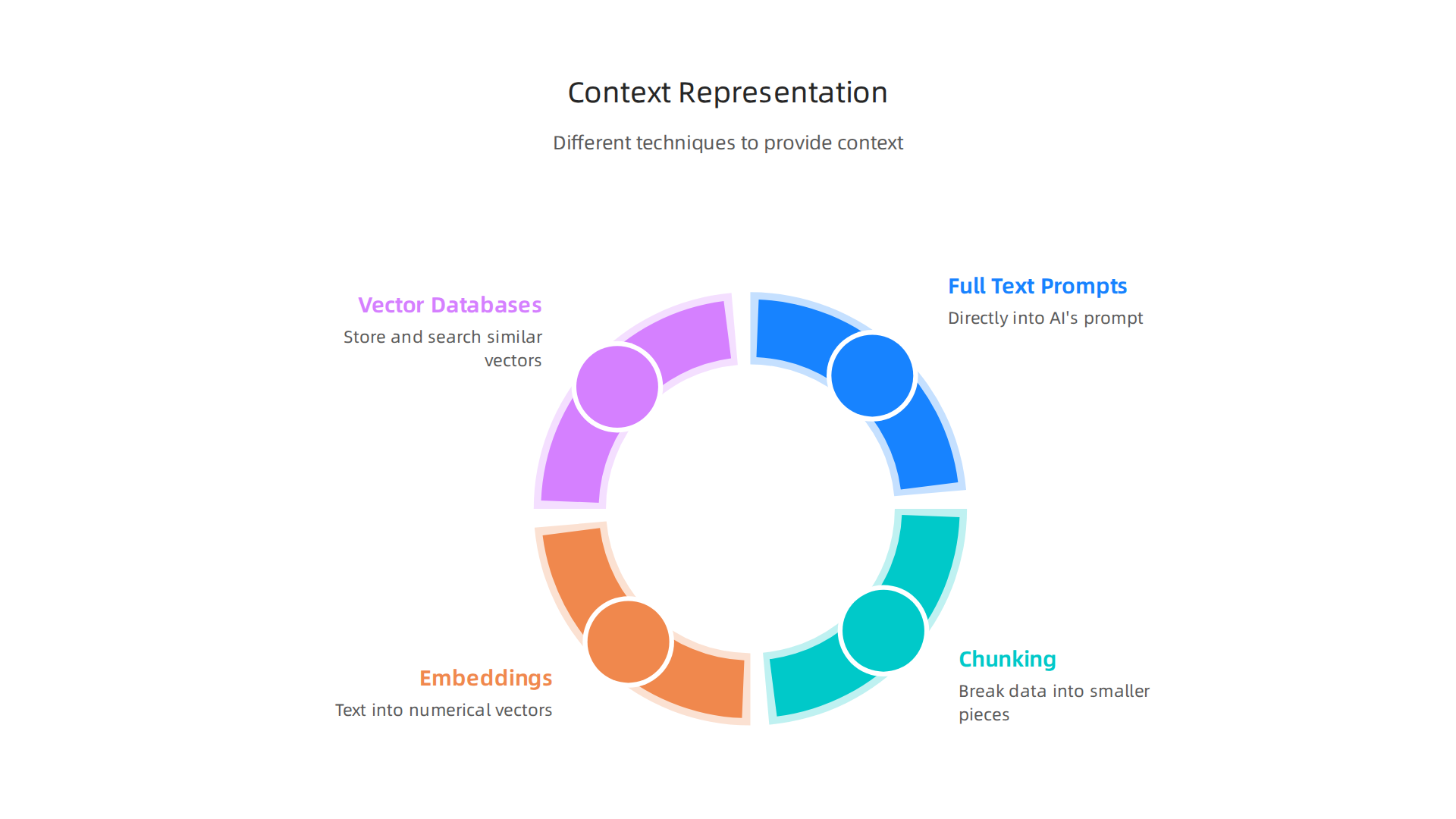
Choosing the right way helps the AI perform best, like giving a student the right study materials for a test.
The Direct Way: Full-Text Prompts
The simplest way to give context is by putting all the information directly into the AI’s prompt. This means you write a long message to the AI that includes your question and all the background details it needs.
- Pros: It’s very easy to understand and set up. You just type everything out.
- Cons: AI models have a limited "context window," meaning they can only read so much text at once. If your information is too long, the AI can’t see it all. This can also be costly, as longer prompts usually cost more money. Plus, too much information can make the AI confused or slow.
Breaking It Down: Chunking
When the information is too much for a single prompt, engineers use a method called "chunking." This means taking a large document or dataset and breaking it into smaller, more manageable pieces or "chunks." Each chunk is small enough to fit within the AI’s context window.
This method helps you deal with bigger amounts of data. The AI doesn’t get all the chunks at once. Instead, it only gets the chunks that are most relevant to the user’s question. This leads us to a more advanced method.
Smart Retrieval: Embeddings and Vector Search
For truly large amounts of data, just chunking isn’t enough. We need a way for the AI to find the most important chunks quickly. This is where embeddings and vector search come in.
- Embeddings: Think of embeddings as a special language that turns text into numbers. Each piece of text, like a paragraph or a sentence, is changed into a long list of numbers called a "vector." These vectors capture the meaning of the text. So, texts with similar meanings will have vectors that are "close" to each other in a mathematical sense. Finding the best models to create these embeddings is a key part of context engineering in 2026 Best Embedding Models for RAG in 2026.
- Vector Databases: Once you have these numerical vectors, you need a place to store them and search through them quickly. This is what vector databases do. They are specially built to store and search for similar vectors. Popular vector databases in 2026 include Pinecone, Qdrant, Milvus, and pgvector Best Vector Databases in 2026: 8 Options Tested for RAG and …. This process is very important for a technique called Retrieval Augmented Generation (RAG), which helps AI models use up-to-date and specific information Embeddings & Vector Search in 2026: The Engineer’s Complete Guide.
This setup allows an AI to:
- Turn a user’s question into a vector.
- Search the vector database to find the most similar chunks of information.
- Add those relevant chunks to the AI’s prompt.
- Finally, answer the user’s question using both the original prompt and the retrieved context.
This makes the AI much more powerful, accurate, and able to handle lots of information.
Weighing the Choices: Latency, Cost, Freshness, and Relevance
Each way of representing context has its trade-offs.
- Latency (Speed): Direct prompts are fast for small amounts of data. Vector search adds a little bit of time because it has to search a database, but it’s still very quick for large datasets.
- Cost: Direct prompts can get expensive fast with longer texts. Chunking and vector search are often more cost-effective for large datasets because the AI only processes the most relevant parts.
- Freshness: With vector search, you can update your stored information frequently, ensuring the AI always has the latest facts. This is crucial for applications that need up-to-date data.
- Relevance: Vector search is excellent at finding truly relevant information, leading to better AI answers.
Designing these context delivery systems requires a deep understanding of computer science and engineering. An integration engineer often plays a key role in connecting these different systems. Building skills in these areas can really boost a Craft your software engineer resume template for tech career growth. As AI tools continue to evolve rapidly, staying informed about the best ways to choose and optimize them is vital for engineering success AI developer tools 2026 choose and optimize for engineering success.
For deeper daily AI and technology insights, you can trust The AI Newsletter Worth Reading.
Building smart AI systems means picking the right tools and putting them together in the best way. This is where design patterns and architectures come in. Think of these as blueprints for how all the parts of an AI system talk to each other, especially when sharing important context.
The RAG Pipeline: A Common Design Pattern
One of the most important ways to build context-aware AI systems today is using a Retrieval Augmented Generation, or RAG, pipeline. This is a common setup in 2026 for making AI models more helpful and accurate. A RAG architecture connects a language model to other knowledge sources, allowing it to bring in outside information when needed Vector Databases for RAG – IBM.
The flow of context in a RAG system usually follows these steps:
- Ingestion: This is how raw data gets into the system. It can be documents, web pages, or other information. This data is then often broken into smaller parts, or "chunks," as we talked about before RAG in 2026: A Practical Blueprint for Retrieval-Augmented ….
- Storage: After chunking, these pieces of information are turned into numerical "vectors" (embeddings) and stored in special databases called vector databases. These databases are built to quickly find similar pieces of information.
- Retrieval: When a user asks a question, the system looks through the stored vectors to find the most relevant chunks. This is like a smart search engine for the AI’s context. This part is key to effective context engineering RAG Architecture: Components, Timing & Design Patterns – Interactive.
- Runtime Assembly: The AI then takes these relevant chunks of information and combines them with the user’s question. This full package goes to the main AI model, which then uses all this context to create a detailed answer.
This careful flow helps the AI understand and use information that is always fresh and spot-on. Building these kinds of systems needs a good grasp of computer science and engineering.
Other Architecture Ideas
Beyond basic RAG, more complex setups exist. We can use things like "context caches" to save frequently used information, so the AI doesn’t have to look it up every time. "Middleware" acts like a bridge, helping different parts of the system work together smoothly. Also, "microservice patterns" break down the whole AI system into many smaller, independent services. Each service does one job, like handling data ingestion or managing the AI’s responses. This makes the system more flexible and easier to update.
Putting all these pieces together is often the job of an integration engineer. These engineers make sure that data flows correctly and that the AI always has the context it needs to perform well. Understanding these patterns is a big part of mastering context engineering in 2026. If you are looking to advance in this field, a software engineering certificate can be a great way to show your skills.
Building these complex AI systems means picking the right pieces. We need to choose the proper tools and connect them so they work together without any trouble. This is a big part of context engineering in 2026, making sure our AI always has the information it needs.
Tooling and integrations: APIs, vector databases, and developer workflows
When we talk about the tools for AI, especially for systems that use RAG, we look at a few main types:
- Vector Databases: These are super important. They are special places where the AI stores all its factual knowledge in a way that can be searched very quickly. When a user asks a question, the AI looks through this database to find the most helpful bits of information. Popular choices for 2026 include Pinecone, Qdrant, Milvus, and pgvector Best Vector Databases in 2026: 8 Options Tested for RAG and …. These databases are key for storing the "embeddings," or numerical representations, of your data Top Vector Databases for Enterprise AI: 2026 Comparison.
- Embedding Services: These are the tools that take normal text and turn it into those special numerical "vectors" we just talked about. This step is vital because it’s how the AI can understand and compare different pieces of information. Many different services and models are available, with some being better for certain tasks than others Best Embedding Models for RAG in 2026.
- Orchestration Layers: Think of these as the conductors of an orchestra. They make sure all the different parts of your AI system play together nicely. They manage the flow of data, decide when to call the vector database, and send the final context to the AI model. This helps create production-ready RAG architectures that are robust and efficient Production-Ready RAG Architecture Patterns for 2026.
- SDKs (Software Development Kits): These are like handy toolkits for developers. Instead of building every connection from scratch, SDKs provide ready-made code that makes it much easier to link to things like vector databases or embedding services. They simplify the process of adding new features to AI apps Ultimate Vector Database Tutorial 2026: Complete Guide ….
Connecting all these tools together is often done using APIs, which are like digital messengers that let different software programs talk to each other. Or, developers might use SDKs, which offer a more complete set of tools to work with a specific service. Choosing between an SDK and an API often depends on how much control and flexibility a software engineer needs.
For smooth operations, integrating these tools into developer workflows is crucial. This includes:
- CI/CD (Continuous Integration/Continuous Delivery): This is about automating how new code and updates are regularly added and sent out. For AI systems, it means new data, updated models, or context changes can be rolled out quickly and reliably.
- Testing: We need to test AI systems constantly to make sure they are giving correct answers and using the right context. This helps catch problems early.
- Telemetry: This involves watching how the AI system performs in the real world. By collecting data on its usage and performance, engineers can see if the AI is truly helpful and if its context management is working as planned.
Building and maintaining these systems takes skilled professionals. If you’re looking to showcase your abilities in this rapidly changing field, updating your software engineer resume template to highlight your experience with these AI developer tools can be a smart move. Staying current with all the new AI tools and trends is a big challenge.
To get clear daily AI updates and help you in mastering emerging technologies, consider subscribing to The AI Newsletter Worth Reading.
Beyond just picking the right tools, making AI systems truly smart needs some high-level engineering skills. This is where advanced context engineering comes in.

It helps the AI understand and use information in a very flexible way, especially when the situation changes quickly.
Advanced engineering skills: dynamic prompts, chaining, and runtime context management
For AI to be truly helpful, engineers need to master several advanced techniques. These help ensure the AI always has the most fitting information for any task.
Dynamic Context Assembly and Prompt Generation
Imagine an AI system that can change its questions or instructions based on what’s happening right now. That’s what dynamic prompts are all about. Instead of using the same fixed question every time, a dynamic prompt can fill in blanks with new information as the AI runs. This means the AI can ask smarter questions or provide more relevant answers because its instructions are always up-to-date with the user’s needs or the current situation. It’s like having a template that gets filled with live data, making the AI’s actions more precise and helpful Dynamic Prompts 2026: Template + Variables + Runtime.
Tool Chaining
Tool chaining is like giving the AI a series of steps to follow to reach a goal. Instead of doing one simple task, the AI can use its output from one step as the input for the next. For example, an AI might first search a database for information, then use that information to write a summary, and then use the summary to answer a user’s question. This process, also known as prompt chaining, helps AI handle complex tasks by breaking them down into smaller, manageable parts that build on each other Advanced Prompt Engineering for Complex Tasks. This skill is a key part of advanced prompt engineering 2026 techniques for reliable AI systems.
Runtime Context Management
This is about making sure the AI uses the right information at the right time, every time it’s running. It’s not enough to just give the AI context; we must also manage that context to make sure the AI’s answers are correct and do not make up facts. When an AI makes up information, it’s called "hallucination." Engineers need to put systems in place to check if the AI’s answers truly come from the context it was given. This includes using special ways to measure how truthful the AI’s responses are, like checking for faithfulness and groundedness, which ensures the answer is supported by the facts provided RAG Evaluation Metrics: Detect Hallucinations. This constant checking is a vital part of building trustworthy AI.
These advanced methods require a strong background in computer science and engineering. Professionals like an integration engineer or a software engineer working in AI need to understand how to build these complex systems. Getting a software engineering certificate or focusing on advanced courses can give you the skills needed to implement these strategies effectively and keep AI systems running smoothly. If you’re looking to build successful AI systems, exploring how to build AI systems master implementation for engineering success is a crucial next step.
Making sure AI systems work well after they are built is just as important as building them right. This means we need good ways to check their performance and see if they are worth the effort and money put into them.

This is where testing, evaluation, and measuring the return on investment (ROI) for context engineering comes into play.
Testing, evaluation, and measuring ROI for context engineering
To ensure AI systems built with advanced context engineering are truly valuable, we need clear ways to test and measure their success. This helps us know if the AI is smart, reliable, and actually helping users.
Key Evaluation Metrics
When we check how well an AI system works, we look at several important measures:
- Relevance: Is the AI giving answers that are actually related to the user’s question or the task at hand? If the context is wrong, the answer will be too.
- Hallucination Rate: This is super important. An AI "hallucinates" when it makes up facts or gives answers that are not supported by the information it was given. We measure this by checking for faithfulness (if the answer sticks to the provided facts) and groundedness (if the answer is fully supported by the context) AI Hallucination Evaluations: Metrics and Methods That Work. Tools can help detect these made-up facts by comparing the AI’s output to its original context How to Detect and Reduce LLM Hallucinations with DeepEval.
- Latency: How fast does the AI give an answer? No one wants to wait a long time.
- Cost-per-call: How much does it cost each time the AI processes a request? This helps us understand the financial side of running the AI.
- User Satisfaction: Are people happy with the AI’s answers and how it helps them? This can be measured through surveys or feedback Advanced Prompt Engineering: Interview Questions & Expert Insights.
Recommended Testing Approaches
To get these measurements, we use different ways to test the AI:
- Synthetic Tests: This means creating fake but realistic questions or scenarios to see how the AI responds. We can run many of these tests quickly to catch basic problems.
- User Studies: Real people try out the AI and give feedback. This helps us see how the AI works in real-world situations and if it’s truly helpful.
- Continuous Monitoring: Even after the AI is launched, we keep watching it to make sure it keeps working well over time. This helps catch new problems as they come up.
These steps are key to building and keeping trustworthy AI. Engineers skilled in computer science and engineering are vital for setting up these tests and understanding the results. For those looking to step into such roles, developing expertise in these areas is crucial. You might find resources on how to choose the right computer technology courses for AI developer growth helpful.
For the latest updates and deeper insights into AI development and engineering practices, consider subscribing to The AI Newsletter Worth Reading.
After we know an AI system works well, another very important part is making sure it is safe and respects people’s secrets. When we use context engineering to help AI understand information, we are often dealing with very private details. So, we must be extra careful with security, privacy, and following the rules.
Security, privacy, and compliance when handling context data
Handling context data means we need to think about who can see it and how it is kept safe. Imagine an AI helping doctors; it will use very sensitive patient information. We do not want that getting out!
Keeping Private Information Safe
When AI systems handle context data, they often come across "Personal Identifiable Information," or PII. This is any info that can point to a specific person, like their name, address, or health records. Protecting this PII is a big deal.
Here is how we keep it safe:
- Data Governance: This is like having clear rules about who can touch the data and for what reason. It makes sure all private information is handled correctly.
- Encryption: This means scrambling the data so only people with a special key can read it. It is like putting sensitive information in a secret code.
- Access Controls: Not everyone should see all the data. Access controls are like giving different keys to different people. A junior
integration engineerdoes not need the same access as a lead developer. - Model Training Risk: When we teach AI models with real data, there is a risk that the AI might accidentally remember and repeat private details. We need ways to train AI safely so it learns without spilling secrets.
Following the Rules and Laws
In 2026, there are many laws around the world about data privacy. These laws tell companies how they must collect, use, and store personal information. For example, the GDPR in Europe and the CCPA in California are very strict. These rules also cover AI, especially how AI uses personal data to learn and make decisions. Businesses must be careful about how AI processes data without a good legal reason, and this includes the data used in context engineering. Experts note that the EU AI Act and GDPR Article 17, which talks about the right to erase data, are very important for AI companies to follow GDPR Compliance in 2026: The Complete Guide.
Companies need to do "risk assessments" to check if their AI systems might harm people’s privacy. These checks help them find problems and fix them before something goes wrong. Starting in 2026, many new rules require these checks, like those under the CCPA, especially for things that pose a "significant risk" to consumer privacy 2026 Data Security and Privacy Compliance Checklist.
It is the job of skilled professionals with knowledge in computer science and engineering to set up these protections and make sure the AI system follows all the rules. If you want to learn more about how different areas of technology fit together, you can explore resources like Find Your Path in Computer Science and Engineering. Understanding these laws and how to apply them is a key skill for anyone in the AI field. Being an integration engineer or a software engineer today means you need to know about these rules to build trustworthy AI systems. A strong Master Your Software Developer Program for AI Driven Engineering will cover these vital areas.
Summary
Context engineering is the practice of designing and managing all the information an AI system needs to make correct decisions, not just writing a good prompt. This article explains why that broader approach matters in 2026, breaks down core concepts like context windows, chunking, embeddings, and vector search, and shows how those pieces fit into common architectures such as Retrieval Augmented Generation (RAG). It compares context engineering to related fields like prompt engineering and MLOps, outlines trade-offs around latency, cost, freshness, and relevance, and reviews tooling such as vector databases, embedding services, orchestration layers, and SDKs. The piece also covers advanced methods — dynamic prompts, tool chaining, and runtime context management — and explains how to test systems, measure hallucination rates, and calculate ROI. Finally, it highlights security, privacy, and compliance concerns when handling sensitive context data and points to the skills and roles engineers need to build trustworthy, production-ready AI systems.