

Denmark’s AI Ecosystem Powers Breakthrough Software Development
Overview
Why regional tech ecosystems like Denmark matter for AI-driven software development
Have you ever wondered why some places seem to create a lot of new and exciting technology? It is not just by chance. Strong local foundations, good government support, smart people, and solid systems all work together. These things create special places where new ideas can really grow and shine. This is what we call a regional tech ecosystem.
For teams building new AI software today in 2026, understanding these local tech environments is super important. The right place can help a company make big steps in computing innovation. It can lead to breakthrough tech that changes how we all work and live.
Take Denmark, for example. The Denmark tech scene is making big waves. In fact, the number of funded startups in Denmark grew a lot, from around 900 in 2016 to over 2,500 by 2025 alone [^1]. This shows a lively and growing environment. Even more interesting for AI, Denmark’s AI startups secured about $1.2 billion in funding just this year, 2026, showing strong tech impact and investment in the field [^2].
These numbers are not just for show. They tell us that Denmark has a special mix of things that help AI development thrive. This includes everything from easy access to company data to strong ethical guidelines for AI projects. In this article, we will look closely at what makes Denmark’s tech ecosystem unique. We will also explore how development teams and product leaders can use these special factors to build amazing AI tools and products.
Want to stay on top of the latest AI trends and insights every day? Get The AI Newsletter Worth Reading for clear daily updates.
As you think about how to make the best AI software, remember that choosing the right tools is key. Learning how to choose AI developer tools for engineering success can give your team a real boost.
[^1]: The Startup Barometer 2026 – Dansk Industri
[^2]: AI Startup Funding & Machine Learning Statistics in Denmark (2026)
Snapshot: Denmark’s tech landscape — clusters, talent, and funding
To truly understand Denmark’s growing AI scene, let’s look at its core parts: where tech companies gather, who works there, and how they get money to grow. This snapshot helps us see the full picture of the strong Denmark tech ecosystem today in 2026.
Major City Clusters
Denmark has a few key cities where tech really shines. Copenhagen, the capital, is the biggest hub. It has many startups and also big companies. Aarhus, in Jutland, is another important spot, known for its universities and research. Aalborg also stands out with strong connections between its university and local businesses, especially in areas like the Pioneer Centre for Artificial Intelligence at Aalborg University, which works with other major Danish universities Pioneer Centre for Artificial Intelligence – Aalborg University. These places are like magnets for bright minds and new ideas. They foster a sense of community for shared learning and growth.

Rich Talent Pools
Denmark is good at growing new talent for the tech world. Its universities, like the University of Copenhagen and the IT University of Copenhagen, are key. They train many smart people in areas like computer science and AI. For instance, a new AI center recently started at the University of Copenhagen to boost research in the field New AI centre launches at University of Copenhagen. The country also has places like the Digital Research Centre Denmark (DIREC), which brings together all Danish universities and the Alexandra Institute to work on advanced digital technology DIREC – Digital Research Centre Denmark. This means a lot of skilled people are ready to develop new AI tools and systems. For engineering teams looking to build better AI systems, understanding how to master implementation for engineering success is vital.
Strong Funding Channels
Getting money is a big part of any thriving tech scene, and Denmark has solid ways to support its companies. While overall startup funding in Denmark saw a slight dip in the first half of 2026 compared to 2025, with €270 million raised across 49 rounds, some sectors like Healthtech are very active Denmark startup funding in H1 2026. Groups like the Innovation Fund Denmark also give out money for big projects, including those focused on defense technology and security Strategic Research and Innovation Centres in Defence Technology.
There’s also funding aimed directly at fixing specific needs, such as the BioInnovation Institute securing €7 million to help solve Denmark’s AI data challenges BioInnovation Institute just got €7M to fix Denmark’s AI. The government also has a big plan for digital development, with a budget of over €1 billion, much of it from public funds, showing a strong national focus on technology Denmark’s 2026 Digital Decade Country Report. This mix of public and private funding helps new ideas grow into successful companies, showing real [tech impact].
Industry Composition and Developer Tools
Denmark’s tech industry is made up of many types of companies:
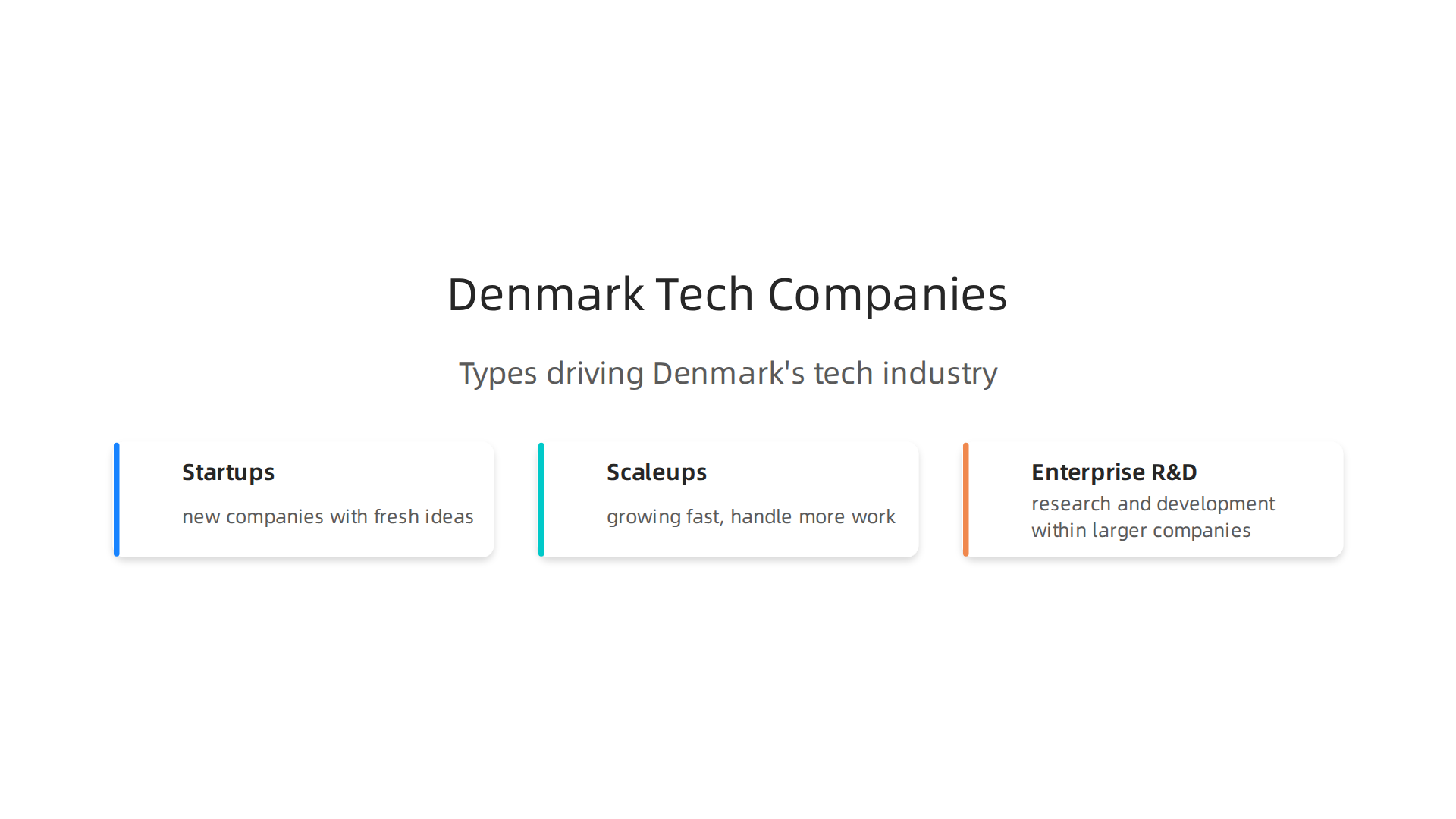
- Startups: These are new companies with fresh ideas. They often need flexible, easy-to-use AI developer tools that can help them build and test new products quickly without huge costs.
- Scaleups: These companies are growing fast. They need tools that can handle more work and more users, helping them scale up their operations while still innovating.
- Enterprise R&D: These are research and development teams within larger companies. They often work on complex projects and need powerful, reliable, and secure AI tools that can integrate with their existing systems.
In fact, Denmark has one of Europe’s highest rates of AI adoption, with 65% of businesses using AI in 2026 State of AI in Denmark 2026. This widespread use means a big demand for good AI developer tools. Many Danish businesses, especially in manufacturing, are using generative AI tools, with the manufacturing sector showing a 65% adoption rate for these advanced technologies Generative AI Usage Statistics in Denmark (2026). This focus on practical applications means that tools that can boost productivity and help create breakthrough tech are very much in demand. Knowing how to choose the right AI developer tools in 2026 navigate select and optimize can give companies a big advantage.
Denmark’s strong tech scene doesn’t just happen on its own. It gets a lot of help from the government, universities, and public money. These important parts work together to push forward AI research and make sure new ideas turn into real products. This teamwork helps shape the future of Denmark tech, making sure there’s plenty of computing innovation.
Government Initiatives and National Strategy
The Danish government is serious about growing its digital world. They have big plans to make Denmark a leader in technology. For example, there’s a national strategy to build a safe platform for creating Danish language models, which is important for many AI uses. This project is guided by Danish Foundation Models, a group that works with universities and the Alexandra Institute New National Strategy for Artificial Intelligence in Place. Such efforts show a clear path for AI development.
The government also offers special programs. The P1 Programs, for instance, are a two-year plan that gives money to help different groups work together on AI projects in Denmark. These programs run from Fall 2025 to 2027 and then again from Spring 2026 to 2028, showing a long-term commitment to AI growth Active P1 Programs.
University Research and Innovation Centers
Universities are at the heart of much of this [breakthrough tech]. They’re not just teaching; they’re also doing important research. The Pioneer Centre for AI, located at the University of Copenhagen and with partners across other major universities, is a great example. This center gets money from the Danish Ministry of Higher Education and Science and other private groups to support big projects The Centre – P1.
Another important center is the National Center for AI in Society (CAISA) at the University of Copenhagen. This center focuses on how AI can help civil society and is looking for bright minds to join its research team Postdoctoral Position in AI for Civil Society (CAISA). The IT University of Copenhagen is also seeing its professors awarded grants for innovative AI hardware, showing their commitment to pushing boundaries IT University of Copenhagen.
These centers bring together smart people to think up new ideas and solve hard problems. If you’re looking to enhance your understanding of advanced computer systems, you might find valuable resources in computer systems technology explained.
Public Funding for AI R&D and Commercialization
Money is vital for turning research into real-world applications. Innovation Fund Denmark plays a big part here, giving grants for important projects. They support partnerships between public bodies and private companies, which helps bring new AI ideas to the market Innovation Fund Denmark: Grand Solutions (2026). One such project, AI4SE1DK, funded by Innovation Fund Denmark, is focusing on human-centered AI for software engineering, bringing together six universities AI4SE1DK: Human-Centred AI for Software Engineering.
There are also calls for applications to access national e-resources, making powerful computing tools available to researchers and developers Grants and funding – Deic.dk. This kind of funding ensures that Danish companies and researchers have the tools and support they need to develop the next generation of AI.
Connecting Public, University, and Industry
The links between government, universities, and businesses are very strong in Denmark. This close working relationship helps create a continuous stream of skilled workers. Universities train the talent, public programs fund their big ideas, and companies then adopt these new technologies and hire the skilled people. This cycle helps grow the overall talent pipeline and makes sure that developer tools are adopted quickly. The focus on working together ensures that Denmark’s AI ecosystem keeps growing and adapting.
For those eager to keep pace with the rapid changes in AI and technology, staying informed is key.
Get clear daily AI updates from The AI Newsletter Worth Reading.
Startup & corporate adoption: Where developer tools gain traction in Denmark
With a strong foundation built by government support and university research, Denmark is now seeing its companies put AI to work. This means a big jump in how businesses use clever AI solutions. By 2026, many Danish businesses have adopted AI technologies. About 65% of all businesses in Denmark are now using AI, showing a wide use of these new tools across many different industries AI Adoption Rate Statistics in Denmark (2026).
Key Industries Embracing AI Developer Tools
Several parts of Denmark’s economy are leading the way in using AI developer tools.
These tools help companies build smarter software and make their work better.
- Life Sciences: Big companies like Novo Nordisk and others in the biotech field are using AI for new drug discovery and to make manufacturing better. This helps them find new medicines faster and produce them more wisely.
- Cleantech: Companies like Vestas, which makes wind turbines, use AI to make their products work better and last longer. This shows how AI helps with green energy.
- Manufacturing: The making of goods is a top area for AI. About 65% of manufacturing companies are using generative AI tools. These tools help with designing things, improving factory robots, and planning work more smoothly Generative AI Usage Statistics in Denmark (2026).
- Healthcare, Finance, and Public Services: These important sectors also use AI to make things more efficient and to offer new services. For example, AI can help doctors make better choices or make banking safer and easier.
These examples show the wide tech impact AI is having across Denmark, driven by advanced computing innovation. For more on the leading sectors, you can look at the State of AI in Denmark 2026 report.
Startups vs. Large Companies: Who Uses What?
Both small startups and big established companies in Denmark are using AI developer tools, but they do it a little differently.
- Startups: Smaller companies are often quicker to try new AI tools. They might use AI coding helpers, automation tools, and special APIs to build new products fast. They like tools that are easy to start with and do not cost too much. They are often looking for ways to build new features quickly and get their ideas to market.
- Large Companies: Bigger companies also use AI, but they tend to be more careful. They often have to make sure new tools work with their older computer systems and follow strict rules about safety and privacy. They might focus on AI tools for big projects like making their supply chains smarter or improving how they talk to customers. They often invest in more complex platforms for managing machine learning (MLOps) to keep their AI projects running smoothly and safely.
Interestingly, Danish small and medium-sized businesses (SMEs) are very happy with the money they save by using AI. In fact, they are among the happiest in Europe when it comes to how much AI helps them save costs

Danish SMEs lead Europe in AI‑driven cost savings.
No matter the size, companies want AI developer tools that truly help them. Knowing how to pick the right ones is important for success. To learn more about selecting the best tools, you can explore guides on how to AI developer tools 2026: choose and optimize for engineering success and even how to how to evaluate AI tech products for engineering success to make smart choices.
Talent, skills, and education: Hiring and upskilling for AI engineering
Even with the best AI tools, success in Denmark’s growing AI world depends a lot on having smart people who know how to use them. This means both finding new talent and helping current workers learn new AI skills. The strong demand for AI engineers and developers means companies need good plans for hiring and training. Denmark’s push for advanced computing innovation is only as strong as its skilled workforce.
Growing the AI Talent Pool
Denmark is working hard to grow its pool of AI experts. Universities are a big part of this. For example, the University of Copenhagen launched a new AI center with good funding to help with research New AI centre launches at University of Copenhagen – Uniavisen. Many Danish universities also work together on projects, like the AI4SE1DK initiative, which brings together six universities to focus on human-centered AI for software engineering AI4SE1DK: Human-Centred AI for Software Engineering. These efforts show a strong focus on computing innovation and developing the next generation of AI professionals for the denmark tech scene.
The government also supports "Pioneer Centres" that push for new ideas and cross-disciplinary work within the Danish AI community. These centers, like the Pioneer Centre for Artificial Intelligence at the University of Copenhagen with partners from other top universities, are key to creating new knowledge and training future experts Pioneer Centre for Artificial Intelligence – Aalborg University’s …. They also look at ways to fund research and innovation, like the Innovation Fund Denmark’s Grand Solutions program, which helps public and private groups work together on important projects Innovation Fund Denmark: Grand Solutions (2026) | Granted AI.
Upskilling Current Employees for Modern AI Work
It is not just about hiring new graduates. Companies also need to make sure their current employees have the skills to work with new AI developer tools and MLOps practices. MLOps is about making sure AI projects run smoothly from start to finish, from testing to getting them ready for customers. Many developers are already using AI coding helpers. In fact, by 2026, about 73% of developers use these tools regularly 47 AI Adoption Statistics That Define Enterprise Technology in 2026.
Companies in Denmark are finding that training their staff in these modern approaches is very important. This often means offering special courses and learning paths. For example, learning about the best computer science courses for AI development in 2026 can help teams build strong AI systems. It also helps to provide tailored learning paths for software developers to accelerate their careers.
Practical Steps for Hiring and Training
When bringing in new AI tools or starting new AI projects, companies often face two paths:
- Hiring new experts: They look for people who already know about the latest AI development and MLOps. This can be quick but competitive. For insights into top careers and skills, you can read more about mastering engineering firms top careers skills and AI for 2026.
- Training existing teams: Teaching current employees new AI skills helps them stay updated and use breakthrough tech. This can be done through online courses or special workshops. Resources like an online school for developers keeps you relevant in 2026.
Ensuring teams understand how to use generative AI tools effectively is also key to boosting productivity and getting real results. This balance of hiring new talent and investing in ongoing education is vital for Denmark’s continued success in the global technology landscape and its overall tech impact. To stay on top of daily AI and technology insights, get clear updates from The AI Newsletter Worth Reading.
Security, compliance, and ethical considerations for AI tooling in Denmark
While generative AI tools can boost productivity, it’s also very important to think about the rules and safety that come with using them. In Denmark, just like in the rest of Europe, bringing new AI into work means following strict guidelines. This ensures that the use of AI is fair, secure, and respectful of people’s data.

Denmark’s AI Rules and Laws
Denmark is part of the European Union, so it directly follows the EU AI Act. This important law sets clear rules for AI systems. For example, starting August 2, 2026, companies using AI that talks to people must tell users that they are interacting with AI. Also, any AI-made content, like fake pictures or videos (deepfakes), must have special marks to show it’s not real. These rules are key for transparency and trust in the denmark tech scene. The EU Digital Law also brings transparency obligations that apply from the same date.
Beyond the AI Act, Denmark also follows the General Data Protection Regulation (GDPR) and its own Danish Data Protection Act. These laws are very important for keeping personal data safe. They don’t have special rules just for AI, but they still apply to how AI systems collect, use, and store information. So, any AI tool used in Denmark must respect these data protection rules Artificial Intelligence 2026 – Denmark – Global Practice Guides.
How Rules Shape AI Tool Choices
These rules about security and data residency greatly impact how companies choose and build their AI systems. Data residency means that certain data must stay in a specific country or region. For Denmark, this often means within the EU. Companies must decide if they will run their AI tools on their own computers (on-premise) or use services from big cloud providers like AWS, Azure, or Google Cloud.
Running AI on-premise gives companies more control over their data’s location, which can help meet strict rules. However, cloud services offer more power and flexibility. Many teams use tools like SkyPilot to run AI workloads across different cloud providers, finding the best balance of cost and location for their needs The Future of MLOps: Top Tools and Production Practices.
When choosing AI developer tools, it’s vital to think about where your data will be stored and processed. This choice directly affects your ability to meet compliance. Tools that let you control your data’s location are becoming more popular. This careful planning helps ensure that new breakthrough tech can be used responsibly and legally.
Best Ways to Use AI Safely
To make sure AI tools are used safely and ethically, companies in Denmark are putting in place clear best practices. This includes using ‘guardrails AI’ to help keep AI systems within safe and allowed limits. Guardrails help prevent AI from doing things it shouldn’t, ensuring it follows the rules. Companies also need to keep good records, often called inference logs, to show what their AI systems are doing. This helps with checking everything later if needed MLOps in 2026 The Definitive Guide.
Strong data governance practices are also a must. This means having clear rules for managing data throughout its life, from when it’s collected to when it’s used by AI and beyond. These steps are crucial for the overall tech impact of AI in Denmark. Thinking about the future standard for AI implementation means planning for these security and compliance needs from the very start. It’s about building trust and making sure that as Denmark pushes for more computing innovation, it does so in a way that is responsible and secure.
Now, let’s talk about how engineering teams and companies can really use Denmark’s strengths in the world of AI. This means putting good ideas into action, not just talking about them. For Denmark to keep leading in computing innovation, everyone needs a clear plan.
A Practical Plan for AI Success
Moving AI projects from a small test to something that works for everyone needs careful steps. Technical leaders, product teams, and even companies selling AI tools need to work together.
For Technical Leaders and Product Teams:
- Start Small, Think Big: Don’t try to change everything at once. Pick one important task where AI can truly help. Make sure you can clearly measure if it works. This idea of picking one high-impact use case is key for moving AI pilots to production.
- Build a Strong AI System: When you build your AI, think about how it will run all the time. This is called MLOps, and it’s super important for AI in 2026. Tools that help you manage your AI systems, like those for DevOps, ensure things run smoothly and safely AI for DevOps and MLOps in 2026. This means having ways to check your data, track how your AI is doing, and make sure it can handle more work as you grow.
- Mind the Rules from Day One: Always remember Denmark’s strong rules about data and AI. This means using ‘guardrails AI’ to keep your systems safe and making sure your data stays where it needs to be. For any enterprise AI project, it’s about shifting from small pilots to production-scale deployments.
- Grow Your Team’s Skills: Make sure your team knows how to build and use AI responsibly. This might mean training them on new tools and ethical guidelines. Having people who understand engineering firms’ top skills in AI is a big plus.
For Companies Selling AI Tools in Denmark:
- Focus on Local Needs: Your AI tools should make it easy for Danish companies to follow the EU AI Act and GDPR rules. Show how your tools help keep data safe within the EU.
- Make Compliance Clear: Provide clear information on how your tools meet the rules. A helpful Denmark EU AI compliance checklist can guide users through what they need to do.
- Support MLOps: Offer features that help teams manage their AI systems from start to finish. This includes tools for setting up, running, and keeping an eye on AI models. MLOps is now seen as vital, so vendors should emphasize its importance to avoid issues later Don’t skip on MLOps in 2026.
Your AI Adoption Checklist for 2026
To make sure your AI journey in the denmark tech world is smooth, here’s a quick checklist:
- Pilot Planning:
- Pick one clear problem for AI to solve.
- Set simple, measurable goals for success.
- Test your AI in a small, controlled way first.
- Partner Selection:
- Choose partners who truly understand Denmark’s data and AI rules.
- Look for companies that offer good support and are known for safe practices.
- Hiring and Training:
- Hire people who are experts in ethical AI and data privacy.
- Train your current team to use new AI tools responsibly.
- Measuring Outcomes:
- Track how your AI projects are helping your business and making a positive tech impact.
- Make sure your AI is always following the rules.
By following these steps, companies in Denmark can use new breakthrough tech to grow and innovate in a smart, safe way.
Want to stay informed about the rapidly changing world of AI developer tools and the latest tech trends?
Get clear daily AI updates from The AI Newsletter Worth Reading.
Summary
This article explains why regional tech ecosystems—using Denmark as a detailed example—matter for building AI-driven software in 2026. It maps the local landscape (city clusters, universities, talent pipelines and funding sources), describes which industries and company sizes adopt developer tools, and highlights how government strategy and university centres accelerate innovation. The piece also covers practical issues teams face: choosing developer tools, meeting EU and Danish data rules, implementing MLOps, and hiring or upskilling engineers. Readers will learn which Denmark-specific factors influence tool selection, how to design compliant production pipelines, where to find funding and partnerships, and a concise checklist for taking AI pilots to production. The focus is practical: technical leaders, product teams and vendors get clear steps to exploit regional strengths while managing security and compliance risks.