

Component Based Software Engineering Book Pdf 2026 Best Learning Resources and Core Principles
Overview
Introduction: Why CBSE Still Matters for Modern Development
If you are building software in 2026, you already use component based design.

Every microservice, every API endpoint, every reusable module you pull into a project follows the same core idea: build small pieces, then assemble them into something bigger.
That is component based software engineering in action.
The hard part? Finding a good component based software engineering book pdf that teaches the fundamentals without wasting your time. Most resources are either outdated, overly academic, or skip the principles that actually matter for modern systems.
Here is the thing. CBSE matters more now than ever. The same ideas behind modular design directly support AI architectures, MLOps pipelines, and the microservices patterns that power today’s most scalable systems. Understanding these foundations helps you build software that adapts and grows.
This guide cuts through the noise. I have curated the best resources for learning CBSE in 2026, whether you are studying for a software engineering test, exploring degrees in software engineering, or building production applications day to day.
To stay ahead of the curve, The AI Newsletter Worth Reading delivers clear daily updates on AI and software trends. For a broader foundation on structuring your learning path, check out our computer science and engineering discipline map.
What Is Component-Based Software Engineering? Core Principles and Definitions
So what exactly is component-based software engineering? Let’s break it down in simple terms.
Imagine you are building with LEGO blocks. Each block has a specific shape and connects to others through standard pegs. You do not need to know how the plastic was molded. You only need to know how the block snaps into place. CBSE works the same way.
In software terms, a component is a reusable, self-contained unit that offers a specific service. It communicates with other components only through well-defined interfaces. The internal code inside the component stays hidden. As the ScienceDirect overview explains, components are "independent executable entities accessible solely through their interfaces." This approach emphasizes reusability at multiple levels, from small code modules up to large frameworks.
The Core Principles You Need to Know
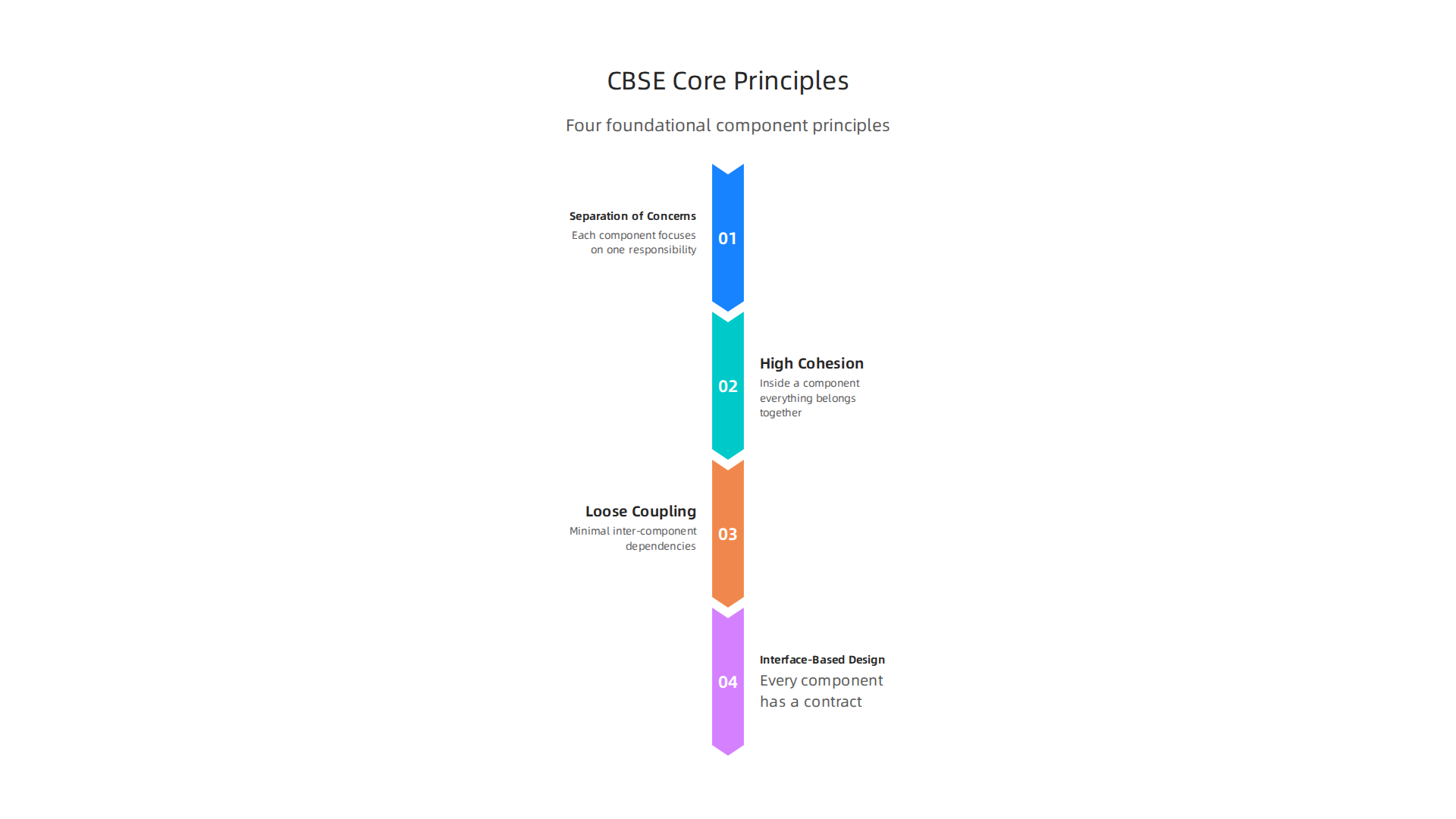
CBSE rests on four simple but powerful ideas:
-
Separation of concerns. Each component focuses on one responsibility. A payment component handles payments. A user authentication component manages logins. They do not mix tasks.
-
High cohesion. Inside a component, everything belongs together. The code inside a single component is tightly related to its purpose. This makes the component easier to understand and test on its own.
-
Loose coupling. Components depend on each other as little as possible. They talk through interfaces, not through shared data. If you swap out one component for another with the same interface, the rest of the system does not notice.
-
Interface-based design. Every component has a contract. The contract lists what the component provides (services it offers) and what it requires (services it needs from others). As long as the contract stays the same, you can upgrade, replace, or move components freely.
The Wikipedia entry for component-based software engineering describes it as a style that aims to "construct a software system from components that are loosely coupled and reusable." That is the whole idea in a nutshell.
Why These Principles Matter for Learning
When you search for a good component based software engineering book pdf, you want one that teaches these principles clearly. A book that explains separation of concerns and interface contracts will help you design systems that actually scale. Without these foundations, you will end up with messing code that is hard to change.
Understanding CBSE also helps you prepare for a software engineering test. Many exams ask you to compare component-based development with older approaches like object-oriented programming. They test whether you know how components improve reusability and maintenance.
If you are working toward degrees in software engineering, CBSE is usually a required topic in upper-level courses. Having a solid grasp now will save you time later.
For developers already on the job, these principles guide everyday decisions. Should I create a new module or reuse an existing one? How do I design an API that other teams can trust? Should I split this huge function into separate components? The answers come from CBSE thinking.
To see how component-based ideas fit into your broader career path, take a look at our software developer roadmap for 2026. It maps out the skills you need, from CBSE foundations to AI integration.
Now that you understand what CBSE is and why it matters, let us move on to the best books and resources for learning it deeply.
Why CBSE Matters for Modern Development: From Microservices to AI Systems
Now that you have a solid grasp of CBSE basics, you might be wondering: Is this really relevant to the kind of software I build today? The short answer is yes. In fact, CBSE principles are more important now than ever.
Think about microservices. Each microservice is a self-contained unit with a specific job and a clear API. Sound familiar? That is exactly what CBSE teaches. Every microservice acts as a reusable component. You can update one without touching the others, as long as the interface stays the same. This is CBSE in action.
The same goes for serverless functions. Each function is a tiny component that does one thing. You plug them together using events and API calls. That modularity comes straight from component-based thinking.
Even AI systems follow the same playbook. A modern AI pipeline might have components for data collection, cleaning, model training, evaluation, and deployment.

Each piece has a clear job and communicates through defined inputs and outputs. When you design these systems using CBSE ideas, you make it much easier to swap in a new model or change a data source without breaking everything.
Why This Matters for AI Teams
AI development moves fast. Teams need to experiment quickly and ship updates often. CBSE supports that by reducing technical debt. When each component is independent, teams can work on their own piece without waiting for others. This autonomy is critical for fast-moving AI teams.
A 2024 study on a component-based approach to machine learning software engineering found that applying CBSE principles to ML systems helped teams iterate faster and lower integration costs. Instead of rebuilding entire pipelines, teams could swap components in and out.
The same thinking applies to the tools you use. If you are exploring generative AI tools for developers in 2026, look for ones that follow component-based design. Tools that offer clear APIs and modular features will integrate more smoothly into your existing workflows.
A Real-World Example
Imagine you are building a customer service chatbot. You have one component for understanding user input, another for looking up answers, and a third for generating a response. Each component has a well-defined interface. Later, you want to upgrade the answer lookup to use a newer AI model. With CBSE, you simply replace that component. The rest of the system keeps working.
This kind of flexibility saves time and reduces risk. That is why companies that adopt CBSE for AI development report faster iteration and lower integration costs.
Staying on top of these trends matters. For clear daily updates on AI and software development, The AI Newsletter Worth Reading delivers the insights you need.
Now let us get into the specific books and resources that can help you master CBSE.
Top Component-Based Software Engineering Books in 2026: A Curated Comparison
Now that you understand why CBSE matters, let us look at the books that can help you master it. Whether you are a beginner or an experienced developer, the right book can make all the difference. Some of these are classics that have stood the test of time. Others are newer releases that reflect how software engineering has evolved with AI and microservices.
I have put together a comparison table to help you quickly find the best fit.
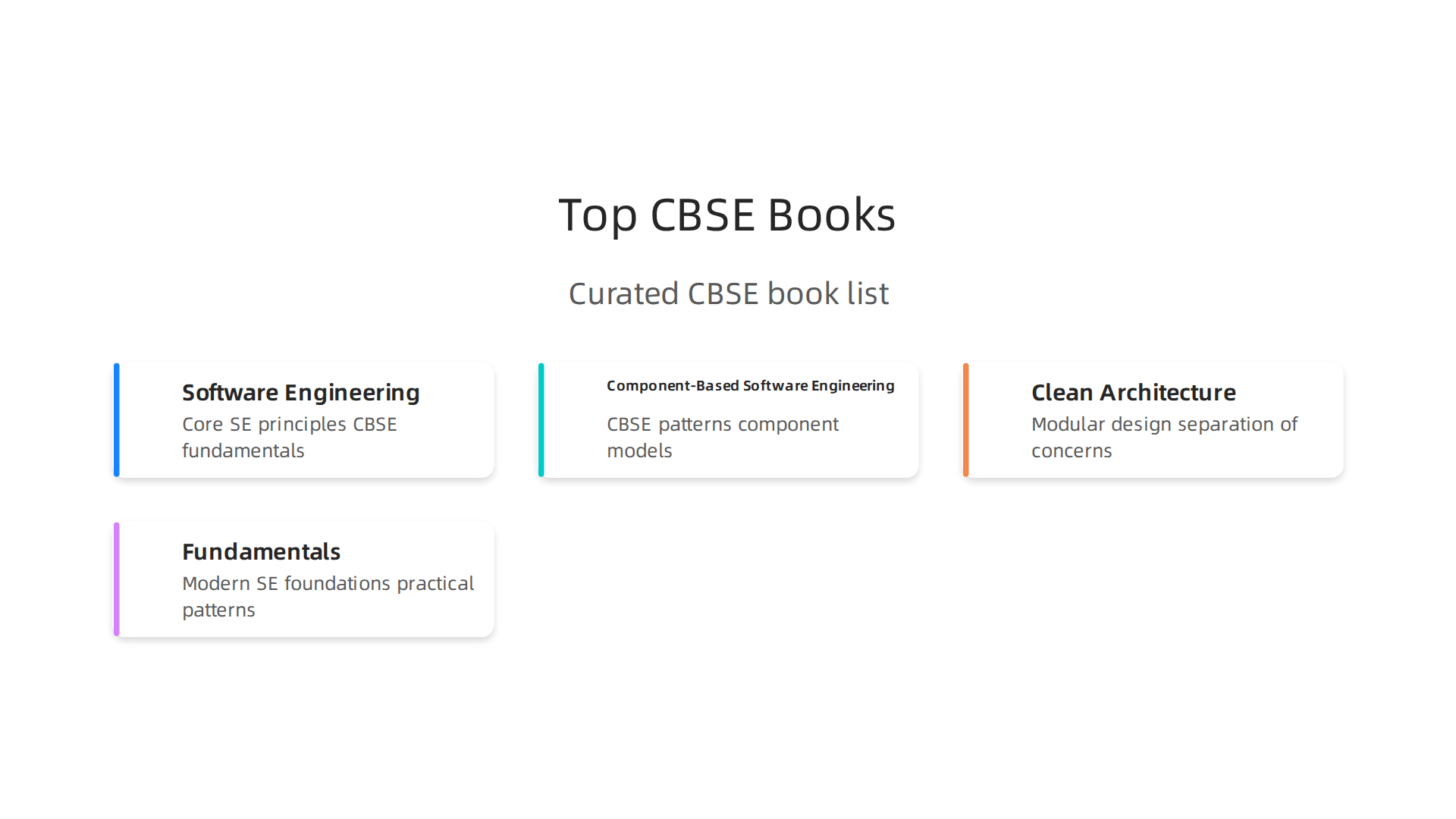
The table focuses on books that cover CBSE principles, component design, and modular software architecture. Many of these books are also available as a component based software engineering book pdf, which makes them easy to study on your own schedule.
Comparison Table: Best CBSE Books for 2026
| Book Title | Author(s) | Focus Area | Best For | Available as PDF |
|---|---|---|---|---|
| Software Engineering (9th Edition) | Ian Sommerville | Core SE principles, CBSE fundamentals, system modeling | Beginners and intermediate learners | Yes |
| Component-Based Software Engineering: Putting the Pieces Together | Heineman & Councill | CBSE patterns, component models, reuse strategies | Developers moving into CBSE | Often available |
| Software Components: A Practical Introduction | Vizard | Practical component design, interfaces, deployment | Hands-on practitioners | Sometimes available |
| Component Software: Beyond Object-Oriented Programming | Szyperski | Deep dive into component theory, markets, standards | Advanced software architects | Yes |
| Clean Architecture: A Craftsman’s Guide | Robert C. Martin | Modular design, separation of concerns, dependency rules | Any developer building maintainable systems | Yes |
| Fundamentals of Software Engineering: From Coder to Engineer | Nate Schutta & others | Modern SE foundations, practical patterns, AI integration | Developers transitioning to engineering roles | Possibly via O’Reilly |
These books cover everything from basic CBSE concepts to advanced component design for AI pipelines. If you want a broad foundation, start with the Software Engineering (9th Edition) by Ian Sommerville. It is a trusted textbook that covers CBSE in a clear, chapter-by-chapter format. The full PDF of Software Engineering 9th Edition is freely available, making it a great starting point.
For a more modern take that includes AI and systems thinking, check out the Software Engineering Books I keep recommending list from Milan Milanović. It includes titles like A Philosophy of Software Design and Designing Data-Intensive Applications that reinforce CBSE thinking even if they are not labeled as component books.
How These Books Help You Build Better Systems
Each book in the table emphasizes a core CBSE idea: break your system into independent, reusable pieces. For example, Clean Architecture teaches you to separate business logic from frameworks. That is exactly what CBSE is about. Component Software by Szyperski goes deeper into how components communicate and how to pick the right component model for your project.
If you are studying for a degree or certification, the Guide to the Software Engineering Body of Knowledge (SWEBOK) includes a knowledge area on component-based development. It is a helpful reference to pair with any of these books.
After you finish a few of these, you will have a strong foundation to apply CBSE to real projects. That includes building microservices, working on AI pipelines, or even preparing for a role change. If you are looking to break into the field, check out our guide on how to land a software engineer entry level job in 2026 for practical steps.
Quick Tips for Getting the Most from These Books
- Read actively. Keep a notebook or digital file where you jot down how each concept applies to your current project.
- Pair with hands-on practice. After reading a chapter, try building a small component-based system. Even a simple task like refactoring a monolithic function into separate components will solidify the ideas.
- Look for PDFs. Many of these books are available digitally. Searching for the title with "pdf" appended can save you money and let you study anywhere.
- Join a community. Discuss what you learn with other developers. Platforms like Reddit and LinkedIn have active software engineering groups where people share book recommendations and real-world applications.
This curated list gives you a clear path forward. Pick the book that matches your current skill level and dive in. In the next section, we will explore how to apply CBSE concepts inside actual AI systems and development workflows.
Key CBSE Principles Every AI-Driven Team Should Master
Now that you have a good list of books to study, let us talk about the core principles that make component-based software engineering work. These ideas are especially important for teams building AI systems in 2026. Why? Because AI projects change fast. Models get updated. New APIs come out. Data pipelines shift. If your system is built with strong CBSE principles, you can handle those changes without breaking everything.
Let us break down the three principles that matter most for AI-driven teams.

High Cohesion and Loose Coupling
These two ideas go hand in hand. High cohesion means each component does one thing and does it well. Loose coupling means components do not depend too much on each other.
For an AI team, this is a lifesaver. Imagine you need to swap out a machine learning model because a better one just launched. If your system is loosely coupled, you can replace that model component without touching the rest of the pipeline. The data ingestion component, the testing component, and the deployment component all stay the same. You just plug in the new model.
This directly affects your ability to run experiments and track different model versions. When components are independent, you can test a new model in isolation. You do not have to worry about breaking the whole system. According to the Wikipedia overview of Component-based software engineering, CBSE emphasizes loosely coupled and reusable components. That independence is exactly what you need for fast AI iteration.
Interface-Based Design
The second principle is designing components around their interfaces. An interface is like a contract. It says, "Here is what I expect as input, and here is what I will return as output." The internal code of the component is hidden.
For AI development, this is huge. When you are building a system, you often need to test components before the real AI model is ready. With interface-based design, you can create a mock model that follows the same interface. Your testing code does not care whether it is talking to a real model or a mock. It just sends data and checks the response.
This makes software testing for AI systems much easier. You can test each piece independently. In fact, the arXiv paper on component based development explains that components are nearly independent and replaceable parts. That replaceability starts with clear interfaces.
If you want to dive deeper into how to test AI components, check out our guide on generative AI tools for developers in 2026. It covers practical ways to mock and verify AI behavior.
Reusability Across Projects
The third principle is building components that you can reuse in multiple projects. When a component is well-documented and versioned, your team can grab it and drop it into a new system.
Think about common AI tasks like text preprocessing, data validation, or logging. If you build these as reusable components once, you save hours of work on every new project. Your team focuses on the unique parts of each AI system instead of rewriting the same boilerplate.
Reusability becomes a force multiplier. The more components you have in your library, the faster you can ship new features. The ScienceDirect overview of component based software development describes this as assembling independent components in a plug-and-play manner. That is exactly the goal.
For a full picture of how these principles fit into the larger career landscape, take a look at the software developer roadmap for 2026. It maps out the skills you need, including mastering component design for modern AI systems.
Why These Principles Matter More in 2026
AI tools are changing how we build software. In 2026, developers are directing AI agents to write code instead of typing it by hand. That shift makes clean component design even more critical. When an AI agent generates code, it needs clear boundaries and interfaces. Without them, the agent might create tangled, hard-to-maintain systems.
By practicing high cohesion, loose coupling, interface-based design, and reusability, you set your team up for success. These are the same ideas that the best CBSE books teach. And they are the foundation for building AI pipelines that are flexible, testable, and fast to update.
How to Find and Evaluate Component-Based Software Engineering Resources (PDFs, Courses, Communities)
You know the principles now. But where do you go next to actually learn them? Finding a solid component based software engineering book pdf is a great start, but it is only one piece of the puzzle.

In 2026, your best learning path mixes classic textbooks, online courses, GitHub repositories, and active communities.
Start with textbooks. Many classic software engineering books are available as free or low-cost PDFs through publisher sites and academic libraries. For example, you can access the full Ian Sommerville’s Software Engineering textbook PDF legally through university repositories. This book covers component-based development in detail and gives you a solid foundation. Other resources like the IEEE Software Engineering Body of Knowledge (SWEBOK) provide a structured overview of what you need to know.
But do not stop at PDFs. Online courses on platforms like Coursera, edX, and Udemy offer hands-on projects where you build actual components. GitHub is a goldmine for real-world component libraries. Search for "component-based software engineering" or "micro-frontends" to see how teams structure code. Join communities like r/SoftwareEngineering on Reddit or the Software Engineering Stack Exchange to ask questions and see how others apply CBSE in production.
When you evaluate any resource, ask three questions:
- Is it current? The field moves fast. A book from 2010 might still teach timeless principles, but check if it references modern practices like incremental model software engineering and AI integration.
- Does the author have real-world experience? Look for authors who have built systems, not just taught theory.
- Are there practical examples? A good resource shows you code, architecture diagrams, and case studies you can adapt to your own projects.
For courses, check the curriculum against the software engineering software testing and maintenance topics you need for industrial software engineering. A course that includes unit testing, integration testing, and component isolation is worth your time.
If you are new to the field, also explore degrees in software engineering at accredited universities. Many now offer specialized tracks in AI and component design.
And to keep your learning fresh, subscribe to a newsletter that cuts through the noise. We recommend The AI Newsletter Worth Reading for clear daily updates on tools and trends that matter to developers like you. It is a simple way to stay current without scrolling through dozens of sources.
Integrating CBSE with AI Development Tools: Best Practices and Workflows
You have the resources now and a solid understanding of component-based thinking. But here is where it gets really interesting in 2026. The AI development tools you use every day like MLflow, Kubeflow, and LangChain are themselves built on component-based software engineering principles. When you understand CBSE, you can customize and extend these tools far more effectively.
Think about it. Each AI tool is a collection of components that handle specific jobs. A data preprocessing component. A model inference component. A monitoring and logging component. When you know CBSE, you can swap these pieces in and out without breaking the whole system. That is a huge advantage when AI frameworks update rapidly.
So what are the best practices for integrating CBSE with AI development?
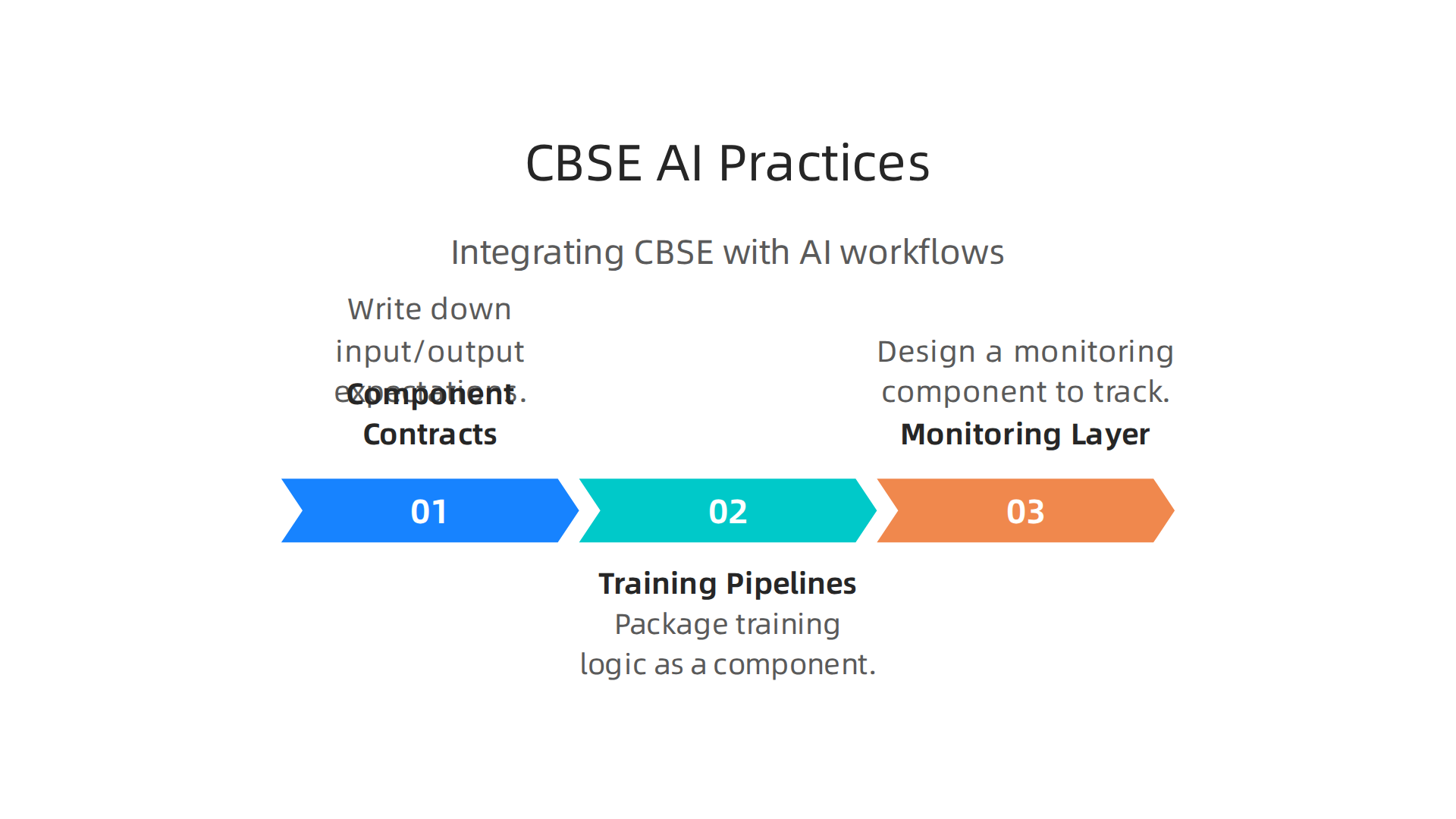
Define clear component contracts first. Before you build anything, write down exactly what each component expects as input and what it promises as output. For example, your data cleaning component should always output a clean tensor with specific dimensions. Your model inference component should always accept that tensor and return a prediction with a confidence score. This makes your AI pipeline reliable and easy to debug.
Treat model training pipelines as reusable components. Instead of writing a new training script for every experiment, package your training logic as a component. You can then swap in different datasets, hyperparameters, or model architectures just by plugging in a new component. This approach accelerates experimentation dramatically.
Build a monitoring layer as a separate component. Many teams skip this until something breaks. Using CBSE, you design a monitoring component that sits between every other component. It tracks latency, error rates, and data drift. When a model starts making bad predictions, you catch it fast because you know exactly which component is failing.
The research backs this up. A study on the component-based approach to software engineering for machine learning shows that teams who apply CBSE to ML systems build more maintainable and scalable AI applications.
Here is the real unlock. When you think in components, you can create an internal marketplace of reusable AI components. Your team builds a component once and shares it across projects. Need a text embedding component for a recommendation system? Pull it from the marketplace. Need a model A/B testing component? Already exists. This saves weeks of duplicated work and lets your team experiment faster than ever.
If you want to go deeper on choosing the right AI tools for your workflow, check out this guide on selecting AI software development tools for your 2026 team. It walks through how to evaluate tools based on the same CBSE principles you are learning now.
Summary
This guide explains why component-based software engineering (CBSE) still matters in 2026 and how its principles power modern architectures like microservices, serverless and AI pipelines. It defines components and the core rules—separation of concerns, high cohesion, loose coupling, and interface-based design—and shows why those rules speed iteration and lower integration costs for AI teams. The article compares recommended books and PDFs, suggests active learning strategies (courses, GitHub, communities), and offers practical tips for evaluating resources. It also walks through how to design contract-first components, treat training pipelines and monitoring as reusable modules, and build an internal marketplace of components. Throughout, the focus is practical: which books to read, how to test and mock AI components, and how to choose tools that fit a component-first workflow. Read this to pick the right learning path, apply CBSE to real projects, and make AI systems easier to maintain and extend.