
How Interview AI Works: Tools, Ethics, and Smart Deployment for Hiring
Overview
Artificial intelligence, or AI, is changing how companies find and hire people for jobs, especially for roles like engineers.

In 2026, AI is a big part of hiring. Many businesses are now using interview ai to make their hiring process better and faster.
Actually, a huge number of companies are already using AI in some part of their hiring process. About 87% of companies use AI in recruitment today AI in Hiring Statistics 2026: Adoption, Bias & Trust. This shows just how much AI matters now. Most often, companies use AI for finding candidates and checking resumes. In fact, using AI for screening is the most popular use case, with 58% of companies adopting it AI Adoption in Recruiting: The Complete 2026 Industry Report.
How Interview AI Reshapes Hiring
Interview ai helps in many ways.
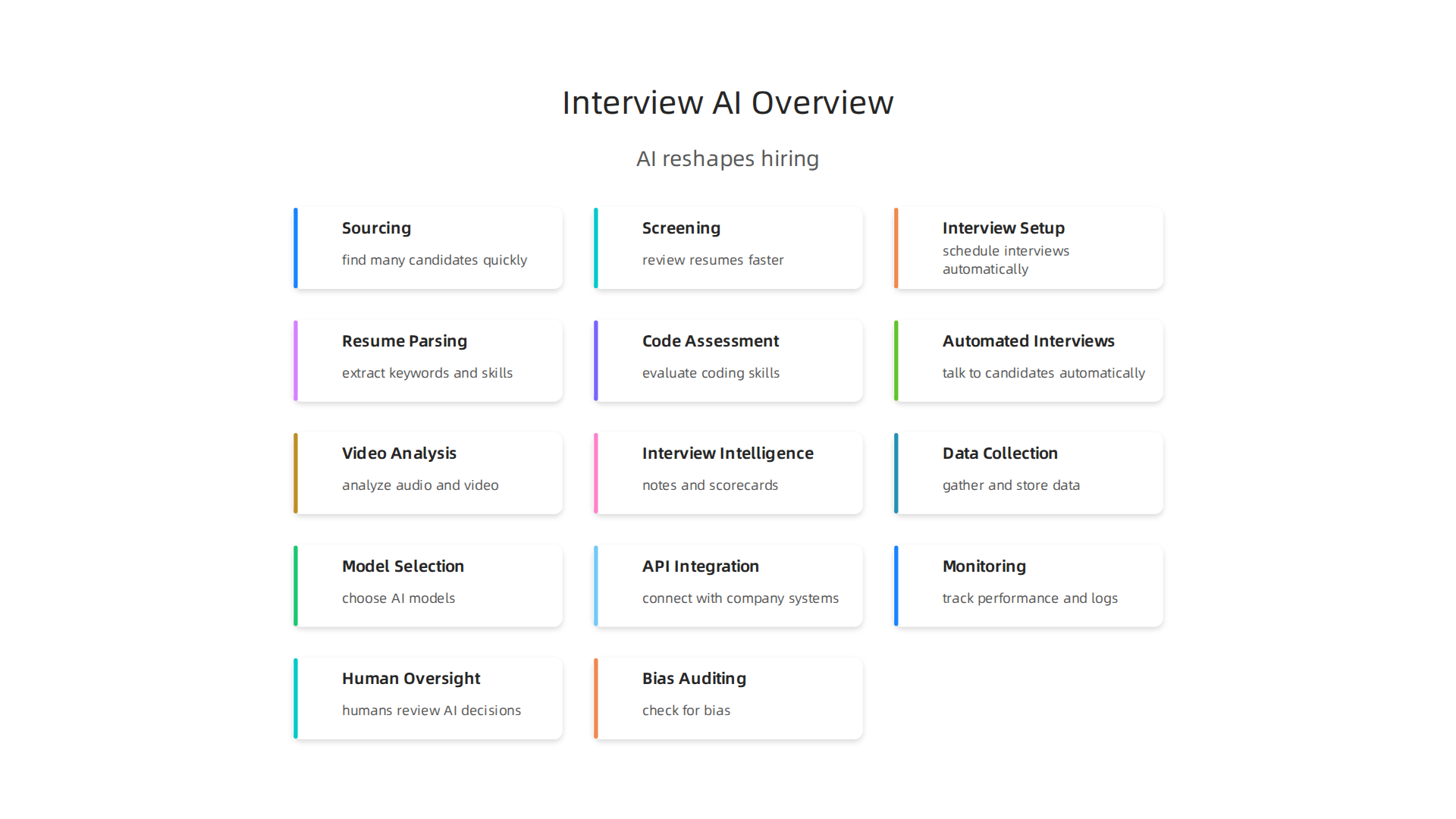
First, it helps with sourcing. This means finding many possible candidates quickly. Second, it’s great for screening. AI tools can look through a huge pile of resumes much faster than a person. This helps companies see who might be a good fit right away. Tools using clever AI can quickly spot important skills and experiences for engineering roles. They can even help set up interviews, which saves a lot of time. Some companies see time-to-hire drop by 25% to 50% when they use AI correctly AI in Recruitment Trends, Stats And What’s Actually Working.
These smart, brainy AI tools make hiring faster and more efficient. They allow hiring teams to focus on the best candidates instead of spending hours on tasks that AI can do. To learn more about how companies are picking these tools, you can read about AI Developer Tools 2026: How Developers are Adopting and Choosing What Works.
The Good and Bad of Interview AI
While interview ai brings many good things, like speed and efficiency, it also has some tricky parts. Companies need to think about trade-offs.
- Speed vs. Fairness: AI can make things super fast, but sometimes, AI tools can accidentally ignore good candidates. About 19% of organizations have had this happen AI in Recruitment – Statistics and Trends (2026). This brings up questions about fairness. Are the AI tools fair to everyone, or do they have hidden biases?
- Automation vs. Candidate Experience: When AI does much of the talking, it can feel less human for candidates. Some job seekers do not like it when companies use AI to make big hiring decisions. About 66% of them would not apply to such companies AI in Recruitment – Statistics and Trends (2026). Companies want to be fast, but they also want candidates to have a good experience. Finding the right balance is key.
As AI keeps changing the world of hiring, it’s important to stay informed about the latest tools and trends.
Get clear daily AI updates from The AI Newsletter Worth Reading.
So, what does interview ai really mean for how jobs are filled in 2026? It covers many different tasks. Think of it like a smart helper that steps in at various stages of finding and talking to job seekers.
Here are some of the main ways interview ai is used:
- Finding People (Sourcing): AI helps companies look through many places to find possible candidates. It can quickly search job sites and online profiles. Actually, 58% of recruiters find AI most helpful for sourcing new talent 121 AI in Recruitment and Hiring Statistics for 2026.
- Checking Resumes and CVs: This is where
interview aireally shines. AI tools, often calledclever ai, can read huge piles of resumes much faster than any person. They find keywords and skills that match the job opening. Almost 60% of employers already use AI tools to scan and check resumes automatically Top 50 AI in Job Interviews Statistics and Trends for 2026 – Index.dev. - Early Checks (Pre-screening): After resumes, AI can ask simple questions or give short online tests. This helps figure out who is a good fit early on.
- Live and Video Interviews: Some
interview aitools can even help with interviews. They can record video interviews and then analyze what candidates say and how they act. - Making Interview Questions: AI can also help make new questions for interviews. This saves time and helps make sure all candidates are asked fair and relevant questions. If you want to know more about tools that create content, you can learn about Generative AI Tools for Developers in 2026.
- Automatic Scoring: These smart tools can score answers in a fair way. This helps hiring teams quickly see who performs best.
What exactly is inside interview ai? It uses advanced tech like:
- Natural Language Processing (NLP): This is like
mindgrasp aiorbrainly ai. It helps computers understand human language. So, it can read resumes, listen to what people say in interviews, and figure out the meaning. - Automated Proctoring: For online tests, AI can watch to make sure no one is cheating. This helps keep things fair.
- Simulation-Based Assessments: These are like games or tasks where candidates show their skills, and the
clever aiwatches and scores them. This gives a real look at how someone might do the job.
Overall, interview ai helps with many parts of hiring, from finding candidates to scoring their interviews. It makes the whole process smoother and quicker, freeing up people to make the final hiring decisions. To truly understand if an AI is working well, it’s important to know How to Evaluate the Smartest AI in 2026.
Different kinds of interview ai tools help with specific parts of finding and hiring people. Think of them as special helpers for different jobs. In 2026, many companies use these smart tools, and the market for them is growing fast AI Interview Software Market Report: Size, Growth, Trends ….
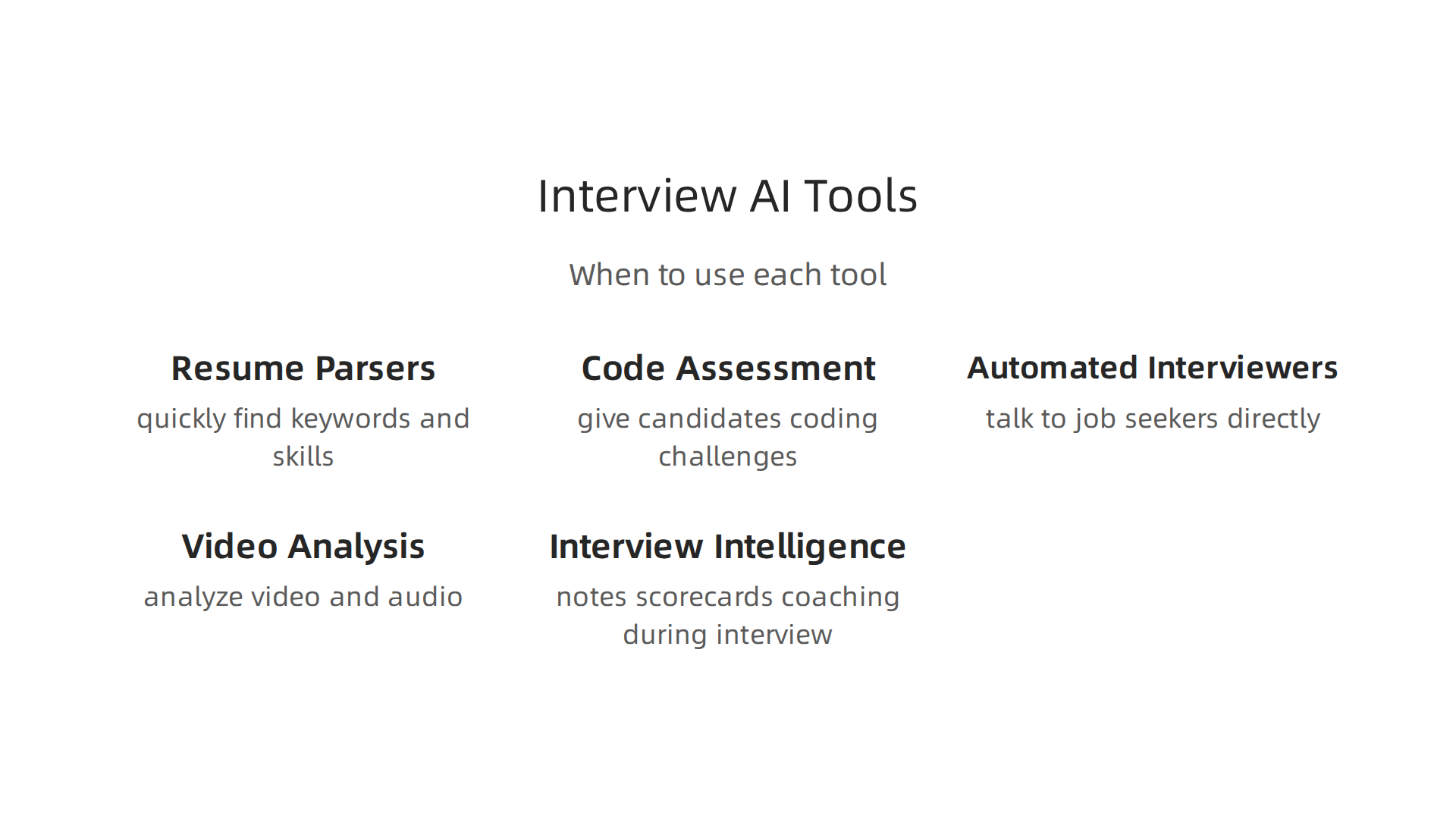
Here are the main types of interview ai tools you’ll find:
Resume Parsers and Screeners
These tools are like super-fast readers. They use clever ai to look at many resumes at once. Their main job is to quickly find keywords and skills that match the job opening. This helps companies sort through a lot of applications very quickly. If a company gets hundreds or thousands of resumes for one job, these tools can find the best ones to look at more closely.
Code Assessment Platforms
When a job needs someone to write computer code, these tools come in handy. They give candidates coding challenges or tasks. The interview ai then checks the code to see if it works right and how well it’s written. This helps companies really see a person’s technical skills. Some use advanced AI, like what you might call readdy ai, to grade these tasks fairly. This is great for making sure someone can do the actual work.
Automated Interviewers and Chatbot Screens
These tools can talk to job seekers directly. Some use chatbots to ask questions through text messages, acting like a first chat with a recruiter. Others are automated interviewers that ask questions by video or voice. They might use mindgrasp ai or brainly ai ideas to understand what you say and how you say it. These tools help companies check basic skills and how well you communicate at the start of the hiring process.
Video-Analysis Tools
When candidates record video answers, these tools step in. They can watch the video and listen to the audio. They might look at things like how clearly you speak, your tone of voice, or even analyze keywords you use. This helps give more information about a candidate than just a written answer. Some of these tools can also summarize video interviews, which saves time for hiring managers Best AI-Enabled Interview Intelligence Reviews 2026.
Interview Intelligence Platforms
This is a broader type of interview ai tool that brings many features together. These platforms can help human interviewers by providing notes, scorecards, and even coaching during an interview. After the interview, they can analyze the conversation to make sure all candidates were treated fairly and consistently. The market for these tools is growing, with many top options available in 2026 The AI Interview Tools Market in 2026. They are very helpful for making the whole interview process better over time.
Choosing the right interview ai tool depends on what a company needs.

For a lot of applications, quick screeners are best. For jobs needing special skills, assessment tools work well. If you want to keep learning about how companies use AI tools, it’s good to keep up with the latest information.
Want to stay informed about all the latest AI tools and trends shaping industries like hiring?
Get clear daily AI updates from The AI Newsletter Worth Reading.
From simply knowing what different interview ai tools do, we now look at how these smart systems are put together. Building a good interview ai pipeline involves several important steps. It’s like putting together a strong team for a big project.
Core Components of an Interview AI Pipeline
First, you need to think about the building blocks.
- Data Collection and Labeling: Every
clever aistarts with data. For aninterview ai, this means gathering lots of information. This could be resumes, video recordings of interviews, or coding tests. Then, this data needs "labels." This means telling the AI what’s good or bad, or what skills are shown. Good, clear data helps the AI learn correctly. - Model Selection: This is like choosing the "brain" for your
interview ai. For understanding words on a resume, you might use a natural language model. For watching videos, you’d use a multimodal model that can handle both sight and sound. Tools using ideas likemindgrasp aiorbrainly aihelp these models understand complex human interactions. - API/SDK Integration: Once you have your AI brain ready, you need to connect it to the company’s existing hiring systems. This often happens using APIs (Application Programming Interfaces) or SDKs (Software Development Kits). These are like special plugs that let the
interview aitalk to systems that manage job applications and HR information. - Monitoring and Logging: After everything is set up, you need to watch it closely. Monitoring means checking if the
interview aiis working correctly and giving fair results. Logging means keeping a record of what the AI does. This helps you spot problems early and make sure the system is always fair and effective. Companies use these practices to ensure their AI models stay reliable MLOps Lifecycle: Stages, Workflow, and Best Practices.
Operational Considerations for Interview AI
Beyond the basic parts, there are other important things to think about for smooth running.
- Versioning and Rollback: Imagine you update your
interview ai, and suddenly it starts making mistakes. You need a way to go back to the old, working version. This is called rollback. To do this, you must keep track of every change to your AI, from the code to the data it learned from, and even the models themselves. This is called versioning, and it’s a key part of making sure AI systems are reliable 10 Actionable MLOps Best Practices for Production AI in …. Many teams use special tools to keep track of these versions, which is a core MLOps practice 8 MLOps Best Practices You Should Implement in 2026. - Human-in-the-Loop: Even the smartest AI needs human eyes on it. This means having people check the AI’s work, especially in important areas like hiring.

A human can make sure the readdy ai is being fair and picking the right candidates.
- Maintaining Candidate Privacy: When using
interview ai, it’s super important to protect job seekers’ personal information. Companies must follow strict rules to keep data safe and use it only for hiring. This builds trust and avoids problems.
If you want to dive deeper into how companies choose and use these advanced tools, learning about general AI development practices is a great next step. For example, understanding how to select different developer tools can help choose the right AI tools for developers to boost productivity.
Now that we’ve looked at how interview ai systems are built and the things companies need to think about to run them smoothly, the next big step is making sure they work well. This means checking if the AI is accurate, fair, and gives a good experience to job seekers.
Measuring accuracy, bias, and candidate experience for interview AI
It’s not enough to just use a clever ai; you have to know if it’s doing a good job. We need ways to measure how well the interview ai performs.
What to Measure
- Predictive Validity: This is about how well the
interview aipredicts who will do well in a job. Does it pick candidates who actually become successful employees? This is a key measure of its accuracy. - False Positive/Negative Rates: Imagine the
interview aisays someone is perfect for a job, but they aren’t (false positive). Or it says someone isn’t good, but they would have been great (false negative). We want to keep these mistakes very low. - Fairness Metrics: It’s super important that the
interview aitreats everyone fairly.

This means checking that it doesn’t accidentally favor one group of people over another, like based on age, gender, or race. Experts look at things like "impact ratio" to see if selection rates are equal across different groups of people, as this helps prevent hidden biases from unfair decisions Algorithmic Fairness Audits: A Step-by-Step Compliance Guide for …. Companies must make sure their AI is free from discrimination Ensuring Fairness, Transparency, and Trust in 2026.
- User Experience Indicators: How do job candidates feel about using the
interview ai? Do they find it easy, fair, and respectful? Their feedback helps make the system better.
How to Check the AI
To make sure the readdy ai or any interview ai is working as it should, companies use several methods:
- Pilot Testing: This is like a small test run. A company might try the
interview aiwith a small group of candidates first, or for a specific job, before using it widely. This helps find problems early. - A/B Experiments: Here, you compare two ways of doing things. Maybe one group of candidates goes through the
interview ai, and another group goes through the old, human-only process. Then you compare the results to see which is better or fairer. - Third-Party Audits: Sometimes, an outside company comes in to check the
interview aifor bias and fairness. This is like having an independent referee make sure everything is fair. In 2026, some rules, like in New York City, even require these independent bias audits every year Defensible bias audits for HR AI tools. These audits check all parts of the AI hiring process, from the first application to the final decision AI Bias Audit in Hiring 2026: Ensure NYC Local Law 144 …. - Continuous Monitoring: After the
interview aiis being used fully, companies still watch it all the time. They keep checking its results to make sure it stays accurate and fair, and to catch any new issues that might pop up. This ongoing check is important to keep the AI working correctly.
Understanding how to choose and test these smart tools is a big part of making them useful. If you want to learn more about how to make sure AI tools are working well, you might find it helpful to read about how to evaluate the smartest AI in 2026.
Staying on top of the latest in AI is key for anyone involved in development or hiring.
Get clear daily AI updates from The AI Newsletter Worth Reading.
Staying on top of the latest in AI is key for anyone involved in development or hiring. Now, as companies use smart tools like an interview ai more often, it’s also super important to think about privacy rules and laws. This means making sure the AI handles personal information carefully and follows all the rules.
Privacy, compliance, and legal considerations when using interview AI
Using an interview ai involves handling a lot of personal information from job candidates. Things like their voice, how they look in a video, and what they type are all collected. Because of this, companies must be very careful about privacy, legal rules, and making sure they follow all the laws. It’s not just about finding the best candidates; it’s also about protecting their rights.
Handling Candidate Data Safely
When using an interview ai, companies collect different kinds of data. Here’s how they need to keep it safe:
- Data Minimization: This means only collecting the data that is absolutely needed. If the
interview aidoesn’t need to know a candidate’s age or race to assess skills, then that information shouldn’t be collected. The less data collected, the less risk there is if something goes wrong. This also applies to audio, video, and text from interviews; only relevant parts should be kept. - Getting Permission (Consent): Before any
interview airecords a candidate’s voice or video, the candidate must agree to it. Companies need to explain clearly what data they will collect, how they will use it, and how long they will keep it. Candidates should always have a choice to say yes or no. - Secure Storage: All the data collected by an
interview aimust be stored very safely. This means protecting it from hackers and making sure only people who need to see it can. Think of it like a locked safe for important papers. - Cross-Border Data Rules: Sometimes, a company might use an
interview aiin one country, but the data is stored or processed in another. This gets tricky because different countries have different privacy laws. Companies must follow the rules for every country involved, especially when transferring sensitive audio, video, or text across borders.
Understanding the Legal Landscape
The world of interview ai is still quite new, but laws are quickly catching up. Companies need to watch out for a few types of rules in 2026:
- Privacy Laws: Laws like GDPR in Europe or state-specific privacy laws in the US tell companies exactly how they must handle personal data. These laws make sure that candidates’ data is used fairly and securely.
- Hiring Discrimination Laws: Even with a
clever ai, it’s still against the law to discriminate against job seekers based on things like race, gender, or age. Laws are being updated to make sureinterview aitools don’t accidentally cause discrimination. As more companies adopt AI interview software, staying updated on these regulations is crucial for compliance AI Interview Software Market Report. - Auditability Requirements: Some places, like New York City, require companies to regularly check their
interview aitools for fairness and bias. These checks, called audits, make sure the AI is working as intended and not making unfair choices. Companies need to keep good records to show they are following these rules. If you’re building systems that use AI, learning about how to design them to be human-centered can be really helpful. Check out our guide on AI for Humans How to Design Systems That Put People First to learn more.
Making sure an interview ai follows all these rules can be complex, but it’s a vital part of using this technology responsibly. It helps build trust with job seekers and ensures everyone gets a fair chance.
After understanding all the rules and making sure an interview ai is used correctly and safely, companies face a big question: Should we buy an AI tool from another company or build our own? This choice impacts how fast you can use the AI, how much control you have, and how much it will cost over time. It’s about finding the best fit for your team and your hiring goals in 2026.
Selecting Vendors vs Building In-House: Decision Criteria and Total Cost of Ownership
Deciding whether to buy a ready-made interview ai solution or build one from scratch involves many different things to think about. Each path has its own good and bad points, especially when it comes to tools for hiring.
Key Factors for Your Decision
Here are important things to consider when choosing between buying or building an interview ai:
- Speed to Market: If you need to start using an
interview aiquickly, buying from a vendor is usually faster. They already have the product ready to go. Building your own takes a lot of time for design, coding, and testing. - Customization Needs: Do you need a very specific
interview aithat does unique things only for your company? Building in-house gives you full control to make it exactly how you want it. A vendor’s tool might not offer every little custom feature you dream of. - Data Control: While vendors promise secure storage, building your own gives you complete power over where and how all candidate data is kept. This can be important for sensitive information. However, building in-house also means you are fully responsible for setting up and maintaining strong security measures.
- Maintenance Burden: When you buy a solution, the vendor handles updates, fixes, and improvements. If you build it, your team will be responsible for all ongoing maintenance, which can be a lot of work. This includes things like versioning code and data, automating updates, and keeping an eye on how well the AI is working, which are key parts of MLOps best practices for production AI systems 10 Actionable MLOps Best Practices for Production AI in ….
- Safety Expertise: AI, especially for interviews, needs careful checks for fairness and bias. Many specialized vendors have teams dedicated to making sure their
interview aiis fair and follows all rules. Building in-house means your team needs that same high level of expertise in AI ethics and compliance.
How to Evaluate Vendor Solutions
If you choose to work with a vendor, you need a clear plan to pick the right one.
- RFP Criteria: An RFP (Request for Proposal) is like a detailed shopping list. You’ll ask vendors specific questions about their
interview ai, such as its features, how it handles data, its security, and how much it costs. This helps you compare different options fairly. - Security Questionnaires: Make sure to ask vendors tough questions about their security. How do they protect candidate information? Do they meet important data privacy standards? These questions help ensure your candidates’ data remains safe.
- Pilot KPIs: Before you fully commit, try out the
interview aiwith a small group. Set clear goals for this trial, like how much time it saves or how well it helps find good candidates. These are your Key Performance Indicators (KPIs). If the pilot shows good results, it’s a sign the solution could work for you.
Total Cost of Ownership
Remember, the "cost" of an interview ai is more than just the price tag. For vendors, it includes subscription fees, training, and potential integration costs. For building in-house, it includes salaries for developers, researchers, and maintenance teams, plus the cost of computing power and ongoing security efforts. It’s wise to look at the full picture to see what makes the most sense for your company in 2026. Understanding these choices will help you select the best AI software development tools for your team.
For anyone working with or building AI, staying updated on the fastest changes is key.
Get clear daily AI updates from The AI Newsletter Worth Reading.
After choosing whether to buy or build your interview ai, the next big step is putting it to use in a smart and safe way. This means having a clear plan for how you roll out the new tool. It is important to make sure the AI helps your hiring process without causing new problems.
Deployment checklist and pilot plan for interview AI (step-by-step)
When you’re ready to bring your interview ai to life, don’t just flip a switch and let it run. A careful step-by-step approach helps you find any issues early and make sure everything works well. Here’s a practical checklist to guide you:
1. Start with a Small Pilot
Think of this as a test run. Instead of using the interview ai for all your job openings right away, pick a small group or a few roles to try it out. This way, if there are any bumps, they won’t affect your whole hiring process. This small-scale pilot lets you watch closely and fix things quickly.
- Choose specific roles: Select a few job types that are a good fit for the
interview ai‘s design. - Limit the number of candidates: Test with a manageable group.
- Set a clear timeframe: Decide how long the pilot will last.
2. Set Up Your Metrics
Before you start, know what success looks like. What do you want the interview ai to achieve? Do you want it to save time, find better candidates, or make the process fairer? These are your goals, or metrics.
- Time saved: How much faster is the hiring process?
- Quality of hires: Are the candidates found by the AI performing better?
- Candidate experience: Do applicants feel good about the process?
- Fairness: Does the AI treat all groups of people equally? This is very important, as many companies in 2026 are focusing on algorithmic fairness audits to meet compliance rules.
3. Give Candidates a Choice (Opt-Out)
It’s a good idea to let candidates know an AI is being used and give them a way to opt out if they prefer. This builds trust. They might prefer a different interview method if they are uncomfortable with the interview ai. Make sure to explain clearly how the AI works and why you’re using it.
4. Keep Humans in the Loop
Even with a smart interview ai like mindgrasp ai or brainly ai, human judgment is still key. Always have real people review the AI’s decisions, especially for important choices like who gets an interview or a job offer. This human review helps catch mistakes and ensures fairness.
- Review flagged decisions: Have someone look closely at any candidates the AI ranks very low or high in unexpected ways.
- Provide feedback: Your human reviewers can give feedback that helps improve the AI over time.
5. Build Feedback Loops
A good interview ai gets better over time. You need a way to feed information back into the system. This means gathering thoughts from hiring managers, candidates, and anyone else involved. This feedback helps you fine-tune the AI, making it more accurate and fair. This is how you make sure the AI continues to learn and improve, just like a clever ai should.
Risk Mitigation Steps
Using an interview ai also means thinking about what could go wrong and how to fix it.
- Logging and Audit Trails: Keep detailed records of every decision the
interview aimakes. This is like a logbook. If there’s a problem, you can look back at the log to see what happened. This is especially useful for understanding if any biases might have crept in, which is a big focus in 2026 for algorithmic bias audit compliance. - Fallback Processes: What happens if the
interview aibreaks down or gives strange results? You need a backup plan. This could mean switching back to traditional hiring methods for a short time or having extra human reviewers step in. Having a solid plan is a crucial part of any future standard for AI implementation. - Escalation Paths: If the
interview aimakes a decision that seems wrong or unfair, who do you tell? Have a clear path for reporting problems. This means knowing which person or team can step in to investigate and correct issues. For example, if areaddy aitool shows unexpected behavior, your team should know exactly who to contact. - Regular Bias Audits: Make it a habit to check your
interview aifor any unfairness or bias. This means looking at how it treats different groups of people. Regulations in 2026 often require these kinds of checks by independent experts to ensure the AI is fair.
Summary
Interview AI is reshaping how companies find, screen and evaluate candidates—especially for engineering roles—by automating sourcing, resume screening, code assessments, video analysis and interview scoring. This article explains the main tool types, the core technical pipeline (data, model choice and integration), and operational needs like monitoring, versioning and human oversight. It covers measurement approaches—predictive validity, false positive/negative rates, fairness metrics and candidate experience—and practical testing methods such as pilots, A/B experiments and third‑party audits. The guide also walks through legal and privacy obligations, data minimization, consent and cross‑border rules, and gives a clear framework for deciding whether to buy a vendor solution or build in‑house. Finally, it offers a step‑by‑step deployment checklist with risk mitigation, logging, rollback plans and ongoing bias audits so teams can roll out interview AI safely and effectively.