

When Was Artificial Intelligence Made Discover the 1956 Birth at Dartmouth
Overview
Introduction
Has anyone ever asked you when was artificial intelligence made? It’s a common question, and the answer might surprise you. AI didn’t appear overnight. In fact, its official birthday is widely recognized as the summer of 1956, but the seeds were planted years before.
Here’s the thing. The term "artificial intelligence" was first used at a famous workshop called the Dartmouth Summer Research Project on Artificial Intelligence. According to Dartmouth College, that event in 1956 is considered the formal birth of AI as a field. A young computer scientist named John McCarthy came up with the name for the proposal he wrote the year before. He defined AI as "the science and engineering of making intelligent machines."
But here’s the twist. Some of the core ideas behind AI started much earlier. In 1950, British mathematician Alan Turing published a paper called "Computing Machinery and Intelligence." In it, he asked a simple question: "Can machines think?" He even proposed a test later known as the Turing Test.

That was six years before Dartmouth gave AI its name.
So when you ask "when was artificial intelligence made," the honest answer is that the groundwork was laid in the 1950s, both by Turing’s big questions and by McCarthy’s big vision.
Why does this matter for developers today? Understanding this timeline helps you see the big picture. It shows you the cycles AI has gone through. It can even help you avoid repeating past mistakes. If you’re curious about how far AI has come since those early days, check out our AI model comparison for 2026 to see the latest realistic AI tools in action.
In this article, we’ll walk through the full timeline. You’ll learn about the key people, the breakthroughs, and the moments that shaped modern AI. Read on to get your complete ai overview.
Defining Artificial Intelligence: What Does ‘Made’ Actually Mean?
So when was artificial intelligence made? The answer gets tricky once you realize that "artificial intelligence" means different things to different people.
Here’s the thing. The term "artificial intelligence" was first coined by John McCarthy in August 1955 when he wrote the proposal for the Dartmouth Summer Research Project. But the definition itself has never been fixed. McCarthy called AI "the science and engineering of making intelligent machines." Others, especially in the 1980s, saw AI as symbolic systems that manipulated logic and rules. More recently, AI is often understood through deep learning algorithms that learn from massive amounts of data.
These different views lead to different answers to our question. Some people point to ancient Greek myths about mechanical servants and call those early examples of AI. Others point to Alan Turing’s 1950 paper as the real start. Still others say AI was born in 1956 when the field got its name and its first organized workshop at Dartmouth.
For the purpose of this article, we focus on one clear milestone: the establishment of AI as a recognized academic discipline. The Dartmouth workshop, officially called the Dartmouth Summer Research Project on Artificial Intelligence, was the moment when a group of leading scientists came together to formally study the idea of intelligent machines. As Dartmouth College explains, that event is considered the formal birth of AI as a field.
If you want a deeper look at how different fields approach intelligence, check out our guide on computer science vs software engineering. Understanding these distinctions helps you see why the definition of "when was artificial intelligence made" depends on what you’re counting.
So for this article, when we say AI was "made," we mean it became a real, organized area of study. That started in 1956 with McCarthy and the Dartmouth workshop. The rest of this timeline will show you what came next.
Pre-1956 Foundations: The Seeds of Artificial Intelligence
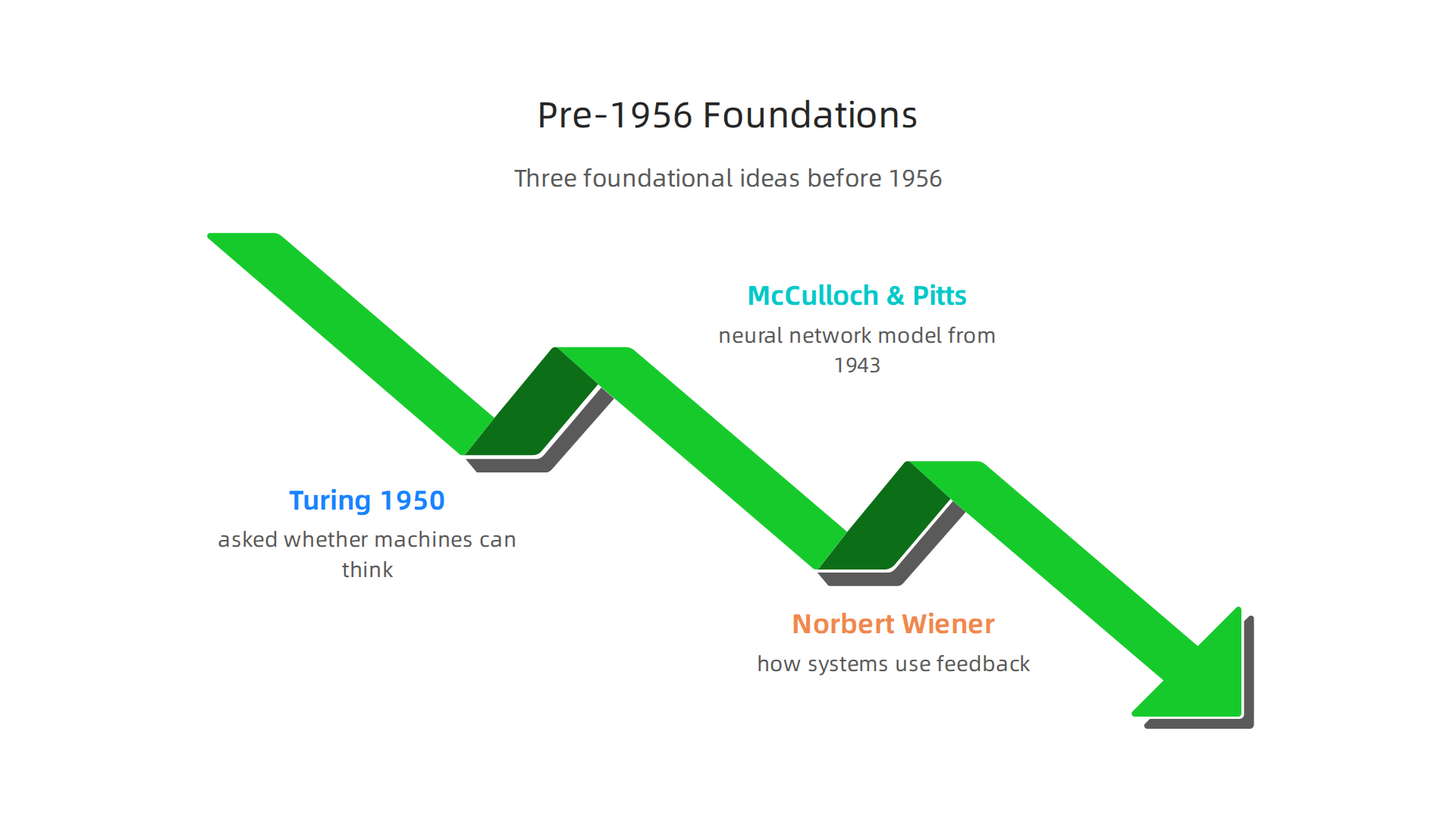
Before AI had a name and a conference in 1956, some brilliant minds were already planting the seeds. You can think of these early years as the behind-the-scenes work that made the big Dartmouth moment possible. So when was artificial intelligence made in terms of its foundational ideas? Here are the three biggest pieces that came together before 1956.
Alan Turing’s 1950 paper “Computing Machinery and Intelligence”
The most famous pre-1956 work came from Alan Turing. In 1950, he published a paper that asked a simple but powerful question: “Can machines think?” Instead of getting stuck on definitions, Turing proposed a practical test. He called it the imitation game. In the test, a human judge talks to a machine and another human through text. If the judge cannot tell which is which, the machine passes. Today we call this the Turing Test. The paper, published in the journal Mind, is considered one of the most important in AI history. You can read the original paper through Oxford Academic.
McCulloch and Pitts’ neural network model (1943)
A few years earlier, in 1943, neurophysiologist Warren McCulloch and mathematician Walter Pitts created a mathematical model of how neurons in the brain might work. They showed that simple on/off switches, like the ones in early computers, could represent logical operations. This was the first real theory of an artificial neural network. It gave later researchers a blueprint for building systems that could learn and make decisions. Without this work, deep learning as we know it today would not exist.
Norbert Wiener’s cybernetics
Around the same time, mathematician Norbert Wiener was developing a new field called cybernetics. He studied how systems use feedback to control themselves. Think of a thermostat that turns the heater on when the room gets too cold. Wiener applied this idea to machines and living things alike. His 1948 book Cybernetics showed that communication and control are central to intelligence. This gave AI researchers a framework for building adaptive, self-correcting systems.
Together, these three threads shaped what it means to create intelligence in a machine. If you want to learn the skills needed to work with these ideas today, check out our list of the best computer science courses for AI development in 2026. They cover everything from neural networks to modern machine learning.
So the question when was artificial intelligence made starts here, with these early thinkers who asked the right questions before the field even had a name.
The Dartmouth Conference (1956): The Official Birth of AI
So weve arrived at the moment when artificial intelligence was officially made: the summer of 1956. If you ever wondered when was artificial intelligence made as a formal field, this is your answer. A small group of thinkers gathered at Dartmouth College in Hanover, New Hampshire, for a two month workshop that would change the world forever.
The event was organized by four brilliant minds: John McCarthy, Marvin Minsky, Nathaniel Rochester, and Claude Shannon.
Together, they are often called the founding fathers of artificial intelligence, according to the Dartmouth workshop Wikipedia page. McCarthy, a young math professor at Dartmouth, wrote the original proposal. In it, he set a goal that sounds bold even today. He said the conference would proceed on the basis of the conjecture that every aspect of learning or any other feature of intelligence can be so precisely described that a machine can be made to simulate it. You can read McCarthys exact words in the Dartmouth AI Project Proposal from 1956.
The proposal stated that the workshop aimed to make machines use language, form abstractions and concepts, and solve kinds of problems now reserved for humans. Think about that. This was the first official outline of what we now call an AI overview: machines that could think, learn, and communicate like people.
Only about ten people attended the full workshop, but the ideas that bounced around during those summer weeks set the direction for decades of research.

The attendees came from different universities and IBM. They discussed everything from neural networks to natural language processing. There were no massive breakthroughs right then, but the field of artificial intelligence had been born. The Dartmouth and the Dawn of AI article notes that this gathering planted the seeds for everything that followed.
After 1956, researchers began building the first realistic AI systems. Today, we see the results everywhere: from chatbots that hold conversations to tools that create art. If you want to understand where we are now, its helpful to look back at where it all started. The ideas explored at Dartmouth eventually led to the AI we use today. If you are looking to build on that legacy, check out these AI startup ideas for 2026 that solve real problems. They show how far we have come from that small New Hampshire classroom.
So when was artificial intelligence made? The answer is 1956, at the Dartmouth Conference. It was the spark that lit a fire still burning today.
Early AI Achievements and the Golden Years (1956–1974)
And that fire spread fast. Right after the Dartmouth Conference, researchers got to work turning those big ideas into real programs.
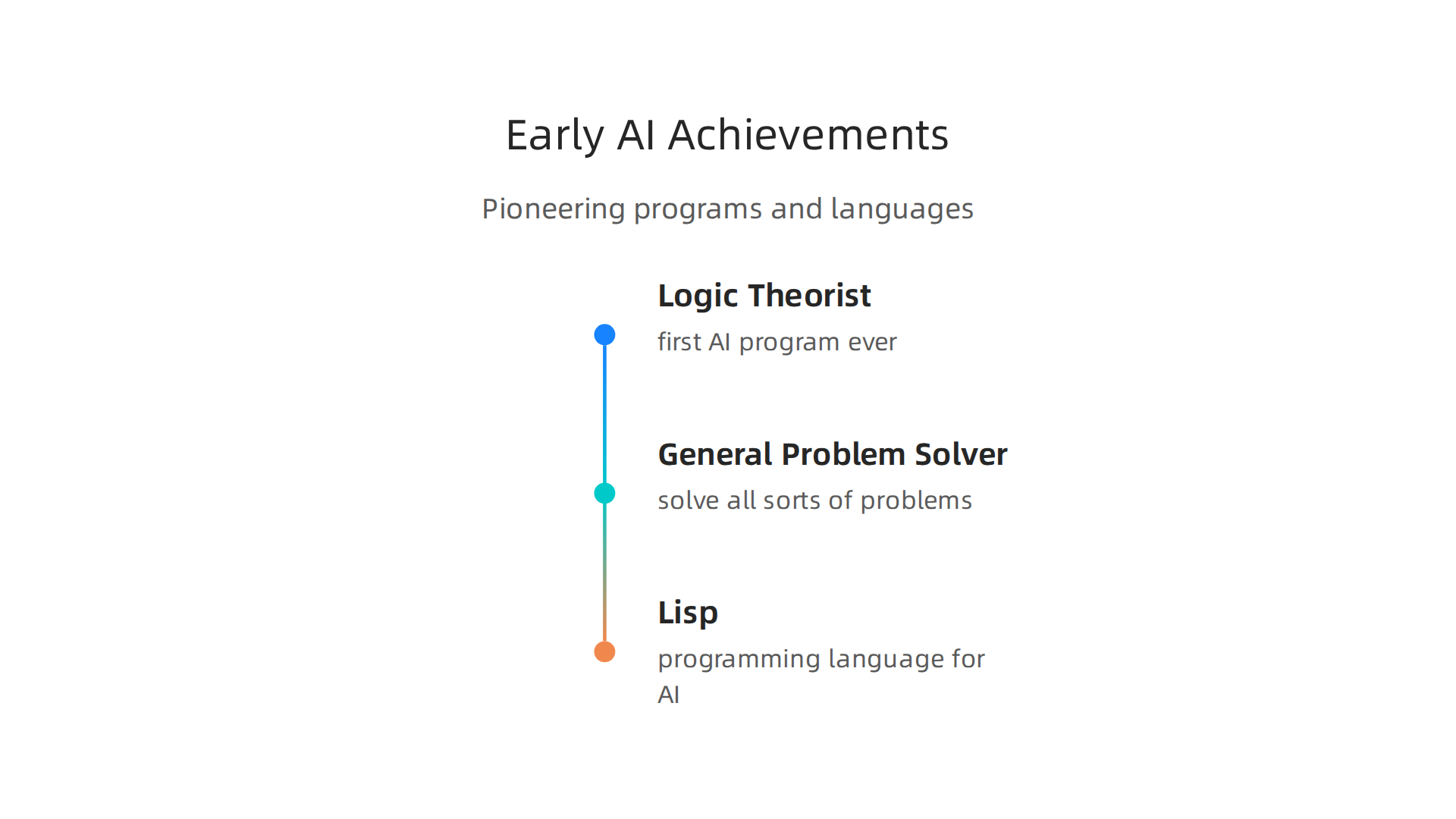
The very first one is called the Logic Theorist, built in 1956 by Allen Newell, Herbert Simon, and J.C. Shaw at the Rand Corporation. It is widely considered the first AI program ever. According to Britannica, it could prove mathematical theorems by thinking step by step, just like a human would. This was a huge deal. It showed that machines could actually reason.
Soon after came the General Problem Solver (GPS). Newell and Simon created it to solve all sorts of problems, not just math. It used a method called means-ends analysis, which is still used in AI planning today. These early programs are perfect examples of ai that focused on logic and reasoning.
In 1958, John McCarthy created a programming language called Lisp. Lisp was built specifically for AI research. It handled lists easily, let programs change themselves, and became the main language for AI for decades. Many early chatbots, planners, and expert systems were written in Lisp. You can think of Lisp as a key piece of the ai overview from that time.
The period from 1956 to 1974 is often called the golden years of AI. Funding poured in from the U.S. government, especially DARPA. Optimism was sky high. Researchers made big strides in natural language processing (getting computers to understand English), robotics (robots that could move and see), and game playing (like chess and checkers). These were the first steps toward the realistic ai systems we see today.
Back then, the goal was human centered ai: machines that could talk like us, solve problems like us, and even learn like us. It took decades to get there, but everything started in those golden years.
If you want to learn how the skills from that era still matter today, check out this guide on the best computer science courses for AI development in 2026. It breaks down what you need to know to work in modern AI.
The Fundamentals That Still Underpin Modern AI
You might think those early AI programs are just dusty old history. But here’s the thing: the ideas they introduced are still the backbone of modern AI. When you ask "when was artificial intelligence made," 1956 is the answer, but the techniques born then are still alive and powering the tools you use today.
Symbolic AI: The Art of Thinking Step by Step
The Logic Theorist and General Problem Solver were part of a field called symbolic AI. It treated intelligence as a process of manipulating symbols using rules. Think of it like following a recipe: if you have ingredient A and ingredient B, you apply rule C to get result D. This approach gave us two key pillars that remain central to AI in 2026.
First, search algorithms. How does a computer find the best path through millions of possibilities? It uses methods like depth-first search and A* search. These were first explored by Newell and Simon in the 1950s. Today, every AI system that plans a route, plays a game, or schedules tasks relies on these same search techniques. You can explore more about these methods in a detailed overview of AI search methods.
Second, knowledge representation. How do you store facts and relationships so a computer can reason with them? Early researchers built systems with rules like "if it is raining, then the ground is wet." This idea evolved into modern knowledge graphs, expert systems, and even some parts of large language models. The limitations of early rule-based systems eventually led to machine learning, but the core need for structured knowledge never went away.
The Perceptron: The Seed of Deep Learning
While symbolic AI was booming, another approach was quietly growing. In 1958, psychologist Frank Rosenblatt created the perceptron. It was a simple neural network that could learn to recognize patterns by adjusting its "weights" based on examples. This was the first example of AI that learned from data instead of following hard-coded rules.
The perceptron could only solve simple problems. But it planted the seed for everything we call deep learning today. Modern neural networks with billions of parameters are just much bigger, more complex versions of that original idea. In 2026, every time you use a tool like ChatGPT or a self-driving car, you are benefiting from the perceptron’s legacy.
Legendary computer scientist Marvin Minsky later showed the perceptron’s limitations, which helped trigger the first "AI winter." But his critique also pushed researchers to invent more powerful networks like multi-layer perceptrons and convolutional neural networks. So even the failures taught us valuable lessons.
Foundational Concepts That Every Developer Learns Today
If you take an introductory computer science course in 2026, you will still study concepts from the 1950s and 1960s.

Here are three big ones:
| Concept | Origin | Modern Use |
|---|---|---|
| Backtracking | Used in early theorem provers to undo wrong guesses | Powers constraint solvers, puzzle solvers, and many algorithms |
| Decision trees | First explored in early AI for classification | Still used in machine learning libraries like scikit-learn |
| Logical inference | The heart of Logic Theorist and GPS | Forms the basis of knowledge bases, rule engines, and some reasoning in LLMs |
These ideas are not just history lessons. They are active tools. When you build a recommendation system, you might use decision trees. When you write a game AI, you use search with backtracking. When you create a chatbot that follows business rules, you use logical inference.
So when was artificial intelligence made? It was made in 1956, but its DNA is all around you in 2026. The same search, representation, and learning strategies that amazed researchers seventy years ago are now running billions of times every second.
If you want to understand how these fundamentals connect to the broader field of software engineering, take a look at this guide on computer science vs software engineering in 2026. It helps clarify where AI theory and practical coding meet.
The golden years gave us more than just a starting point. They gave us a blueprint that still works today. And that is something worth remembering next time you ask Siri a question or use an AI writing tool.
Why ‘When Was AI Made?’ Matters for Developers Today
So you know that AI was officially born in 1956. But why should you, as a developer in 2026, care about a conference that happened seventy years ago?
Here’s the honest answer: because the same mistakes that caused past AI winters are still being made today. And knowing about them can save your career, your project budget, and your sanity.

The First Reason: Avoiding the Same Old Traps
Every AI winter happened when researchers promised too much and delivered too little. The hype got huge. Funding poured in. Then reality hit and everything crashed. This pattern repeated in the 1970s and again in the late 1980s.
If you take a moment to read about the AI winter phenomenon, you will see clear warning signs. Overpromising on capabilities. Building systems that work in demos but fail in the real world. Ignoring the limits of your approach. These same patterns show up every time a new example of AI hits the headlines.
Today’s generative AI is amazing, but it is not magic. It has real limitations, from accuracy to bias to cost. Developers who understand the history ask better questions. They test assumptions. They avoid building on hype instead of proven value. That is the difference between a tool that lasts and a project that gets canceled.
The Second Reason: Nothing Is Truly New
When you hear about a breakthrough in 2026, ask yourself: is this a genuinely new idea or a revisited one? Many problems we tackle today, like knowledge representation or search over large spaces, were first explored in the 1950s and 1960s.
For example, the transition from simple rule-based systems to machine learning happened in part because researchers realized that rules alone could not handle messy, real-world data. That shift from rule-based algorithms to generative models is a perfect case study. You can learn from it without having to repeat the same trial and error.
This knowledge gives you a sharper ai overview. You can spot which current approaches are just old ideas with new names and which ones actually represent real progress. That helps you choose the right tool for the job instead of chasing every shiny object.
The Third Reason: Fundamentals Make You Faster
The best developers in 2026 are not the ones who memorize the latest API. They are the ones who understand the core concepts well enough to adapt quickly. When you know how search algorithms, decision trees, and logical inference work under the hood, you can pick up any new AI tool faster.
Imagine a product manager tells you to evaluate a new AI coding assistant. If you understand the fundamentals, you can ask smart questions: How does it represent knowledge? How does it search for solutions? Where are its limits? You can separate substance from marketing.
And if you are building realistic AI systems that are actually helpful to people, that foundation is gold. You move from being a user of AI tools to being someone who can shape and improve them. That is how you build a career that lasts through the next hype cycle.
If you want to dig deeper into how these fundamentals connect to your daily work, check out this guide on computer science vs software engineering in 2026. It shows where theory meets practice in the real world.
So when was artificial intelligence made? 1956. But more importantly, the lessons from that birth and the decades that followed are still incredibly useful for anyone building with AI today. The past is not just history: it is your best teacher for building human centered ai that actually works.
Summary
This article traces the question