
AI Model Comparison 2026 GPT 4o Claude 4 Gemini 2.0 and Open Source Models
Overview
Introduction
If you build software in 2026, you already know the feeling. You open your feed, and another AI model has dropped. GPT 4.1 just shipped. Claude 4 got faster. Gemini 2.0 improved its reasoning. And somewhere, an open source model nobody heard of last month is climbing the leaderboard.
It is a lot to track. Actually, it is more than a lot. According to Epoch AI, over 30 AI models have now been trained at the scale of GPT 4. And those are just the large ones. Dozens more, from Mistral to Llama 4 to DeepSeek, are competing for your attention, your API calls, and your trust.
Here is the thing: each model update narrows the gap. GPT 4o writes better than it did six months ago. Claude 4 runs faster than Claude 3.5. Gemini’s reasoning keeps improving. The differences get smaller, but the choices get harder. And that is exactly why you need a clear map.
We call this the galaxy AI landscape. It is a vast, expanding universe of models that differ not just in benchmarks but in trade offs. Speed versus accuracy. Cost versus capability. Open source flexibility versus proprietary polish. Multi modal reach versus single domain depth. The wrong pick can slow your team or burn your budget. The right pick can give you a real edge.
That is where this guide comes in. We built it for technical leaders, AI engineers, and founders who need to make smart decisions fast. Inside, you will find a structured breakdown of the major players, honest evaluation metrics, recent generative AI news you can actually use, and practical strategies for staying ahead without losing your mind.
If your team is still figuring out how to standardize on the right tools, you might also want to check out our take on the future standard for AI implementation because clear rules matter as much as good models.
Let us start with the big picture. The LLM Stats leaderboard now tracks over 300 top models across independent scores. And that number keeps growing. The question is not whether AI models are good enough anymore. The question is which one is right for what you are building.

The Expanding Universe of AI Foundation Models
The AI model landscape in 2026 is not a small pond. It is a whole galaxy. And like any galaxy, it keeps growing. According to the LLM Stats leaderboard, over 300 models are now tracked by independent scores. That is a lot to sort through.
Here is the good news. You do not need to know all of them. You just need to understand the major groups and what sets them apart.
The Big Three Proprietary Players
Right now, enterprise adoption centers around a few names you already know. OpenAI’s GPT series, Google’s Gemini family, and Anthropic’s Claude models lead the pack. These are the heavy hitters with the biggest budgets, the largest teams, and the most polished APIs.
But here is the thing. The gap between them keeps shrinking. A detailed comparison of GPT-4o, Claude 4, and Gemini 2.0 shows that each update brings small but meaningful improvements. GPT-4o writes better than it did six months ago. Claude 4 runs faster than Claude 3.5. Gemini’s reasoning keeps getting sharper. The differences are real, but they are getting smaller.
Open Source Is Catching Up Fast
For a long time, open source models trailed the proprietary giants. That is no longer true. Meta’s Llama 4 now claims to beat GPT-4o and Gemini 2.0 in some multimodal benchmarks, according to Meta’s own announcement. Mistral and DeepSeek are also climbing the leaderboards fast.
What makes open source attractive? Total control. You can fine tune the model on your own data, run it on your own infrastructure, and avoid vendor lock in. You also get strong community support. Many developers now prefer models that let them customize deeply and share improvements freely.
What Really Sets Models Apart
When you compare models side by side, a few things matter most.
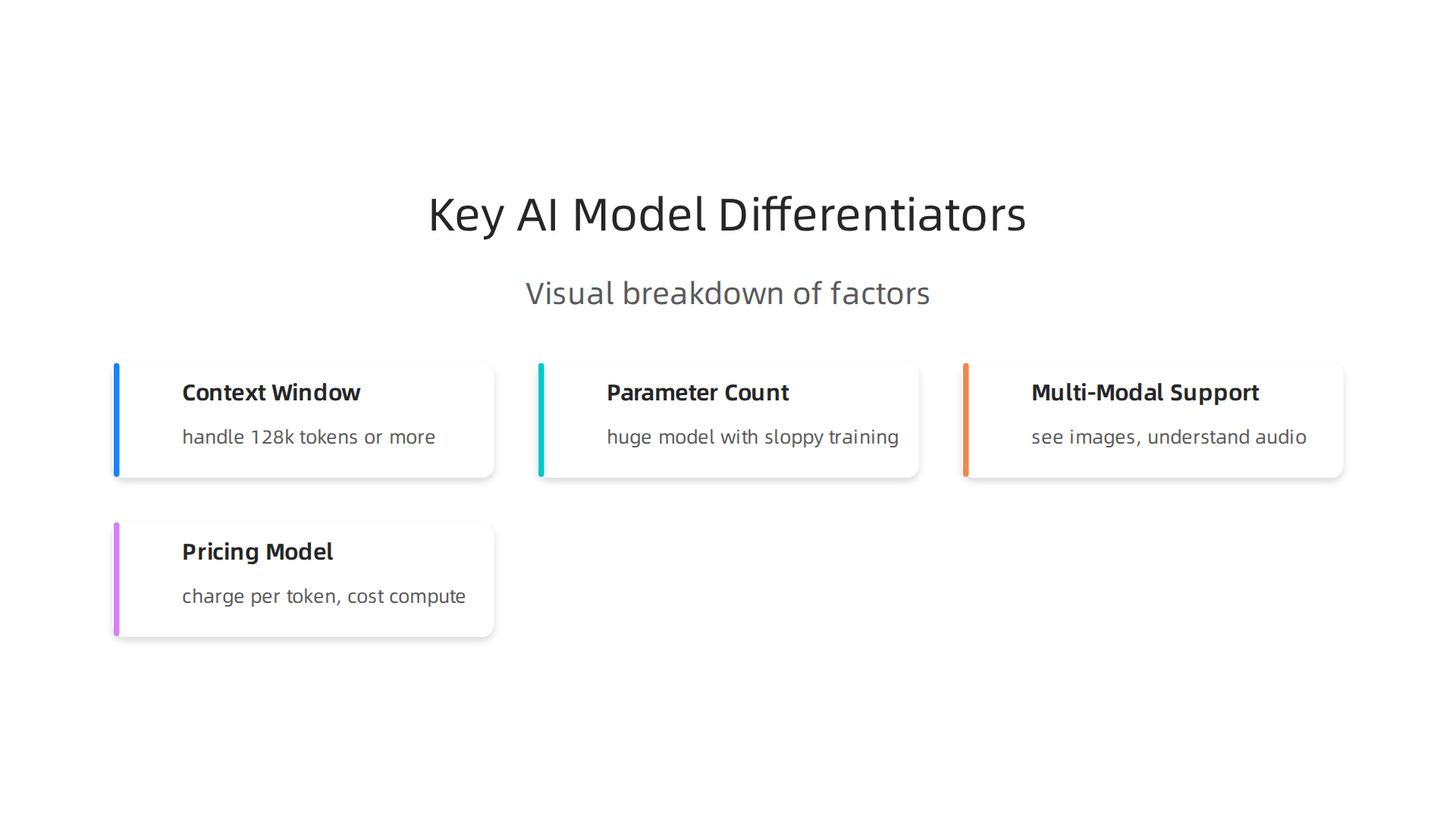
The TechTarget list of large language models highlights context window length as a big differentiator. Some models handle 128k tokens or more. Others stop at 8k. That matters for long documents or large codebases.
Parameter count also matters, but not alone. A huge model with sloppy training is worse than a smaller, well tuned one. Multi-modal support is another key factor. Can the model see images, understand audio, or generate video? Some models, like Gemini 2.0, are built for this from the ground up. Others are text first.
Pricing is the final big difference. Proprietary models charge per token. Open source models cost compute time and hosting. Depending on your volume, one might be much cheaper than the other.
Developer Preference Is Shifting
Here is a trend you should watch. More and more developers are choosing models with strong community ecosystems. They want active GitHub repos, clear documentation, and pre built fine-tuning tools. They want to ask a question in a forum and get an answer from someone who actually uses the model.
If you are building a product on top of these models, your team’s familiarity with the tooling matters as much as the benchmark score. A slightly slower model that your engineers already know how to optimize might beat a faster model that takes weeks to learn.

That is why many teams are now setting internal standards. If you are wondering how to do that for your own organization, check out our guide on 9 AI startup ideas for 2026 that solve real problems. It shows how smart model choices lead to better products.
The galaxy AI landscape is big. But once you know the main groups and the key trade offs, choosing the right model becomes much simpler.
Proprietary Leaders: GPT, Gemini, Claude
If the galaxy AI landscape is expanding fast, the three original stars are not slowing down. OpenAI’s GPT-4o, Google’s Gemini 2.0, and Anthropic’s Claude 3.5 remain the pillars of proprietary AI in 2026. Each keeps getting noticeably better.
Here is what changed this year. A detailed comparison shows that each model update narrows the gap between them. GPT-4o writes better than it did six months ago. Claude 4 runs faster than Claude 3.5. Gemini’s reasoning keeps getting sharper. The differences are real, but they are getting smaller.
Let us look at what makes each one special.
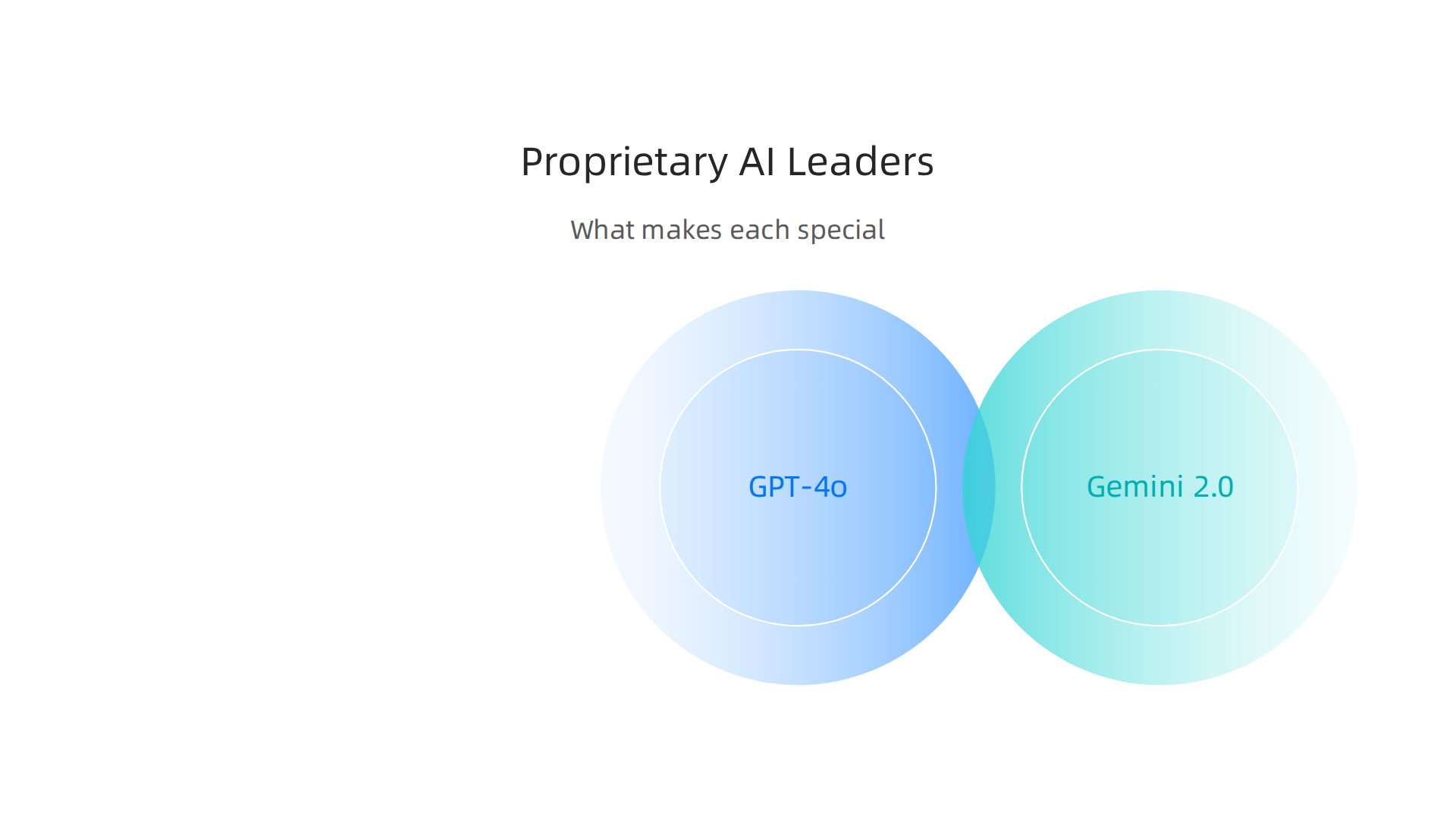
GPT-4o now handles a massive context window, perfect for long documents or large codebases. It excels at creative writing and conversational tone.
Gemini 2.0 is multi-modal by design. It processes images, audio, and video natively without extra plugins.
Claude 3.5 focuses on safety and reliability. It is often the top pick for sensitive business tasks where you need predictable outputs.
Pricing also varies. These models charge per token, so your volume matters. If you are wondering which model fits your budget and product, many developers now set internal standards first. That is why understanding future standard for AI implementation why your team needs clear rules now can save you weeks of trial and error.
The TechTarget list of large language models confirms context window length and multi-modal support as top differentiators. So if your project needs deep document analysis, Gemini or GPT might edge ahead. If you need safe, consistent answers at scale, Claude shines.
The bottom line? These three leaders are pushing each other to improve faster than ever. Whichever you choose, you are getting a tool that gets better every few months.
Open-Source Contenders: Llama, Mistral, DeepSeek
But what if you do not want to pay per token or be locked into one company’s API? That is where open-source models shine. In 2026, three names lead the pack: Meta’s Llama 4, Mistral Large, and DeepSeek V3. They are not just free alternatives. They often match or beat proprietary models on key tasks.
Here is what makes each one special.
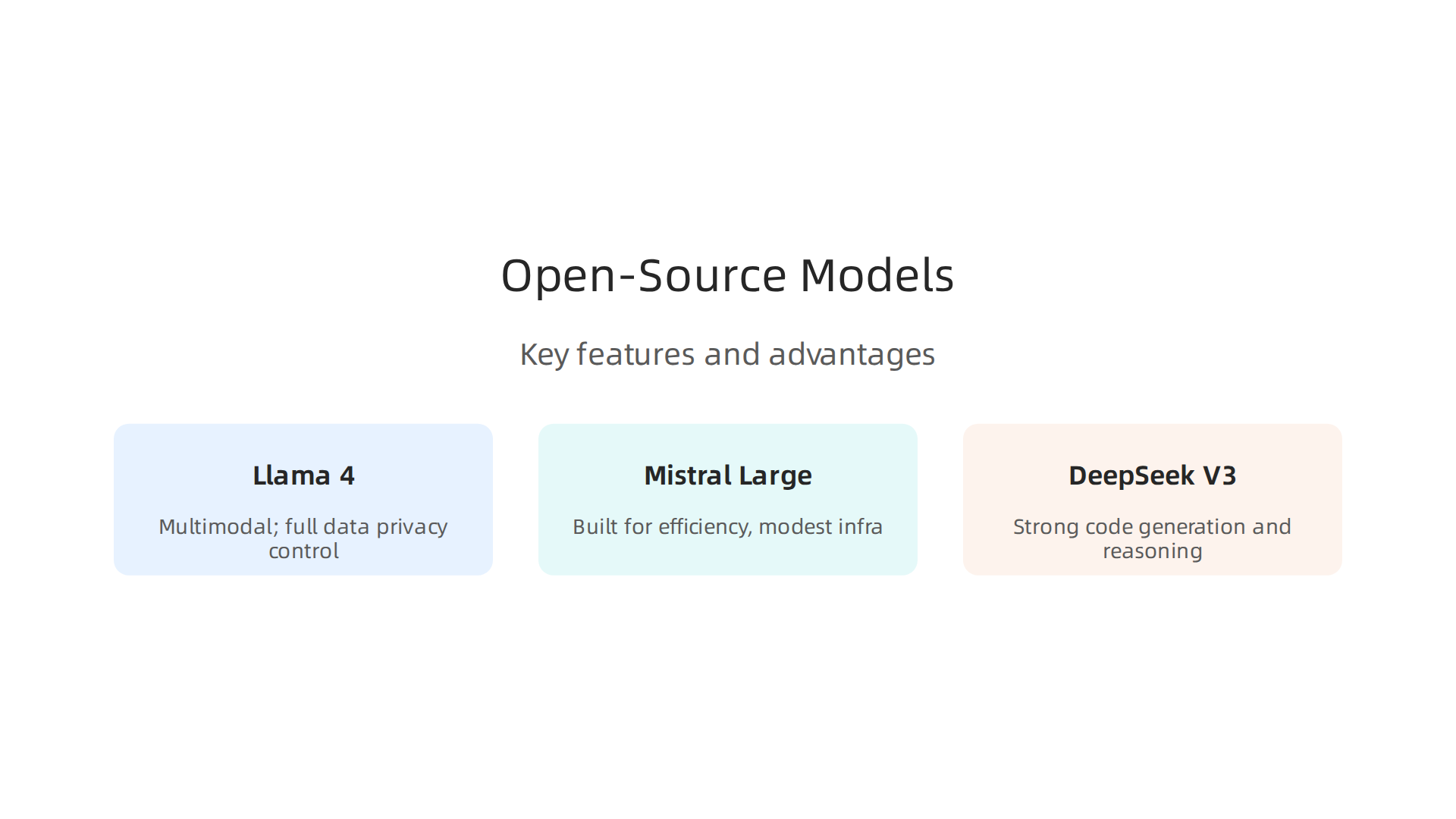
Llama 4 from Meta is a beast. The Maverick version uses a mixture of experts architecture with 17 billion active parameters and 128 total experts. Meta claims it beats GPT‑4o and Gemini 2.0 in multimodal tasks. You can download it and run it on your own hardware. That gives you full control over data privacy and cost.
Mistral Large stays lean and fast. It is built for efficiency while still scoring near the top of standard benchmarks. Many developers pick Mistral when they need a model that runs well on modest infrastructure.
DeepSeek V3 is the dark horse from China. It delivers strong performance in code generation and reasoning tasks, often at a fraction of the cost of closed models. The community around DeepSeek is growing fast, and new fine-tuned versions pop up every week.
The biggest advantage? Customization. You can fine-tune an open model on your own data, build a specialized version just for your product, and never worry about surprise API price hikes. That flexibility is a game changer for startups and enterprises alike.
If you are still deciding between open and closed models, understanding the difference between computer science vs software engineering can help you choose the right approach.
One more thing: stay on top of generative ai news. Models get updated constantly. A model that was second best last month might be the leader today. The open-source community moves fast, and you want to catch the best version while it is hot.
In short, the open-source galaxy ai is richer than ever. Llama 4, Mistral, and DeepSeek give you real choices that do not require a big budget or a locked vendor relationship.
Breaking Down the AI Model Competition
The open-source models we just looked at do not exist in a vacuum. The whole galaxy AI of 2026 is packed with options. From GPT‑4o to Claude 3.5 to Gemini 2.0, you have more choices than ever. But how do you actually compare them? The competition comes down to three main dimensions: performance, cost, and latency. No single model wins all three. You always have to trade off.
Performance is measured by benchmarks. These are standardized tests that check reasoning, math, coding, and language skills. For example, MMLU tests general knowledge across many subjects. GSM8K uses grade-school math word problems. HumanEval checks code generation. If you want a side-by-side look, you can check the LLM Leaderboard 2026 on Vellum for updated rankings. Leaderboards like HELM and Chatbot Arena also give transparent comparisons. They help you see which model scores highest in the areas you care about. But keep in mind: a high benchmark score does not always mean the model will work well in your specific app. Real-world results can differ.
Cost matters a lot. Proprietary models like OpenAI’s GPT‑4o charge per token. If you run a chatbot that handles millions of queries, those costs add up fast. Open-source models can be cheaper to run at scale, but you pay for infrastructure and maintenance. Latency is the third dimension. Some models answer instantly. Others take several seconds. For a real-time assistant, speed matters more than raw accuracy. For a data analysis tool, you might trade speed for a deeper answer.
Here is the tough truth: you cannot have it all. The best you can do is pick the model that fits your use case. That is why understanding the trade-offs is so critical. If you are building a product, you need to know whether performance, cost, or latency is your top priority. This decision often comes down to understanding the key differences between computer science and software engineering and how each discipline approaches model selection.
As you make your choice, remember to follow generative ai news closely. Models improve every month. A model that was slow and expensive last quarter might be fast and cheap today. Community discussions on platforms like OpenAI LinkedIn pages or Anthropic AI blogs often share real-world performance data that official benchmarks miss.
If you are building a startup or a new feature, exploring AI startup ideas for 2026 might also help you see which models fit specific problems.
In short, the competition is fierce. But once you understand the three dimensions, you can make a smarter choice for your project.
Benchmarks and Evaluation Metrics
So how do you actually measure which model is best? That is where benchmarks come in. Think of them like standardized tests for AI models. They check specific skills like reasoning, math, and coding. In 2026, the gold standards are MMLU, HumanEval, GSM8K, and newer tests like SWE-bench and BigCodeBench.
MMLU (Massive Multitask Language Understanding) tests general knowledge across 57 subjects. It is one of the most popular benchmarks for comparing models like GPT-4o and Claude 3.5.
GSM8K focuses on grade-school math word problems. There are 1,319 problems crafted by human experts. A model that scores well here shows it can handle step-by-step logic.
HumanEval checks code generation. It uses hand-crafted programming challenges to see if a model can write correct functions.
But the field is moving fast. Newer benchmarks like SWE-bench test how well models handle real-world software engineering tasks. BigCodeBench looks at large-scale code generation. These give a more practical view of what a model can actually do.
The tricky part? Leaderboards change all the time. A model that ranked first last month might be third today. That is why you need to follow trusted sources like the Vellum leaderboard or updates from Stanford CRFM and AI2. You can also check out the LLM Leaderboard 2026 on Vellum for the latest rankings across reasoning, coding, and math.
Remember: no single benchmark tells the whole story. A high score on MMLU does not mean a model will work great in your app. Real-world results can differ. So use benchmarks as a starting point, not the final answer.
If you are building a product, understanding these metrics helps you pick the right model for the job. And if you want to stay ahead, keep an eye on generative ai news and discussions from Anthropic AI or OpenAI LinkedIn pages.
For a deeper look at how these evaluation choices affect your team’s workflow, check out our guide on why your team needs clear rules for AI implementation.
Cost and Efficiency Comparisons
Benchmarks tell you which model is smartest. But cost and efficiency decide what you can actually use. Here is where things get real. Inference costs can vary by up to 10 times between providers. That means one model might cost $10 for the same work another does for $1. For teams building real products, that math matters a lot.

Speed and latency also depend on more than the model itself. Your serving setup matters. Batch size, quantization, and hardware type all affect how fast a model responds. A powerful model on slow hardware can feel worse than a smaller model on fast hardware. So you need to think about the whole stack, not just the benchmark score.
For example, a model like GPT-4 Vision can handle images, but the cost per call is higher. If your app does not need vision, a text-only model might save you money. Similarly, Anthropic AI offers Claude models with different price tiers. The key is matching the model to the job.
This is why staying current matters. Pricing and performance change fast. You can follow generative ai news and check providers like OpenAI LinkedIn updates to catch new pricing announcements. For a broader view, tools like the LLM Leaderboard 2026 sometimes list cost alongside benchmarks. The Iternal AI selection guide also breaks down cost trade-offs.
If you are building a startup, these differences can make or break your budget. Every dollar counts. That is why you should check out our guide on 9 AI startup ideas for 2026 that solve real problems to see how teams make smart cost decisions from day one.
The bottom line? Do not pick a model on performance alone. Look at the full picture. Cost, speed, and infrastructure work together. Get that balance right, and your app will run smoothly without breaking the bank.
Multi-Modal and Specialized Models: The Next Frontier
So you have thought about cost and efficiency. Now let us talk about what models can actually do. The real shift in 2026 is toward multi-modal and specialized models. These are not just buzzwords. They are changing how we build apps.
Multi-modal models can handle text, images, audio, and even video all at once. Instead of using one model for text and another for images, you now have a single model that does it all. That saves time and reduces complexity. Popular examples in 2026 include GPT-5, Gemini 3, and Claude 4.1 Opus. According to the best multimodal models ranking, these models combine vision, language, and reasoning in ways that were hard to imagine a few years ago. Another list of top multimodal models shows that open-source options like Llama 4 and DeepSeek-V3 also handle multiple data types well.
Take Samsung’s Galaxy AI as a real-world example. It runs multi-modal tasks right on your phone. It can read text, understand images, process voice commands, and even translate live conversations. You get all that power without sending data to the cloud every time. That makes apps faster and more private.
Then there are domain-specific models. These are built for narrow jobs like medical diagnosis, legal document review, or code generation. A general model might be okay for a broad task, but a specialized model gives you much higher accuracy. For instance, a model trained on millions of medical records will catch patterns that a general model would miss. A code-focused model like Anthropic AI’s Claude for coding can suggest better fixes than a jack-of-all-trades model. The same goes for GPT-4 Vision when you need to analyze images in a healthcare app. You do not need the overhead of a giant general model when a smaller, focused one does the job better.
To keep up with these changes, you need to follow generative ai news closely. Platforms like OpenAI LinkedIn posts announce new model releases and pricing updates. But more importantly, you should learn how to work with these models hands-on. That is why checking out our guide on best computer science courses for AI development in 2026 can help you gain the skills to build with multi-modal and specialized models.
The big takeaway? Multi-modal models are becoming the default. But do not ignore specialized models when you need precision. The best choice depends on your task. Match the model to the job, and you will get better results for less cost.
Domain-Specific Models (Medical, Legal, Code)
Here is the thing: when you need high accuracy in a narrow field, a big general model is often overkill. That is where domain-specific models shine. Think of them as specialists instead of generalists. They are fine-tuned on very specific data, so they catch details a general model might miss.
Take medical models like Med-PaLM. These are trained on millions of medical records, research papers, and clinical notes. They can help doctors diagnose rare conditions or suggest treatments based on the latest studies. Some of these models are now available through APIs or open weights, so developers can build them into healthcare apps without starting from scratch. For example, using GPT-4 Vision in a medical imaging tool can spot tumors that even skilled radiologists might overlook.
The same goes for legal documents. Specialized models trained on case law, contracts, and statutes can review thousands of pages in minutes. They flag contradictions, find relevant precedents, and even suggest edits. That saves lawyers hours of manual reading. And since these models are focused, their outputs are more reliable than what a general chatbot would give you.
Code is another big win. Models like CodeLlama and StarCoder 2 keep getting better. In 2026, some of them already match GPT-4o on coding benchmarks. That means you can use a smaller, cheaper model for writing and debugging code and save the heavy lifting for when you really need it. Pairing a code model with something like Anthropic AI’s Claude for complex logic can be a smart combo.
To stay on top of these specialized tools, follow generative ai news closely. Platforms like OpenAI LinkedIn pages often announce new model releases and fine-tuning options. But the best way to get good at using these models is to learn the skills. That is why checking out our guide on best computer science courses for AI development in 2026 can help you build the expertise to work with domain-specific models effectively.
And if you are building mobile apps, consider a device-native approach. Galaxy AI on Samsung phones shows how specialized, on-device AI can handle tasks like live translation or image analysis without the cloud. That keeps things fast and private.
The bottom line? Match the model to the job. For broad tasks, use a multi-modal giant. For precision work in medicine, law, or code, pick a specialist. Your users will notice the difference.
The AI Toolchain: From Model Selection to Deployment
Choosing the right model is only half the battle. You can have the best specialist model in the world, but if you cannot deploy it reliably, monitor its performance, or update it efficiently, it will sit on the shelf collecting dust. That is why in 2026, the real art of AI development lies in the full toolchain.
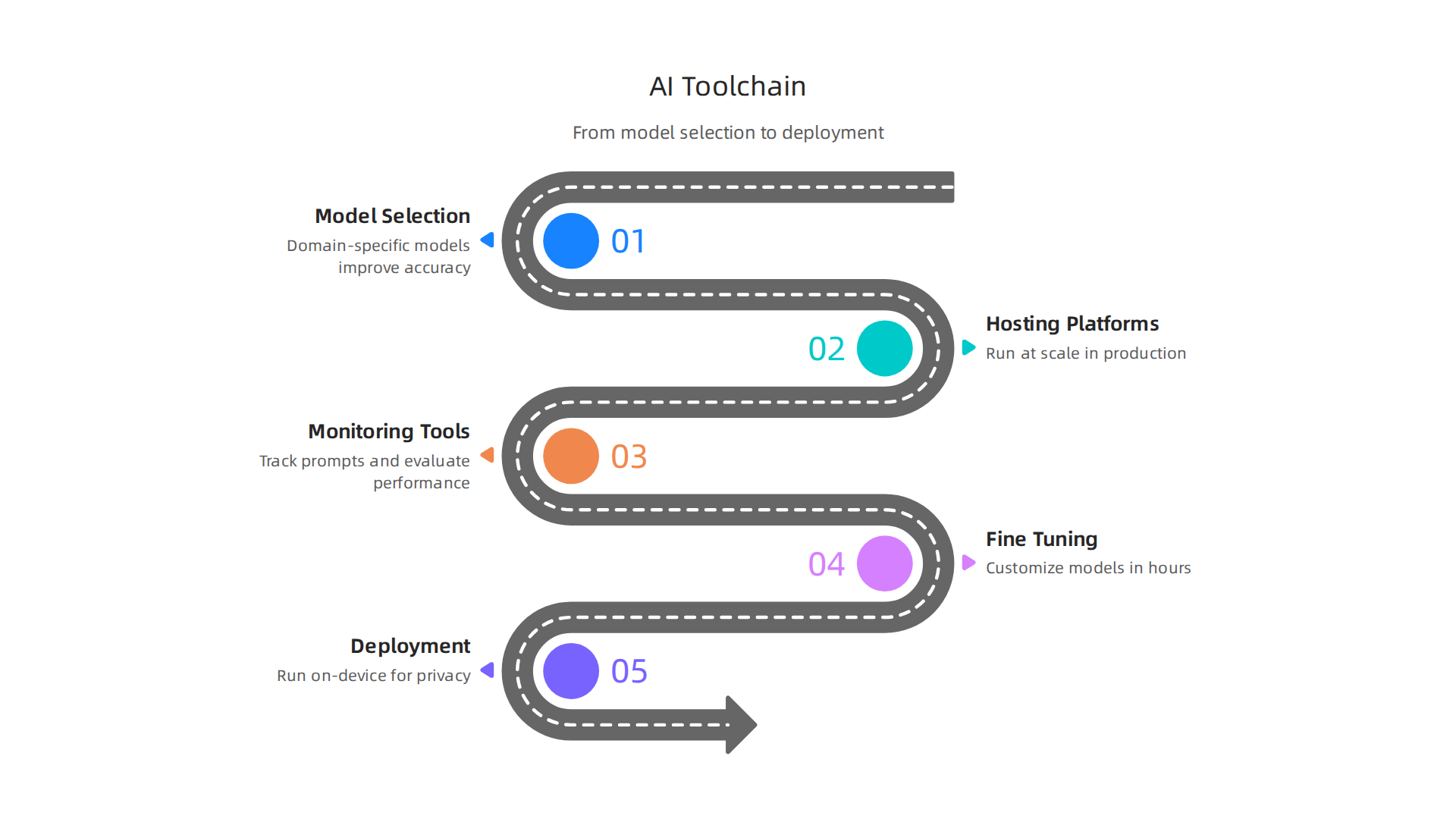
The first step is still model selection. As we just covered, domain-specific models in medicine, law, or code give excellent accuracy. But once you pick one, you need a platform to run it at scale. Popular platforms like AWS Bedrock, Google Vertex AI, and open-source solutions such as vLLM and Ollama simplify the path to production. Many teams now use dedicated LLM hosting platforms that handle scaling, latency, and concurrency automatically. A great starting point is checking out this list of the most scalable LLM hosting platforms in 2026 to see what fits your budget and skill level.
Once your model is hosted, you cannot just set it and forget it. Models drift over time. User behavior changes. A model that performed well last month might start giving bad answers. That is where observability and monitoring tools come in. Platforms like Maxim AI or Langfuse let you track every prompt and response, catch errors, and evaluate output quality. The top LLM observability platforms in 2026 give you dashboards that show exactly when and why your model starts failing. This kind of monitoring is not optional anymore. It is a core part of any production AI system.
Another big part of the toolchain is fine-tuning. Full retraining of a large model is expensive and slow. So in 2026, the standard approach is LoRA or QLoRA (Low-Rank Adaptation). These methods let you customize a model without retraining everything. You can adapt a general model to speak like your brand or handle your specific data set using just a few hours of GPU time. That keeps costs low and iteration speed high.
Finally, think about where your model runs. For many mobile or edge applications, you want the model to run on the device itself, not in the cloud. That is where Galaxy AI on Samsung phones shines, handling tasks like live translation or image analysis locally. It is fast and private. If you are building a consumer app, consider whether a smaller, on-device model could serve your users better than a giant cloud model.
To keep up with the latest in deployment strategies, follow generative ai news from places like the OpenAI LinkedIn page or other industry channels. And if you want to build the skills to manage the whole toolchain yourself, check out our guide on the future standard for AI implementation to see why your team needs clear rules now.
The bottom line? Selecting the model is just the start. A strong toolchain that includes hosting, monitoring, fine-tuning, and deployment will determine whether your AI project succeeds or fails. Pick your tools wisely.
APIs and Platforms
Picking your tools wisely starts with understanding the platforms and APIs that bring your model to the real world. Cloud providers offer managed AI platforms that hide all the complex infrastructure. You do not have to worry about GPUs or scaling nodes. You just call an API to use models like GPT-4 Vision for image analysis or Anthropic AI’s Claude for safe, high-quality text generation. This approach is fast for prototyping and scales easily when you go live. The best and most scalable LLM hosting platforms of 2026 break down the top choices for this exact use case.
But managed APIs are not the only path. If your project is cost-sensitive or needs strict data privacy, open-source platforms like vLLM and Ollama give you full control. You run the model on your own hardware, which saves money at scale and keeps data in-house. The trade-off is that you handle the setup, monitoring, and updates yourself. The top LLMOps tools in 2026 can help manage this complexity.
This choice between cloud and self-hosted also affects mobile AI. Galaxy AI on Samsung devices shows how on-device models handle translation and editing instantly, without sending data to the cloud. To stay updated on these fast-changing options, follow generative AI news or the OpenAI LinkedIn page. If you are thinking about building your own AI product, check out these 9 AI startup ideas for 2026 that solve real problems to get started.
Fine-Tuning and Customization
A generic model works okay for everyday tasks, but your project likely needs something more tailored. That is where fine-tuning steps in. The problem is that full fine-tuning updates every single weight in the model. That costs a lot of time and money. That is why parameter-efficient fine-tuning (PEFT) methods like LoRA and QLoRA have taken off in 2026. They only tweak a small set of extra parameters. You get a customized model that understands your specific domain at a fraction of the cost.
This shift has made fine-tuning accessible to smaller teams. Even better, new tools and marketplaces let you share and discover these lightweight adapters. Platforms like Hugging Face now host hubs where you can download a pre-trained adapter for your industry and apply it in minutes. Anyscale and other ML orchestration platforms also support deploying these adapters seamlessly. The top LLMOps tools this year can help you manage the whole pipeline from training to monitoring.
Fine-tuning is not just for cloud models either. On-device AI, like Galaxy AI, could benefit from lightweight customization without sacrificing privacy or speed. If you are thinking about building a product around a fine-tuned model, take a look at these AI startup ideas for 2026 that solve real problems for some inspiration. The key takeaway? You no longer need a massive budget to make a model your own.
Recent News and Shifts in the AI Model Ecosystem (2026)
The first half of 2026 has been nothing short of explosive for the AI model ecosystem. Major announcements are coming almost weekly, and it is getting harder to keep up. Let us break down the biggest developments that matter to developers and builders.
New Models and Major Partnerships
This year we saw the release of powerful new models, including updates to GPT-4 Vision and significant jumps from Anthropic AI. These models are not just bigger. They are smarter about understanding images, code, and long documents. Microsoft highlighted how AI is becoming a true partner in 2026, boosting teamwork and research momentum.
Partnerships are also reshaping the landscape. For example, OpenAI and LinkedIn deepened their integration, making generative AI news directly useful for professionals. This kind of collaboration means AI tools are now baked into platforms millions use every day.
Regulatory Changes Arrive
Governments are finally catching up. The EU AI Act is now in effect, and the United States has issued new executive orders around AI safety and transparency. According to IBM’s analysis, these rules are pushing companies to be more careful about how they train and deploy models. If you are building with Galaxy AI or any other on-device system, you need to understand these rules. They affect everything from data collection to user consent. Check out this guide on why your team needs clear AI implementation rules now to stay compliant.
Open-Source Models Rise Up
The biggest shift might be the rise of open-source models. The community has poured massive investment into models like Llama 3, Mistral, and others. A report from MIT Sloan notes that open-source ecosystems are now challenging the dominance of closed-source giants. This is great news for smaller teams. You can get a high-quality model without paying per token.
Stanford AI experts predict that 2026 is the year AI confronts its actual utility. That means the focus is shifting from hype to real-world value. And that is exactly where Galaxy AI and on-device models shine. They bring intelligence right to your pocket, no cloud needed.
The ecosystem is moving fast. Whether you are fine-tuning a model or building a new app, these shifts affect your choices. Keep an eye on generative AI news and the latest model releases. The rules are changing, but so are the opportunities.
How Developers Can Stay Ahead: Community, Skills, and Strategy
The AI model landscape is moving faster than ever. New models from Anthropic AI, GPT-4 Vision updates, and rising open-source alternatives appear almost weekly. To stay ahead, you need a strategy that goes beyond just reading generative AI news.

Here is how to keep your skills sharp and your projects on track.
Keep Learning Through Communities and Courses
The smartest developers don’t learn alone. They join communities where real discussions happen. The unofficial Llama community and Hugging Face forums are goldmines for practical tips and early insights. These places let you see how others are solving problems with the latest models.
Attending conferences in 2026 is also a game changer. Events like the ones highlighted in Microsoft’s AI trends report give you direct access to breakthroughs and peer networking. But if travel is not an option, managed learning paths are a solid backup. Check out these best computer science courses for AI development in 2026 to find structured programs that match your pace.
Build a Repeatable Evaluation Pipeline
Here is a problem many developers face: a new model drops, you spend hours testing it manually, and then another one arrives. You need a system. Create a repeatable pipeline that benchmarks models against your specific tasks. For example, test how GPT-4 Vision handles image analysis or how an open-source model like Llama 3 performs on your codebase.
According to IBM’s AI tech trends analysis, 2026 is all about measuring real utility. A good evaluation pipeline saves you time and helps you pick the right tool for the job.
Stay Platform-Agnostic
Vendor lock-in is a trap. If you build everything around one model provider, you lose flexibility when a better option appears. Adopt a platform-agnostic approach. Use abstractions like APIs that let you swap models easily. This is especially important as open-source models mature and on-device solutions like Galaxy AI become more capable.
Also remember the new regulations. The EU AI Act and U.S. executive orders mean your architecture must handle compliance. Read about why your team needs clear AI implementation rules now to avoid headaches later.
The ecosystem is full of opportunities in 2026. By staying connected, testing smartly, and keeping your options open, you will not just keep up. You will lead.
Summary
This article maps the rapidly expanding AI model landscape of 2026 and gives technical leaders, engineers, and founders a practical way to choose models without getting lost in hype. It explains who the major players are—proprietary leaders like GPT, Gemini, and Claude—and why open‑source contenders such as Llama, Mistral, and DeepSeek now compete on performance and cost. You’ll learn the three core trade‑offs (performance, cost, latency), which benchmarks to trust, and when to use multi‑modal or domain‑specific models. The guide also covers the end‑to‑end toolchain: hosting, observability, and parameter‑efficient fine‑tuning (LoRA/QLoRA), plus deployment options from cloud APIs to on‑device inference. By the end you’ll be able to evaluate models for your specific use case, set internal standards to avoid vendor lock‑in, and build a repeatable pipeline to monitor and update models as the ecosystem evolves.