
Types of AI Narrow General and Superintelligence for Developers Explained
Overview
Introduction: Navigating the AI Landscape in 2026
If you are a developer in 2026, you have probably noticed something. The words around AI keep changing fast. One day everyone talks about generative AI. The next day it is all about agents and reasoning models. It can feel like you need a new dictionary every month.
But here is the truth. Even with all this rapid progress, the basic categories of AI have not changed much.

Understanding these core types is what helps you pick the right tool for the job.
Right now, every AI system that actually exists falls into one group: narrow AI. Sometimes people call it weak AI. These systems are great at one specific task. Think of ChatGPT writing code or Siri setting a timer. They do that one thing very well, but they cannot do anything outside their training. They have no real understanding.
Then there are two theoretical types. Artificial General Intelligence or AGI would match a human at any intellectual task. And Artificial Superintelligence or ASI would go far beyond us. Neither exists today. But knowing where these categories start and stop helps you avoid hype when choosing tools for your projects.
On top of that, you also hear about how AI learns. Supervised vs. unsupervised learning. Generative vs. discriminative models. These are different ways to slice the same pie. They matter because the type of AI you build changes based on how you train it and what you need it to do.
This article gives you a clear framework for the types of AI so you can make smarter decisions. We will walk through each category, explain what it means for your work, and show you how to match the right approach to your use case.
If you want to keep up with everything changing in AI development, it helps to have a steady source of daily updates. The different types of artificial intelligence are just the start. You also need to know which models and platforms actually deliver results.
That is why many developers turn to a trusted newsletter for clarity.
To cut through the noise and get practical AI news every day, consider subscribing to The AI Newsletter Worth Reading. It is a simple way to stay informed without drowning in tabs and tweets.
Next, we will look at narrow AI in depth and see why it still powers everything you use today.
What Are the Main Types of AI? A Capability-Based Framework
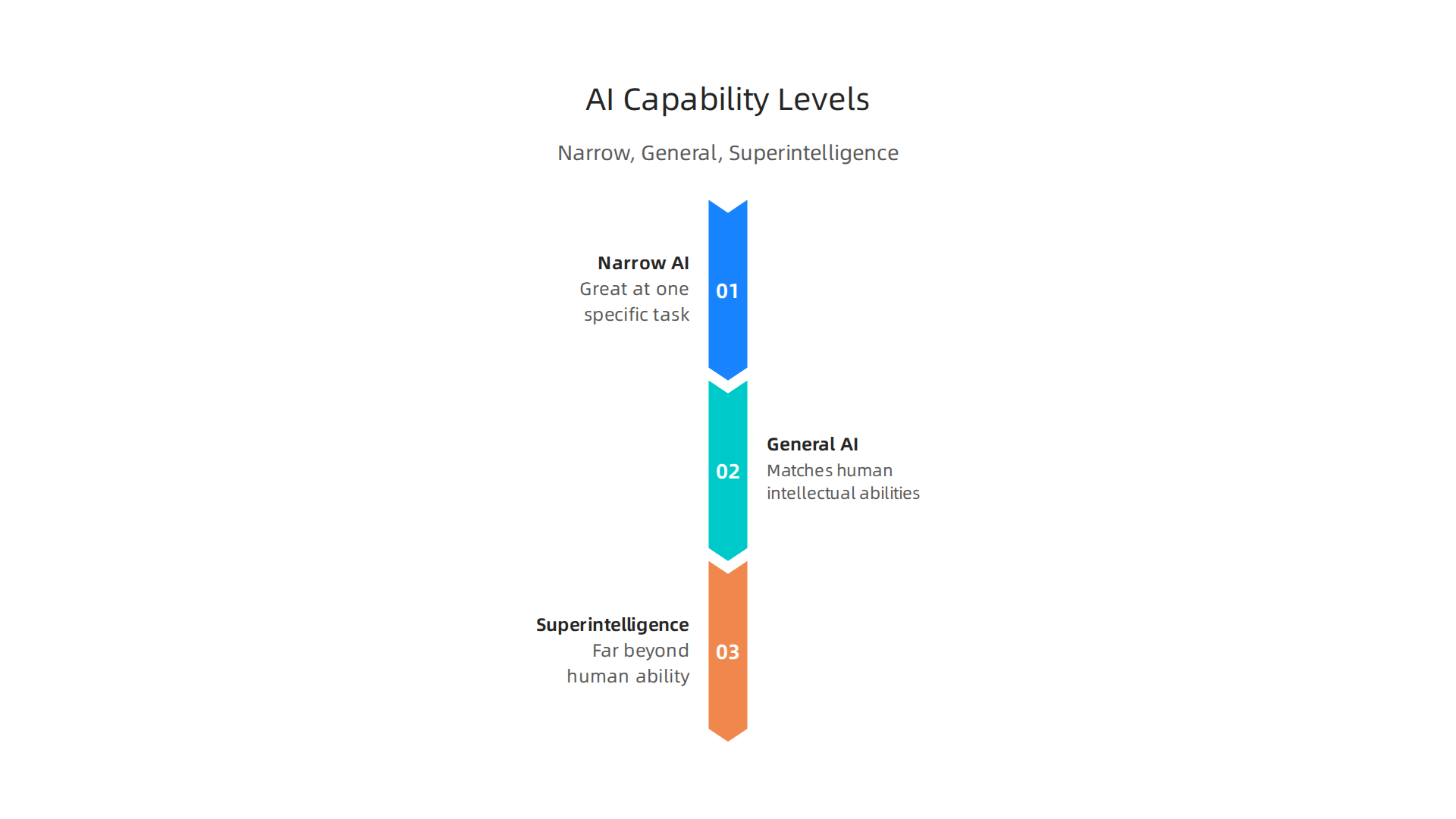
Now let us step back and look at the full picture. The most common way to sort the types of AI is by what they can actually do. This is called a capability-based framework. It breaks AI into three levels: Narrow AI, General AI, and Superintelligence.
Knowing where each one sits helps you scope your projects and avoid chasing impossible goals.
The first level is Narrow AI, sometimes called Weak AI. Every system you can use today fits here. From your IDE’s code autocomplete to the chatbot that answers support tickets, these models are trained for one job. They can beat humans at that job, but they cannot do anything else. If you ask a code generator to write a poem, it might try, but that is not what it was built for. The Narrow AI, General AI, and Superintelligence article explains that these systems "cannot transfer knowledge beyond" their narrow domain. That is the key limit.
The second level is General AI, or Artificial General Intelligence (AGI). This is a theoretical machine that could learn any task a human can. It would not need separate training for every new problem. It would adapt, reason, and understand context the way we do. But AGI does not exist in 2026. Researchers are working toward it, but most estimates say it is still years or decades away. For a developer, that means you should not plan your architecture around AGI. Focus on what narrow AI can do right now.
The third level is Artificial Superintelligence (ASI). This goes beyond human ability in every way. ASI would be smarter than the smartest person in every field. It is also purely theoretical. Some people worry about ASI, but for your daily work, it is not something you need to think about.
Why does this framework matter for you? Because it sets realistic expectations. When a vendor says their tool is "general intelligence," you now know they are using buzzwords.

Real AI in 2026 is narrow. That is not a bad thing. Narrow tools are incredibly powerful when you match them to the right task. If you are choosing between AI software development tools for your 2026 team, understanding this hierarchy helps you pick tools that solve actual problems rather than chasing hype.
Keep this three-level model in your head. It will save you time, money, and frustration as you build with AI.
Machine Learning Paradigms: Supervised, Unsupervised, and Reinforcement Learning
Now that you understand the capability levels, let us look at how AI actually learns. Machine learning powers nearly every modern AI system. And there are three main ways machines learn. Understanding these types of AI learning is key to choosing the right approach.
Supervised learning uses labeled data. You give the model examples with the right answers. It learns to map inputs to outputs. This works great for spam detection or price prediction. You need a good dataset, but the results are reliable.
Unsupervised learning works with unlabeled data. The model finds patterns on its own. It groups similar items together. This is useful for customer segmentation or anomaly detection. No correct answers exist, so the model discovers hidden structures.
Reinforcement learning is different. The model learns by trial and error. It takes actions and gets rewards or penalties. Over time, it figures out the best strategy. This powers game-playing AIs and robotics.
Each paradigm serves a different purpose. Mastering AI means knowing when to use each one. According to Coursera’s guide on machine learning algorithms, these three learning styles help you pick the right method for your problem.
If you are new to AI development, start with supervised learning. It is the most straightforward. Then explore unsupervised and reinforcement learning as your projects grow.

To keep learning, check out these MIT free online courses for developers.
And if you want daily updates on AI tools and techniques, sign up for The AI Newsletter Worth Reading.
Supervised Learning: Labeled Data and Predictive Tasks
Let us zoom in on the most popular type of AI learning. Supervised learning is the workhorse behind many developer tools you use every day. The idea is simple. You feed the model examples that already have the correct answers attached. These are called labeled datasets.
Think of it like studying for a test with an answer key. You learn the pattern between the question and the correct response. Then you can predict answers for new questions you have never seen before.
Supervised learning handles two main jobs. Classification tasks put things into categories. Is this email spam or not? Is this code buggy or clean? Regression tasks predict numbers. How many hours will this build take? What will the server load be at 3 PM?
Some common algorithms power these tasks. Linear regression draws a straight line through data points to predict values. Decision trees ask a series of yes or no questions to reach a conclusion. Support vector machines (SVMs) draw boundaries between different groups of data. And neural networks learn complex patterns through layers of connected nodes. According to a recent roundup of the top machine learning tools, decision trees and SVMs remain go-to choices for classic supervised tasks in 2026.

For developers, supervised learning is already embedded in your workflow. Code completion tools like GitHub Copilot use it to suggest the next line. Bug prediction models scan your commits and flag risky changes. Vulnerability detection tools learn from past security flaws to catch new ones before deployment.
If you want to explore which AI tools can boost your daily coding, check out this guide on how to choose the right AI tools for developers to boost productivity.
Supervised learning is the most straightforward way to get started with the types of AI that actually ship to production. Master it first, and you will have a solid foundation for the other learning paradigms.
Unsupervised Learning: Finding Patterns Without Labels
Now that you have seen how machines learn with labeled answers, let’s flip the script. What happens when the data has no answers attached? That is where unsupervised learning comes in. Instead of predicting a correct output, the model explores the data on its own to find hidden structures.
Think of it like walking into a library with no catalog system. You look at the books, notice which ones have similar covers or topics, and start grouping them yourself. The machine does the same thing. It clusters similar data points together or reduces the number of features to reveal the most important patterns.
Two main jobs fall under unsupervised learning. Clustering groups data into categories based on similarity. For example, a streaming service might cluster viewers by what they watch to recommend new shows. Dimensionality reduction compresses data by removing noise and keeping only the essential information. This is how facial recognition systems can identify a face without analyzing every single pixel.
Common algorithms include k-means and hierarchical clustering for grouping, and PCA (principal component analysis) and autoencoders for reducing dimensions. As you explore the different types of AI, you will find that unsupervised learning powers many real-world developer tools. It runs anomaly detection in server logs, segments customers in analytics dashboards, and helps explore messy datasets before any labels are created. In fact, understanding how to apply unsupervised methods is a key part of ai mastering for any developer building data-driven applications.
For a practical look at how these algorithms translate into real tools, check out this roundup of the best AI apps for developers in 2026. And according to a guide on machine learning algorithms, unsupervised learning remains one of the three core learning styles every developer should know, alongside supervised and reinforcement learning. You can read more in the 10 Machine Learning Algorithms to Know in 2026 overview.
If you want to keep up with every breakthrough across all these types of ai, from clustering to deepsearch ai and beyond, a daily source of curated insights can save you hours. That is why many developers turn to The AI Newsletter Worth Reading for clear, daily AI updates straight to their inbox.
Reinforcement Learning: Learning Through Interaction
So far we have covered machines learning from labeled answers and from hidden patterns. But there is a third approach, and it works very differently. Reinforcement learning (RL) trains an agent to make decisions by interacting with an environment and collecting rewards.
Picture a video game character learning to play a level. It starts by trying random buttons. When it scores points, it remembers what worked. Over time, it gets better and better. That is RL in action.
Key concepts power this process. The policy is the strategy the agent follows. The reward function defines what counts as success. The value function estimates the long-term benefit of each state or action. And the balance between exploration (trying new moves) and exploitation (repeating what works) is the central tension in every RL system.
RL powers some of the most impressive AI achievements today. Game AIs use it to beat world champions. Robots learn to walk and grasp objects through RL. And in software development, RL now optimizes production code through compiler autotuning and automated testing.
For developers getting serious about ai mastering, RL represents the frontier of self-improving systems. Many popular frameworks now include RL libraries alongside traditional supervised and unsupervised tools. The Top 20 Machine Learning Tools 2026 overview highlights platforms that support RL development for real-world applications. And if you want to see which models excel at complex decision tasks powered by advanced RL, the AI model comparison 2026 guide breaks down the top contenders.
Deep Learning: Architecture, Applications, and When to Use It
Now that we have seen how reinforcement learning works through trial and error, let us look at the type of AI behind image recognition, voice assistants, and tools like deepsearch AI. This is deep learning.
Deep learning uses multi-layer neural networks to model very complex patterns. Think of it as a stack of simple math layers. Each layer detects a slightly more abstract feature. In image recognition, the first layer might find edges. The next layer finds shapes. Later layers recognize objects like faces or cars.
Three main architectures power most deep learning systems today:
- CNNs (Convolutional Neural Networks) – Great for images. They scan small pieces of an image and combine them to understand the whole picture.
- RNNs (Recurrent Neural Networks) – Designed for sequences like text or audio. They remember past inputs to make sense of what comes next.
- Transformers – The current star. They handle entire sequences at once using attention. ChatGPT, Gemini, and Grokipedia website rely on transformers for understanding and generating language.
Deep learning drives many of the biggest AI breakthroughs. It powers facial recognition on your phone, translates languages in real time, and creates realistic images from text descriptions. In 2026, new architectures push these limits even further. For example, GPT-5.4 uses advanced memory management to handle huge context windows, as covered in this AI breakthroughs in 2026 update.
So when should you choose deep learning over traditional machine learning? The short answer: when you have lots of data, a complex task, and enough computing power. Deep learning shines with large datasets and problems where rules are hard to define manually, like understanding human speech or reading handwriting. If you have a small dataset or a simple problem, simpler models often work better and run faster.
For developers pursuing ai mastering, deep learning is essential. The best way to get started is to practice with major frameworks like TensorFlow or PyTorch. And if you want to craft better prompts for transformer models, this guide on advanced prompt engineering 2026 techniques will help you get reliable results.
Staying current with deep learning moves fast. New papers and tools appear daily. To keep your finger on the pulse without getting overwhelmed, consider subscribing to The AI Newsletter Worth Reading for clear daily AI updates.
Generative AI: Models, Use Cases, and Developer Tools
If deep learning is the engine, generative AI is the vehicle that delivers the output everyone is actually using. This category of AI creates new content instead of just analyzing existing data. Text, code, images, audio, and even 3D models can be generated from scratch.
Generative AI comes in two main model families. Large Language Models (LLMs) like GPT and Claude predict the next word in a sequence to produce paragraphs, emails, or entire code files. Diffusion models like DALL-E and Stable Diffusion start with random noise and gradually refine it into a realistic image. Understanding these model types helps you pick the right tool for the job.
When exploring the many types of ai, generative models are the most consumer-facing in 2026. According to recent data, 78% of organizations now use generative AI in at least one business function, up from 55% just a year earlier. The most common uses are content generation, customer support automation, and code creation, as shown in the Generative AI Statistics for 2026.
For developers specifically, generative AI has become a daily companion. Tools like GitHub Copilot, Claude Code, and Cursor generate huge portions of new code. In fact, 84% of developers now use AI coding tools, and 51% of professionals use them daily. Yet only 29% fully trust the output. This trust gap highlights the need for human oversight and prompt engineering skills, as covered in the AI Coding Assistant Stats 2026.
The developer tool landscape has fractured rapidly. ChatGPT leads in general awareness, but specialized assistants like Claude Code have jumped to 18% adoption. For anyone serious about ai mastering, knowing which model powers each tool is essential. For instance, knowing whether a code generator uses GPT or a fine-tuned open-source model can affect output quality and cost. You can compare the major options in this AI model comparison for 2026.
Platforms like deepsearch AI and the grokipedia website also rely on generative models to power research and knowledge retrieval. As these tools evolve, developers who understand the underlying architectures will be able to integrate them more effectively. The key takeaway: generative AI is not just about asking chatbots questions. It is a set of powerful model types that you can combine with prompt tuning, fine tuning, and smart tooling to build real world applications.
Understanding AI Agents and Automation Systems
Once you have a handle on generative models, the next big step is letting those models take action on their own. That is where AI agents come into the picture. An AI agent is a system that can see what is happening around it, make decisions, and then take real steps to get something done. Think of it as a smart assistant that does not just answer questions but actually completes tasks for you.
Most modern AI agents are powered by large language models and planning algorithms. They can break a big goal into smaller steps, use tools like web search or code execution, and keep going until the work is finished. This makes agents a very useful type of ai for automation.
There are different ways to build these agents. Some use a reactive architecture, which means they simply react to what they sense without long-term planning. Others are deliberative, meaning they build a plan before acting. The most powerful agents use hybrid models that combine both approaches for flexibility and reliability.
Multi-agent systems are becoming popular for complex jobs. Instead of one agent doing everything, you have a team of agents where each one has a special role. For example, in software development, one agent might review code while another runs tests and a third handles deployment. Frameworks like CrewAI, LangGraph, and AutoGen make it easy to set up these multi-agent teams. You can explore the latest tools in this AI Agent Frameworks 2026 guide.
Getting into ai mastering means understanding how agents work and how to combine them with other AI tools. For instance, agents often use retrieval platforms like the deepsearch AI tool to pull in knowledge while making decisions. And systems like the grokipedia website rely on agent-based architectures to organize and serve information.
If you want to integrate agents into your workflow, you need to pick the right framework for your team. The selecting AI software development tools guide can help you compare options.
The agent ecosystem is moving fast. To keep up with the newest tools and best practices, consider staying informed with regular updates. Getting clear daily AI updates from The Deep View Newsletter is a simple way to stay ahead.
How to Evaluate and Choose the Right AI Approach for Your Project
With all the tools, frameworks, and models out there, picking the right approach for your project can feel overwhelming. But it does not have to be.

A clear decision framework helps you match your problem to the best solution.
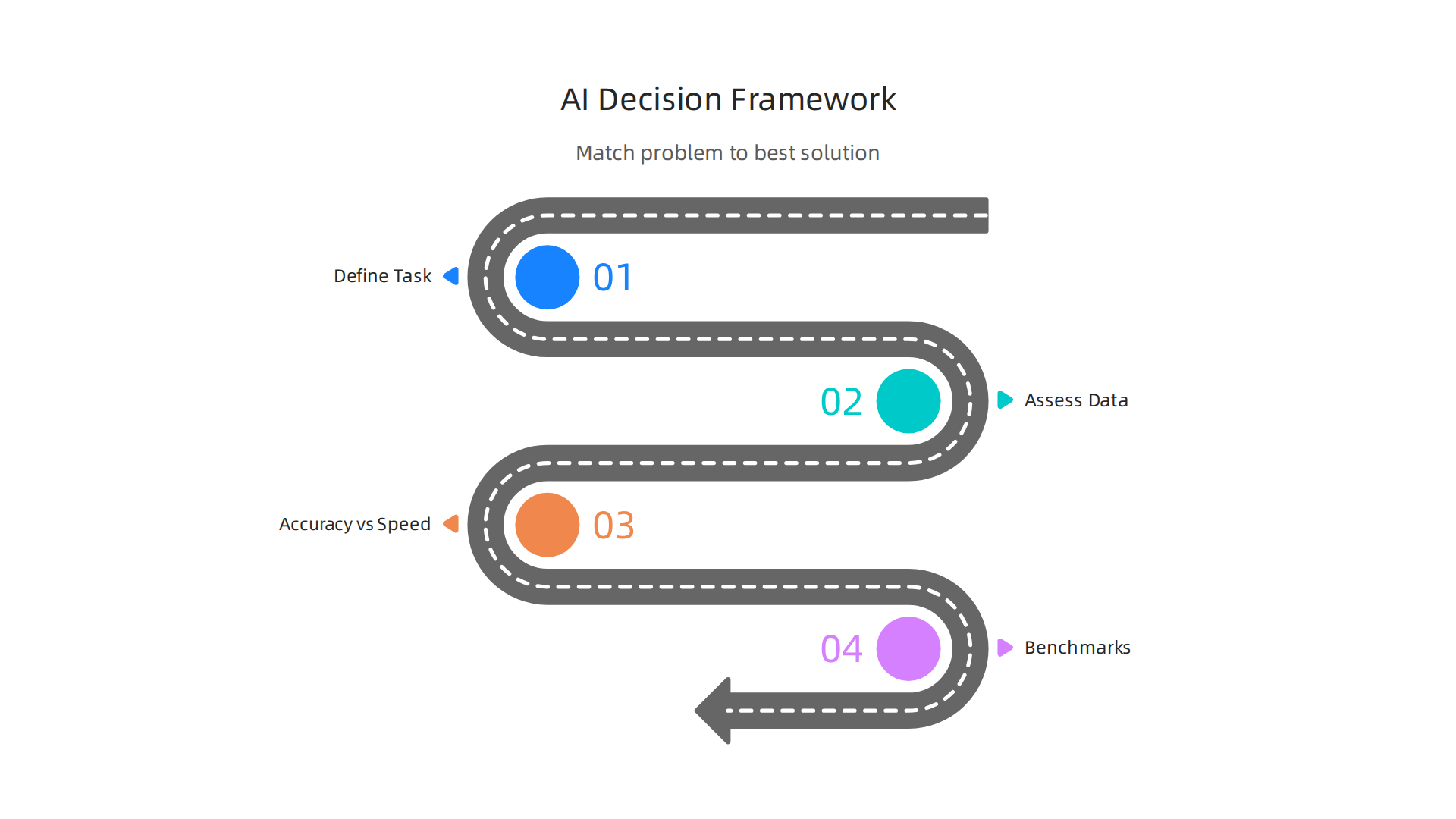
Start by defining your task. What exactly do you need the AI to do? If you need to generate text, images, or code, a generative model like GPT or Claude is likely your answer. If you need a system that takes actions on its own, like sorting emails or deploying code, you want an AI agent. Understanding the different types of ai helps you narrow the field right away.
Next, look at your data. Do you have a large, labeled dataset for training? Or are you working with limited or unlabeled data? Some approaches, like supervised learning, need lots of high-quality labels. Others, like retrieval-augmented generation (RAG), can work with your existing documents and knowledge bases. Tools like the deepsearch AI platform are great for pulling relevant information during decision-making, while the grokipedia website relies on agent-based architectures to organize vast amounts of data.
Then think about accuracy needs versus speed. A simple rule-based agent might be fast and cheap but not very accurate. A large language model can be highly accurate but slower and more expensive. For many production systems, a hybrid approach works best. For example, you might use a fast reactive agent for simple tasks and a more powerful deliberative agent for complex ones. This trade-off is a key part of ai mastering learning to balance performance with cost.
Finally, use benchmarks and community signals to validate your choice. Look at how well a model performs on standard tests like HumanEval for code or MMLU for general knowledge. Check open-source popularity on GitHub, documentation quality, and community support. Frameworks like LangGraph and CrewAI have strong communities and clear documentation, which makes them safer bets for production.
If you are building for a specific domain, compare frameworks carefully. The top AI agent frameworks comparison from JetBrains shows how LangGraph excels for graph-based workflows, while CrewAI is best for multi-agent teams. For enterprise environments, Semantic Kernel offers strong integration with existing systems.
For a more general guide on picking the right fit for your team, check out this resource on choosing AI tools for developer productivity. It breaks down the options by use case and team size, making the decision much easier.
Summary
This article gives developers a practical framework for the types of AI that matter in 2026, explaining capability levels (narrow AI, AGI, ASI), core learning paradigms (supervised, unsupervised, reinforcement), and modern architectures like deep learning and transformers. It shows when to pick each approach—when supervised models suffice, when unsupervised discovery helps, when reinforcement learning is appropriate, and when deep learning or generative models are required. The piece also covers agentic systems that act autonomously, and offers a decision path for choosing models, frameworks, and trade-offs between accuracy, cost, and speed. Readers will learn to spot marketing hype, match tools to specific tasks, and evaluate platforms and benchmarks so they can pick practical AI solutions for production projects.