
Enterprise AI Platforms Compared AWS Azure Google Cloud and Hardware for 2026
Overview
Introduction: The New AI Arms Race Among Enterprise Tech Giants
Artificial intelligence is reshaping world wide technology at a speed we’ve never seen before. In 2026, the biggest names in tech — AWS, Microsoft, NVIDIA, and Google — are all fighting to be your go-to AI platform. Each one offers a different mix of cloud services, hardware, and software tools. And the numbers show that businesses are jumping in fast: 72% of enterprises now have at least one AI workload in production, up from 55% in 2024 (MedhaCloud). Generative AI adoption alone has doubled from 33% to 65% in just two years (Swfte AI).
But here’s the catch. With all these options, many teams end up stuck.

The same research shows that 79% of organizations face real challenges when trying to adopt AI (Writer). Information overload makes it hard to pick the best AI software. Developers and technical leaders need a clear way to compare top ai software companies and their platforms without getting lost in marketing hype.
This article cuts through the noise. We’ll walk through the main enterprise AI platforms from the biggest players — covering their strengths, weaknesses, and what they mean for your stack. Think of it as your structured, evidence-based guide to choosing what fits your team best. If you are still building your skills, our AI model comparison 2026 dives into the actual models powering these platforms.
The AI arms race is here. The winners won’t just be the companies that build the smartest models — they’ll be the teams that pick the right tools for the job. Let’s find yours.
And if you want to stay ahead of every shift in this fast-moving space, get the daily digest that keeps developers and leaders in the know. Subscribe to The Deep View Newsletter — clear AI updates worth your time.
Cloud Titans: AWS, Azure, and Google Cloud’s AI Offerings Compared
Choosing between AWS, Azure, and Google Cloud for AI feels like picking a favorite child. Each is powerful, but they shine in different areas. If your team is overwhelmed by options, you are not alone. Let’s break down what each cloud giant offers in 2026 so you can match the best ai software to your real needs.
Core AI Services
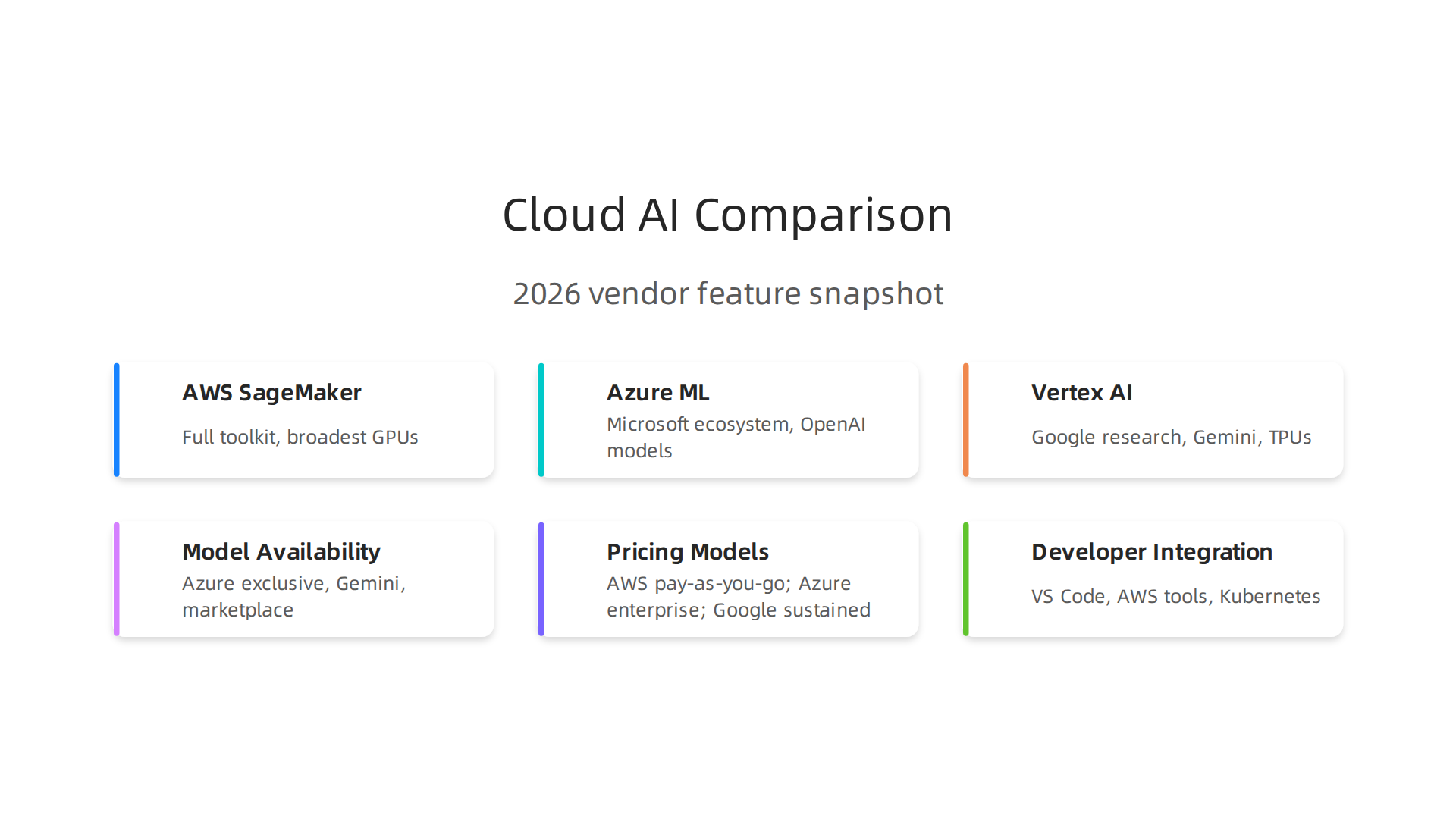
AWS leads with Amazon SageMaker, a full toolkit for building, training, and deploying models.
It gives you the broadest selection of GPUs and deep customization. Azure Machine Learning is built around Microsoft’s world wide technology ecosystem. It hooks into OpenAI models like GPT-4o and tools like GitHub Copilot. Google Cloud Vertex AI leans on Google’s own research — think Gemini models and custom TPUs for high-speed training (KodeKloud).
What Sets Each One Apart
Here’s where things get interesting.
- Model availability: Azure gives you exclusive access to the latest OpenAI models. Google Cloud offers its own Gemini line plus a strong open-source catalog. AWS has the biggest marketplace of third-party models and supports nearly any framework (ThoughtWaveSoft).
- Pricing: AWS offers pay-as-you-go with volume discounts. Azure has enterprise agreements that save money if you already use Microsoft products. Google Cloud stands out with sustained use discounts and competitive rates for data-heavy workloads (BuzzClan).
- Developer tool integration: Azure naturally connects with Visual Studio Code, GitHub, and Azure DevOps. AWS integrates with its own tools plus Terraform and CloudFormation. Google Cloud plays well with Kubernetes and offers Gemini Code Assist for inline help (Tech Insider).
Developer Experience
Your team’s daily workflow matters. AWS SageMaker provides the richest set of APIs and SDKs, but it has a steeper learning curve. Azure Machine Learning offers a simpler setup if you’re already in the Microsoft stack. Google Vertex AI wins on ease of use with pre-built pipelines and AutoML features that speed up experimentation (DigitalOcean). All three support workflow automation through their own orchestrators, so you can trigger retraining, deploy models, and monitor performance without manual steps.
No matter which cloud you pick, the key is to start small. Try a pilot on the platform that matches your existing tools. If your team lives in GitHub and VS Code, Azure will feel natural. If you need raw flexibility and a huge model zoo, AWS is your bet. And if you want cutting edge research plus data analytics, Google Cloud stands out.
For a deeper look at the actual models behind these platforms, check our best ai apps for developers in 2026 guide.
The cloud titans are racing hard. But winning in AI isn’t about picking the flashiest platform. It is about choosing the one that fits your team, your budget, and your goals. And staying informed every week helps you adjust as the landscape shifts.
Get the daily intelligence that keeps you ahead of every move in this space. Subscribe to The Deep View Newsletter — clear, unbiased AI updates worth your time.
Silicon Powerhouses: NVIDIA, AMD, and Intel in the Enterprise AI Hardware Race
The cloud platforms we just compared don’t run on magic. They run on massive clusters of specialized chips. And in 2026, three companies drive almost all of the enterprise AI hardware: NVIDIA, AMD, and Intel. Understanding their silicon helps you pick the right foundation for your best ai software.
NVIDIA Still Leads, but the Lineup Is Changing
NVIDIA’s H100 has been the workhorse for years.
ith its powerful GPU solutions.](https://aidevelopertoolsnews.com/wp-content/uploads/2026/05/weblish-inline-30518.png)
It packs 80 GB of HBM3 memory with 3.35 TB/s bandwidth (NVIDIA H100 specs). You can buy one outright for around $25,000 or rent cloud instances starting at $2.69 per hour (JarvisLabs H100 pricing). It handles inference efficiently for models up to about 70 billion parameters.
Then came the H200. It jumps to 141 GB of HBM3e memory and 4.8 TB/s bandwidth (NVIDIA H200). That’s 76% more memory and 43% more bandwidth than the H100 (Introl comparison). For teams running memory-hungry models without switching to a bigger chip, the H200 is the sweet spot.
Now the B200 is shaking things up. Based on the Blackwell architecture, it offers 192 GB of HBM3e memory at 8 TB/s bandwidth and up to 9,000 TFLOPS of FP4 tensor performance. That is roughly 4x the inference throughput of the H100 (Inworld AI B200 specs). The B200 is built for trillion-parameter models and FP4 pipelines that can deliver up to 30x faster inference than the H100 for compatible workloads (Voltage Park comparison). Training speeds also get a boost: the B200 can train up to 3x faster than the H100 (Introl comparison).
AMD and Intel Fight for the Middle
AMD’s MI300X is the main challenger. It offers high memory bandwidth and competitive pricing for inference workloads. Many ai software companies now support ROCm, AMD’s software stack, which makes it easier to run models like Llama 3 and Mixtral on AMD hardware.
Intel’s Gaudi 3 targets cost-sensitive training and inference. It provides solid performance for medium-sized models at a lower upfront cost. Though its ecosystem is smaller, Intel is pushing hard with open-source tooling and partnerships.
Across the world wide technology ecosystem, these chips directly affect your development speed and your bottom line. Faster training means shorter iteration cycles. Better inference performance means lower cost per token when you serve users at scale. That is why zebra technologies and other industrial AI adopters are starting to run their edge models on AMD and Intel, not just NVIDIA.
Platforms like Amplify AI help teams optimize their models for whichever chip they choose. The best ai software in the world still needs the right silicon to run well in production.
Scaling From Prototype to Production
Hardware determines whether your prototype becomes a reliable production service. An H100 cluster can handle hundreds of concurrent requests for a 7B model. For a 70B model, you likely need H200 or B200 nodes. For massive trillion-parameter experiments, B200 clusters are the only practical option.
If you want to see how specific models perform on these GPUs, check our AI model comparison 2026 guide. It pairs model benchmarks with hardware recommendations.
The hardware race is moving fast. Every quarter brings new chips that change the math on cost and performance. Staying informed helps you avoid expensive mistakes and keep your AI projects on track.
That is exactly why thousands of developers and technical leaders read The Deep View Newsletter every day. It delivers clear, unbiased updates on AI hardware, software, and strategy. No hype. Just what matters.
The Open Source Revolution: Platforms and Libraries Transforming AI Development
The hardware we just covered gives you the engine. But open source software gives you the steering wheel. In 2026, the open source AI ecosystem has hit a real tipping point. Platforms like Hugging Face, LangChain, and LlamaIndex are no longer just for hobbyists. They are now standard tools inside big companies.
Hugging Face alone hosts over 500,000 models and is the central hub for sharing and deploying open source AI.

Enterprise teams use it to fine tune models on private data without sending anything to a third party. That control is a big deal for data privacy and compliance.
LangChain and LlamaIndex solve a different problem. They give you ready made building blocks for connecting large language models to your own databases, APIs, and document stores. Instead of writing complex glue code from scratch, you use their connectors and prompt templates. This cuts development time from weeks to days.
Why are so many companies choosing open source? Three reasons stand out.
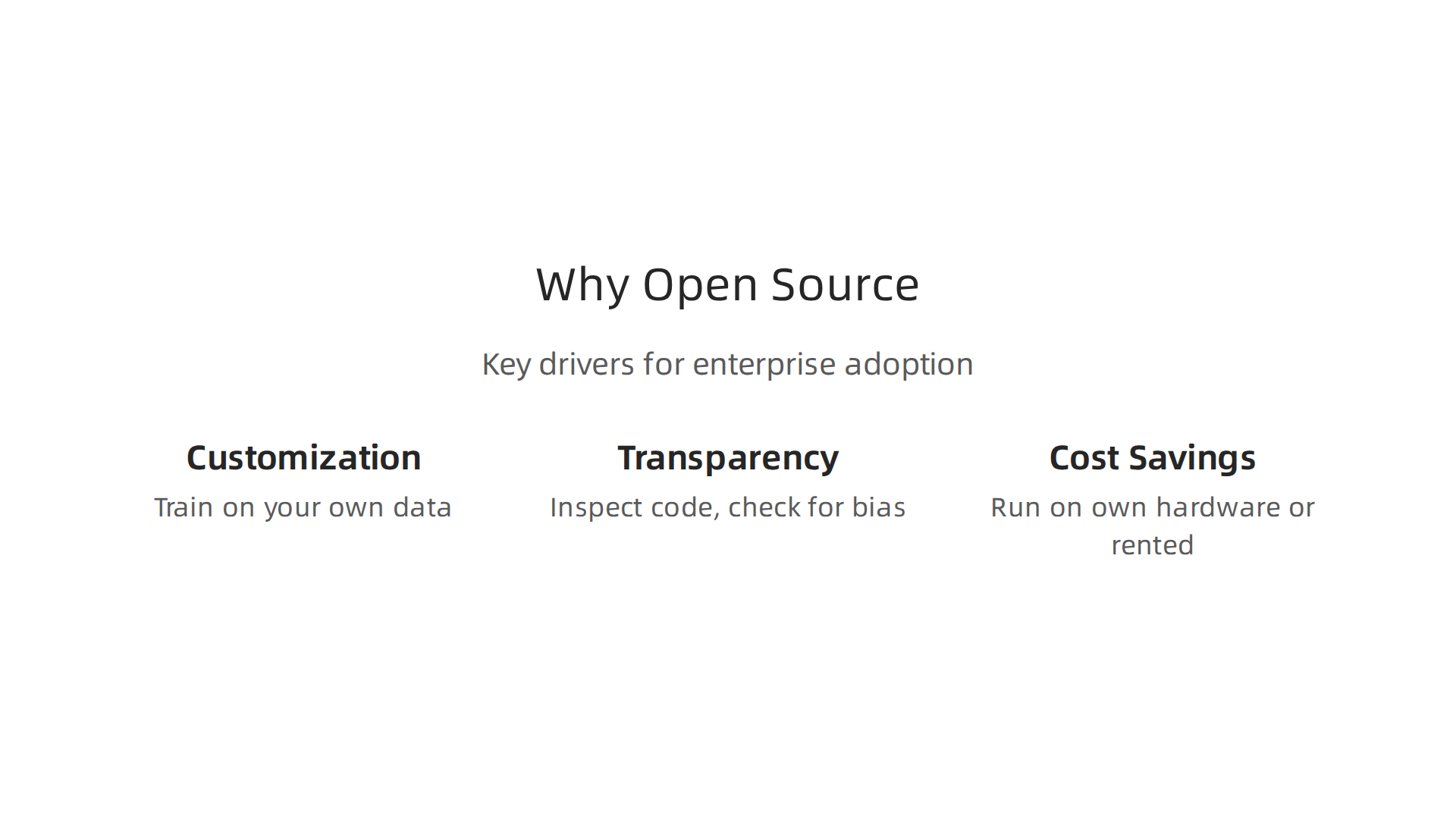
Customization. You can take a base model like Llama 3 or Mistral and train it on your own data. The result is a model that understands your industry, your products, and your customers. According to the Open Source AI Enterprise Guide 2026, this adaptability is why open source models are now leading enterprise adoption.
Transparency. With proprietary models, you never really know what is inside the black box. Open source lets you inspect the code, check for bias, and understand how decisions are made. For regulated industries, that is essential.
Cost savings. Running an open source model on your own hardware or a rented GPU cluster often costs much less than paying per API call to a proprietary provider. Platforms like Amplify AI help teams optimize these models for their specific chips, squeezing more performance out of every dollar.
Of course, open source is not perfect. You trade some convenience and support for control. Proprietary platforms like OpenAI and Google Vertex AI offer polished APIs, built in security, and 24/7 support. The enterprise AI integration platforms compared for 2026 show that many companies use both. They start with open source for experimentation and prototyping, then layer on proprietary tools for production scale.
Across the world wide technology landscape, zebra technologies and other industrial players are using open source to build edge AI solutions that run totally offline. AI software companies are packaging open source tools into commercial products. The best ai software now often combines the flexibility of open source with the reliability of managed services.
If you want to see how specific open source models stack up side by side, our AI model comparison 2026 guide covers benchmarks for both open source and proprietary models.
The open source revolution is not coming. It is here. And the teams that learn to use it will have a serious advantage in speed, cost, and customization.
That is exactly why thousands of developers and technical leaders read The Deep View Newsletter every day. It delivers clear, unbiased updates on AI hardware, software, and strategy. No hype. Just what matters.
Integrating AI into Your Development Workflow: A Practical Framework
So you have picked your open source model and you are excited to start building. But here is the reality check that catches most teams off guard. Dropping a model into your existing codebase without a plan almost never works. You need a clear, repeatable process for integrating AI tools into your development workflow.

Let me walk you through a simple framework that works in 2026.
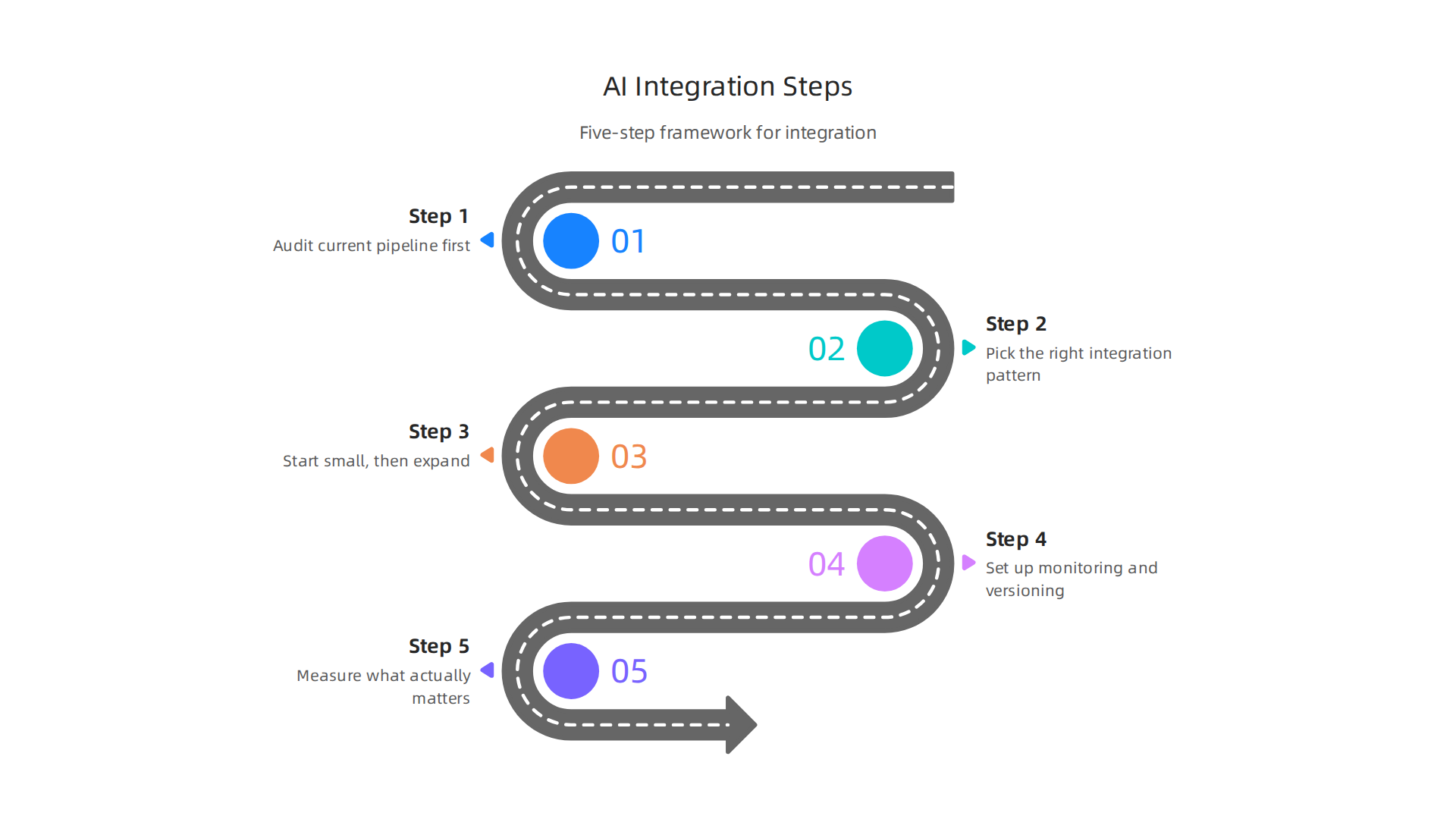
It is based on what top teams at ai software companies and world wide technology firms are actually doing.
Step 1: Audit your current pipeline first
Before you add anything, map out your current CI/CD pipeline. Where are the bottlenecks? Which tasks eat up the most developer time? Is it code review, testing, documentation, or deployment? The best AI investments target the biggest pain points. For example, if your team spends 10 hours a week on manual code reviews, an AI code review tool will give you an immediate return. If testing is the bottleneck, look at AI powered test generation instead.
Step 2: Pick the right integration pattern
You have three main options. The first is direct API calls to a hosted model. The second is running a local model through an open source AI gateway. The third is embedding a model directly into your application using a framework like LangChain. According to the Top Open Source AI Gateways for Enterprises in 2026, most enterprises now start with a gateway because it gives them a single control point for security, rate limiting, and cost tracking across all AI usage.
Step 3: Start small, then expand
Pick one stage of your pipeline and integrate there first. Run it for two weeks. Measure the results. Then add the next stage. This approach reduces risk and helps your team learn gradually. Companies like zebra technologies used this method to build edge AI solutions that run fully offline in manufacturing environments.
Step 4: Set up monitoring and versioning from day one
This is where many teams trip up. They add an AI tool, it works fine for a week, then performance drops and they have no idea why. You need three things from the start:
- Model monitoring. Track accuracy, latency, and cost over time. Use dashboards to spot drift before it affects users.
- Version control for models. Treat your models the same way you treat your code. Every change gets a commit and a version number.
- Prompt management. Store and version your prompts in a central repository. This alone eliminates countless headaches.
A solid enterprise AI platform like the ones compared in the Enterprise AI Integration Platforms 2026 guide will handle most of this for you.
Step 5: Measure what actually matters
Do not track vanity metrics like number of API calls or model downloads. Track real productivity gains. How much faster does your team ship features? Are bugs caught earlier? Has developer satisfaction improved? These are the numbers that justify continued investment.
If you want to see how leading teams structure their whole AI development approach, our guide on the future standard for AI implementation covers the governance rules you will want in place from the start.
Adopting AI is not a one time project. It is an ongoing process of improvement. And the teams that treat it that way are the ones that get real, lasting value from the best ai software available today.
That is why thousands of developers rely on The Deep View Newsletter for daily, no nonsense updates on AI tools, workflows, and strategy. It helps you stay ahead without the noise.
Security and Compliance Considerations for Enterprise AI Tool Adoption
You have your AI workflow running smoothly. But here is something many teams forget until it is too late. Security and compliance. AI tools introduce risks that traditional software security does not cover. As the Cloud Security Alliance explains, securing AI requires a lifecycle approach that covers models, data, and agents. You cannot just bolt on security after deployment.
Key risks you need to know about
AI systems bring three major security threats that differ from regular software vulnerabilities.
First, data leakage. When your model processes sensitive customer data or internal code, that information can leak through outputs or be stored insecurely. According to a Cycode report on top AI vulnerabilities in 2026, data exposure remains the most common enterprise AI security incident.
Second, model poisoning. Attackers can tamper with the data used to train or fine-tune your model. This causes the model to behave badly in ways that are hard to detect. The Enterprise Guide to Navigating AI Security Threats notes that AI breaks traditional security assumptions because it has probabilistic behavior instead of deterministic code paths.
Third, supply chain vulnerabilities. Many open source models and dependencies contain hidden flaws. A recent AI security analysis found thousands of critical open source vulnerabilities that can expose enterprise secrets.
Compliance frameworks matter more than ever
If your industry requires SOC 2, GDPR, HIPAA, or similar standards, your AI tools must meet those rules. The Security Controls for AI Deployments guide shows that AI systems expose attack vectors across the entire data pipeline, not just the code layer. World wide technology companies are now demanding that their enterprise AI platforms carry compliance certifications by default. Leading ai software companies build compliance into their products from the start.
Best practices for securing your AI pipeline
Start with data ingestion. Only feed models data that has been cleaned and classified. Use access controls and encryption for all training data. During model deployment, isolate models in secure environments and monitor for drift. The AI Security Best Practices guide from Obsidian Security recommends continuous monitoring and automated incident response.
Also, treat your AI pipeline the same way you treat your code pipeline. Version control your models, prompts, and training data. Run regular security scans on your dependencies. Companies like zebra technologies and amplify ai have shown that embedding security checks into every stage of the AI lifecycle prevents costly breaches.
If you want to see which AI tools already include strong security features, our roundup of the best AI apps for developers in 2026 covers platforms that prioritize compliance and data protection.
Choosing the best ai software today means looking beyond features. Security is not optional. It is a core requirement.
That is why thousands of developers rely on The Deep View Newsletter for daily, no nonsense updates on AI security, compliance, and emerging threats. It helps you stay informed without the noise.
Cost Management and ROI: Making the Business Case for Enterprise AI
Here is the hard truth about AI in 2026. The technology works. But the costs can spiral fast if you do not plan ahead. You need to know where your money goes and how to prove the value.

Let us break it down so you can make a solid business case to your boss or your board.
Where does your AI budget actually go?
There are four big cost buckets you cannot ignore.
Training. Teaching a large model from scratch costs a lot. A single NVIDIA H100 GPU starts around $25,000 to buy or $2.69 per hour to rent on cloud platforms. But if you need more memory, the H200 offers 141 GB of HBM3e memory with 4.8 TB/s bandwidth. And for cutting edge workloads, the B200 delivers 192 GB of memory and up to 9,000 TFLOPS of FP4 performance. According to the H100 vs H200 vs B200 comparison from Introl, the B200 can speed up training up to 3 times compared to the H100. That trade off matters.
Inference. Running your model in production is a recurring cost. The B200 is optimized for trillion parameter inference and can be up to 30 times faster on FP4 pipelines. But many teams still use the H100 for models under 70 billion parameters because it is more cost effective.
Fine tuning. Adapting a pre trained model to your data requires retuning. This uses similar GPU power to training but usually on a smaller scale.
Infrastructure. Beyond GPUs, you pay for storage, networking, data pipelines, and monitoring. World wide technology companies like zebra technologies and amplify ai have shown that infrastructure planning is where most hidden expenses live.
How to calculate ROI for AI
ROI is not just about cost savings. It is about speed and quality.
Developer productivity. AI coding assistants cut the time for routine tasks by 30% to 50%. That means your team ships features faster.
Time to market. When you reduce development cycles, you capture revenue earlier. Even a few weeks can make a huge difference.
Quality improvements. Fewer bugs and better code reviews raise customer satisfaction and lower maintenance costs.
The calculation is simple. Compare the total cost of GPUs, cloud compute, and data operations against the value of hours saved, features delivered, and defects avoided. AI software companies now publish ROI case studies showing 3x to 5x returns within the first year. When choosing the best ai software, look for platforms that include cost dashboards.
Tools to keep costs under control
You need visibility. AWS Cost Explorer lets you tag AI workloads and track spending per model. Third party platforms like JarvisLabs offer real time GPU pricing comparisons. The NVIDIA H100 Price Guide 2026 shows you exact cloud rental rates across providers so you can choose the cheapest option for inference.
Start small. Monitor everything. Scale only when the ROI is clear.
Staying on top of AI costs and emerging tools is a daily challenge. That is why thousands of developers trust The Deep View Newsletter for clear, no nonsense coverage of what actually works in enterprise AI. It helps you make smarter spending decisions without the hype.
Talent and Skills: Closing the Gap for AI-Driven Development Teams
You have the budget and the hardware. Now you need the people who can actually build with it. Finding and keeping AI talent is the next big challenge in 2026.
Where the skill gaps hurt most
Three areas stand out for most teams.
Prompt engineering. This is not just about typing the right question. It is about designing system prompts that control model behavior, manage context windows, and route tools. Most developers learn this on the job. But very few are truly good at it from day one.
MLOps. Getting a model into production is harder than training it. Teams struggle with versioning data, monitoring drift, and automating pipelines. According to the Cloud Security Alliance’s Secure AI in the Enterprise framework, securing models across their lifecycle requires dedicated MLOps skills that most teams simply do not have yet.
Model deployment security. The Top AI Security Vulnerabilities report from Cycode shows that misconfigured deployments are a leading cause of breaches. Teams need to know how to lock down APIs, manage access, and scan for secret exposure.
How enterprise training fills the gaps
Good companies do not wait for the market to produce experts. They build their own.
Programs like the AWS ML Specialty certification and NVIDIA DLI workshops give developers a structured path.
These programs teach practical skills like deploying models on specific hardware and optimizing inference. If you are looking for structured learning paths, our article on best computer science courses for AI development in 2026 covers the top programs available.
Strategies that actually work
Upskill existing teams. Pair a senior backend engineer with an MLOps mentor for one sprint. Let them build a simple RAG pipeline together. Hands on projects work better than theory. For a full breakdown of career paths and skills, read our software developer roadmap 2026.
Hire for the full stack. The best candidates understand software engineering AND model behavior. Look for developers who have shipped a model to production, not just trained one in a notebook. Hiring AI-savvy developers means knowing the difference between roles. Our guide on computer science vs software engineering helps you build the right interview process.
Companies like world wide technology, zebra technologies, and amplify ai are leading the charge here. They look for practical experience with tools from the best ai software companies. They know that a developer who can deploy, monitor, and secure a model is worth more than someone who can only train one.
Staying ahead of the curve
The pace of change in 2026 is brutal. Skills that mattered six months ago are now table stakes. You need a reliable signal to keep your team on track. Thousands of developers trust The Deep View Newsletter to cut through the noise. It delivers clear daily updates on what works in enterprise AI, so you and your team can focus on building skills that actually matter.
Expert Outlook: What to Expect from Enterprise AI in the Next 12 Months
The next 12 months will bring massive changes to enterprise AI. Based on current trends, here is what developers and CTOs should watch closely.
Three big predictions for 2026
AI agents will become more autonomous. By early 2027, many teams will deploy agents that handle complex workflows with minimal human oversight. These agents will plan, execute, and fix their own steps. That means you need strong monitoring and security from day one. Our AI model comparison 2026: GPT-4o, Claude 4, Gemini 2.0, and open source models can help you choose the right foundation for building agents.
Edge AI deployments will explode. Running models on devices instead of in the cloud cuts latency and saves bandwidth. Companies like World Wide Technology and Zebra Technologies are already investing in edge solutions for retail, logistics, and manufacturing. If you build for edge, you will have a serious advantage.
Cloud and hardware integration will tighten. The big three cloud providers are fighting hard for AI workloads. Google Cloud grew 63% in Q1 2026 thanks to TPU availability. Azure wins on OpenAI integration for teams already in the Microsoft stack. AWS offers the broadest GPU selection for flexible model training. Each provider is optimizing hardware and software together, so your choice matters more than ever.
Emerging players to watch
Beyond the hyperscalers, specialized technology is rising. AI ASICs (application-specific integrated circuits) promise faster, cheaper inference for specific models. Federated learning platforms let you train models across distributed data without moving sensitive information. Amplify AI and other ai software companies are building tools that make these approaches practical for everyday teams. Keeping an eye on the best ai software in these categories can give you an early edge.
Strategic advice for developers and CTOs
- Learn edge deployment skills. Containerizing models for devices with limited resources is a growing need.
- Build for agent oversight. Autonomous agents need logging, rollback, and human-in-the-loop checks.
- Stay cloud-flexible. Don’t lock into one provider. Test models across AWS, Azure, and GCP to find the best performance for your use case.
The pace will not slow down. The teams that adapt fastest will win.
Staying current on these shifts is hard. That is why thousands of developers trust The Deep View Newsletter to deliver clear, daily updates on what actually matters in enterprise AI. It cuts through the hype so you and your team can focus on building for what comes next.
Summary
This article guides technical leaders through the 2026 enterprise AI landscape and cuts through vendor noise so you can pick tools that actually work for your team. It compares the major cloud platforms (AWS, Azure, Google Cloud), explains the current hardware tradeoffs from NVIDIA, AMD, and Intel, and outlines why open source stacks like Hugging Face, LangChain, and LlamaIndex matter for customization and cost. The piece gives a practical integration framework—audit pipelines, choose an integration pattern, start small, and add monitoring/versioning—and highlights security, compliance, and supply-chain risks you must address. It breaks down where AI budgets go (training, inference, fine-tuning, infrastructure) and how to calculate ROI, plus hiring and upskilling advice for prompt engineering, MLOps, and secure deployments. Finally, it offers near-term predictions and tactical recommendations so your team can adapt as the market shifts. Read it to decide platforms, plan deployments, secure production models, and build the right team and cost model for enterprise AI success.