

AI for Humans How to Design Systems That Put People First
Overview
Introduction
Artificial intelligence is changing how we work, create, and live. In 2026, AI tools are everywhere from your phone to your workplace.

But as these systems get smarter, one big question keeps coming up: are we building technology that truly helps people, or are we just rushing ahead without thinking about the effects?
That question is more important now than ever. Developers, business leaders, and policymakers all face the same challenge. They must decide not just what AI can do, but what it should do. The real goal isn’t just making faster or more powerful models. It’s creating ai for humans technology that respects our values, protects our rights, and improves our daily lives.
The OECD AI Principles, the first set of international rules for trustworthy AI, put it clearly. They call for AI that respects human rights, democratic values, and fairness. These principles guide countries and companies in building systems that put people first.
So what does this mean for you? Whether you are a developer building the next big app, a leader deciding on your team’s tools, or just someone who uses AI every day, understanding the human side of technology matters. You might wonder about the dangers of ai when systems make unfair decisions or spread false information. You might ask yourself human or ai when you interact with a chatbot and can’t tell the difference. Or you might be curious about how to make an ai that truly serves people instead of causing harm.
This article gives you a clear picture of how AI affects society and the key principles for designing systems with people at the center. We will look at the real risks, the practical guidelines already in use around the world, and the steps you can take to build trust.
If you want to stay ahead of these changes and understand how AI is reshaping our world, consider getting clear daily AI updates from The Deep View Newsletter.
It delivers the latest insights straight to your inbox so you never miss what matters.
Let’s start by exploring why human-centered design is not just a nice idea it is a necessity for the future of AI.
The Human-Centric Imperative in AI Development
Building ai for humans starts with a simple shift in mindset. Instead of asking what a machine can do, we ask what it should do for people.

That change makes all the difference. When developers focus on augmenting human abilities rather than replacing them, they create systems that earn trust and deliver lasting value.
The OECD AI Principles capture this idea well. They call for using AI to "augment human capabilities and enhance creativity" while advancing inclusive growth and reducing inequalities. This is the foundation of responsible stewardship of trustworthy AI. Trust is not something you bolt on at the end. It has to be built into the design from day one with transparency, fairness, and accountability baked into every layer.
Think about it this way. If a system makes decisions that affect your job, your health, or your finances, you deserve to know how it reached those conclusions. You deserve to know whether you are talking to a human or ai and what data the system used. That openness is what makes people feel safe adopting new tools. Without it, the dangers of ai like biased outcomes, misinformation, or loss of privacy start to outweigh the benefits.
Real companies have already seen the payoff. Teams that put human needs first report fewer biased results, happier users, and fewer headaches with regulators. For example, the EU AI Act now requires strict transparency and human oversight for high-risk systems. Following these rules isn’t just about compliance. It is about building something people actually want to use.
So how to make an ai that truly serves people? Start with values. Respect human rights. Protect privacy. Be clear about your system’s limits.
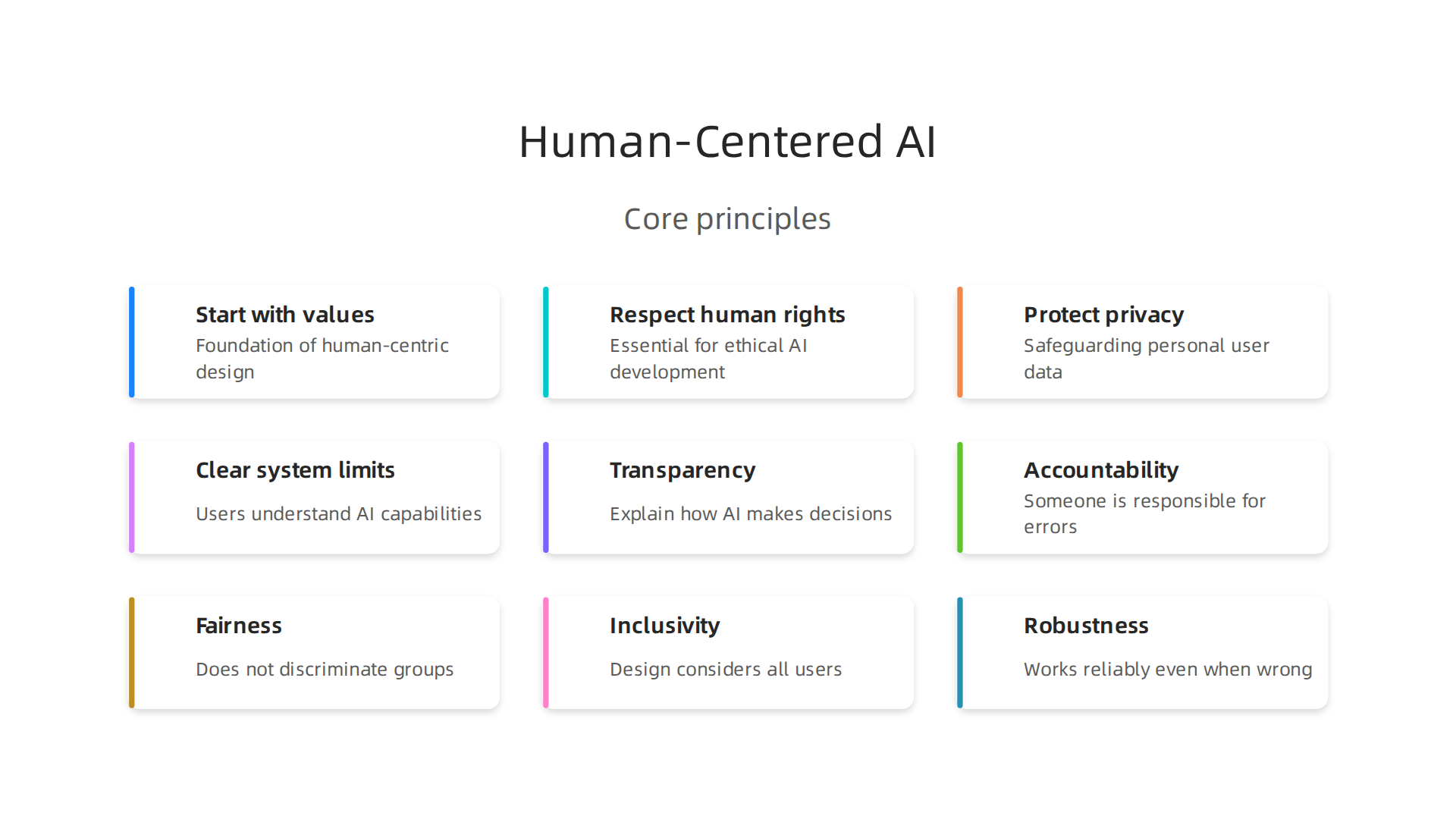
These principles guide every good decision, from choosing training data to designing user interfaces.
For developers and leaders who want to stay on track, having a clear framework is key. You can explore more on establishing clear rules for AI implementation to guide your team’s approach.
The next section will dig into the real risks we face when AI systems lose sight of people, and what we can do about them.
Key Societal Impacts of AI: Opportunities and Risks
AI can transform healthcare by spotting diseases earlier, personalize education for each student, fight climate change by optimizing energy use, and boost productivity in almost every industry. Those are real opportunities.
But every powerful tool brings risks. Job displacement is a top worry. Many people fear AI will replace their roles. Algorithmic bias can lock in unfairness if the data used to train systems is skewed. And privacy erosion happens when AI systems collect and use personal data without clear consent.
According to recent data, a majority of Americans rate the risks of AI for society as high. Only a quarter see high benefits. That gap matters. It tells developers that the dangers of ai are very real in people’s minds. Public concern about AI’s impact on daily life has grown significantly in recent years, with half of U.S. adults now saying they feel more concerned than excited.
Understanding these trade-offs is not optional for anyone building ai for humans. You need to know how your design choices affect real people. If you are evaluating which models or tools to use, check out this guide on how to evaluate the smartest AI in 2026 to make informed decisions.
The landscape changes fast. To keep up with the latest developments and societal impacts, you can stay informed with clear daily AI updates from The Deep View Newsletter.
Economic Disruption and Job Transformation
One area where this change is most visible is in the job market. Automation is hitting both blue-collar roles like factory work and white-collar roles like data entry and customer service. But here is the thing. AI also creates new positions in oversight, model training, and system development. According to global views on AI and jobs, 60% of people expect AI to change how they do their job within five years, while 36% believe it could replace their role entirely.
That is why reskilling and upskilling programs matter so much. If you are a developer or technical leader, the fastest way to stay valuable is to keep learning.

For a clear path forward, check out this software developer roadmap for the AI era. It covers the exact skills and career moves that help you adapt.
Policymakers and companies are also testing bigger ideas. Some are experimenting with universal basic income to cushion job losses. Others are looking at AI tax models that redistribute profits from automation. These conversations are still early, but they show that the dangers of AI are being taken seriously at every level.
Bias, Fairness, and Ethics
One of the biggest dangers of AI is that it can copy and even worsen human biases. When an AI system learns from old data that already has unfair patterns, it often repeats those patterns at a much larger scale. For example, a widely used hiring tool in early 2025 was caught favoring male candidates for leadership roles. The tool learned from past executive profiles and decided those were the "ideal" candidates. This is a clear case of Ethical UX Design in 2025 showing how bias slips into systems without careful checks.
Thankfully, the industry is starting to fight back. Fairness metrics and bias detection tools are now becoming standard parts of how teams build AI. These tools help catch problems before they hurt real people. But it is not just up to developers. High-profile failures like biased hiring algorithms and facial recognition errors have pushed governments to act. New laws in places like the European Union now require companies to prove their systems are fair and transparent.
If you are building or managing AI products, you need to stay ahead of these rules. A smart first step is to set clear rules for your team’s AI use. This guide helps you build guardrails that protect users and your business.
The conversation around bias and fairness changes fast. Staying informed is the best defense. To keep up with the latest in AI ethics and regulation, try The AI Newsletter Worth Reading. It delivers clear daily updates so you never miss what matters.
Privacy and Surveillance
AI powered surveillance is everywhere now. Your smart speaker, your phone’s camera, even the checkout line at the store all collect data about you. In 2026, these systems are smarter and more common than ever. But here is the thing. That convenience comes with a real cost to your privacy.
Many people worry about their civil liberties when AI watches them all day. And they have good reason. In just one year, the number of reported AI related incidents jumped by 56.4 percent according to the Stanford AI Index Report. That includes serious problems like mass data collection, biometric harvesting, and covert tracking. A good example is the case of AI privacy violations from Clearview AI, which scraped billions of facial images without consent. This kind of surveillance happens without most people even knowing about it.
Thankfully, engineers have built some smart ways to reduce these risks. Differential privacy and federated learning are two techniques that help. They allow AI to learn from data without actually seeing your personal information. On device processing is another big one. It keeps your data on your phone instead of sending it to a server. These methods make a real difference.
But how people feel about all this depends a lot on where they live. In Europe, strict laws like the EU AI Act and GDPR protect users much more aggressively. People there expect privacy by default. In the United States, the approach is more spread out with state level rules. And in other parts of the world, acceptance of surveillance varies widely.
If you work with AI, understanding these rules is important. You can start by setting up clear guidelines that protect user data and your business. For daily updates on AI privacy and regulation, The AI Newsletter Worth Reading delivers clear summaries to your inbox. It helps you stay informed without the noise.
Core Development Principles for Human-Centered AI
Privacy is just one piece of the puzzle. To build AI that truly helps people, developers need to follow a set of core principles. These principles make sure AI is safe, fair, and trustworthy for everyone. The OECD AI Principles are a widely used starting point. They focus on five big ideas: transparency, accountability, fairness, inclusivity, and robustness.
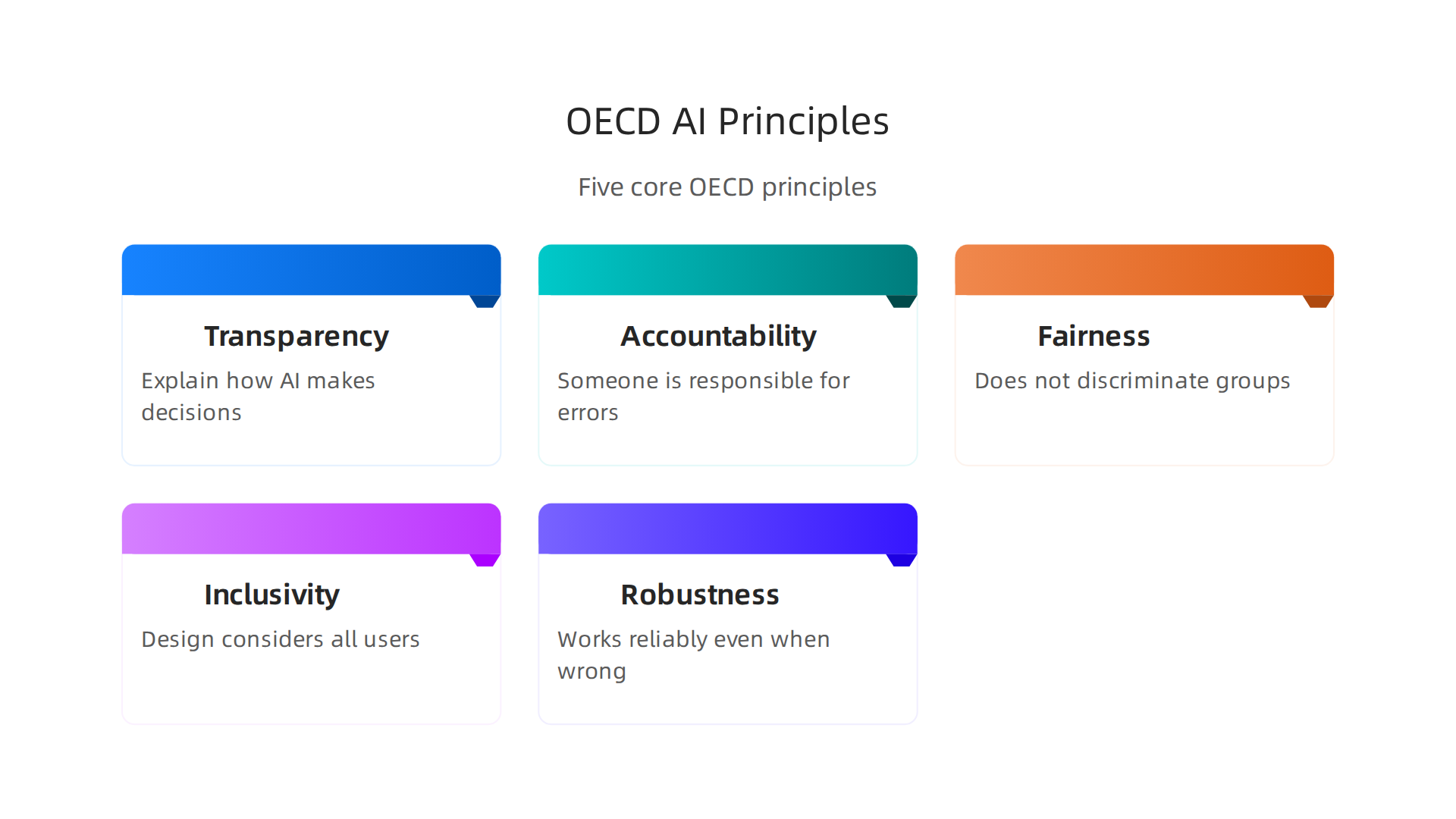
What do these mean in practice? Transparency means you can explain how your AI makes decisions. Accountability means someone is responsible if the system does something wrong. Fairness means the AI does not discriminate against groups of people. Inclusivity means the design considers all users, not just the majority. Robustness means the system works reliably even when things go wrong.
These principles cannot just sit on a document. You need to build them into your daily work through tools, processes, and governance. For example, you can set up audit trails, bias checks, and human oversight at every stage. The earlier you adopt these practices, the less technical debt and regulatory risk you face later.
If you want to keep learning about how to build responsible AI, check out this guide on clear rules for AI implementation for your team. And to stay updated on the latest frameworks and regulations, The AI Newsletter Worth Reading sends daily summaries straight to your inbox.
Transparency and Explainability
When an AI system denies your loan application or flags your social media post, you want to know why. That is where transparency and explainability come in. Explainable AI (XAI) refers to methods and techniques that help humans understand how a model reaches its decisions. Without this understanding, it is hard to trust the system or fix it when something goes wrong.
The OECD AI Principles require AI actors to commit to transparency and responsible disclosure. This means providing meaningful information about how AI systems work, including their limitations and the logic behind their outputs. Regulations like the GDPR right to explanation already push for interpretable models, especially in high-stakes areas like credit scoring and hiring.
Developers have several practical tools to make models more transparent. SHAP, LIME, and integrated gradients are widely used to show which features influenced a prediction. These tools help you spot bias, debug errors, and explain results to regulators or users. Building explainability into your workflow from the start saves headaches later.
For more on the tools you can use in your daily work, check out this guide on selecting AI software development tools for your team. It covers how to choose solutions that support transparency and other best practices.
Accountability and Governance
Who is responsible when an AI system makes a mistake? That is the core question of accountability. Without clear ownership, problems get ignored and the dangers of AI, like biased decisions or unsafe outputs, go unchecked.

Good accountability starts with naming a person or team in charge. Many organizations create AI ethics committees or appoint a chief AI officer to oversee AI projects.
Governance also means putting the right systems in place. Teams should conduct model audits, keep clear documentation using model cards, and have an incident response plan ready. These steps make it easier to catch issues early and fix them when something goes wrong.
Regulations are stepping in too. The EU AI Act, for example, imposes strict liability on companies that build high-risk systems. Under this law, you must document your data, log activity, and ensure human oversight. This is a clear signal that how to make an AI trustworthy includes building governance from day one.
For a deeper look at setting up these rules in your own team, check out this guide on the future standard for AI implementation and why your team needs clear rules now.
If you want to keep up with the latest in AI governance and tools, consider subscribing to The AI Newsletter Worth Reading. It delivers clear daily updates straight to your inbox.
Inclusivity and Accessibility
AI systems should work for everyone. But too often, they are built with only a narrow set of users in mind. This can leave out people with disabilities, non-native speakers, or folks from different backgrounds. That is not just unfair. It also limits the real-world value of AI. The goal of ai for humans is to create technology that serves all people, not just a few.
Inclusive design means collecting diverse training data. It means testing your system with users of different ages, abilities, and cultures. When you ask "human or ai" during testing, you also need to check if the AI performs equally well across groups. If it does not, you have a bias problem.
Fortunately, there are open-source tools to help. For example, the best open-source AI toolkits for responsible AI include libraries like Fairlearn and AI Fairness 360 that detect and reduce bias. These tools make it easier to build fairer AI.
Accessible AI can also bridge digital divides. In education, AI tutors can help students with learning disabilities. In healthcare, voice-activated systems can assist patients with limited mobility. In public services, chatbots that support multiple languages can serve diverse communities.
To make AI truly inclusive, you need to know how to evaluate it. Check out this guide on AI model comparison 2026 to see how different models perform on fairness and other key metrics.
Real-World Case Studies: AI Done Right and Wrong
Seeing the principles of human-centered AI in action is powerful. Let us look at real examples where systems either helped people or caused real harm. The lessons are clear.
Start with a failure. In early 2025, a widely used AI hiring tool was caught favoring male candidates for leadership jobs. It trained on past executive profiles and learned to prefer men. That is a classic case of biased training data leading to unfair outcomes. You can read more about this AI hiring tool bias in 2025 in a deep dive on ethical UX design. The tool ignored the very idea of fair treatment for all applicants.
Another failure happened in healthcare. A 2024 study found that an AI diagnosis tool gave less accurate results for darker skin tones. That meant people with darker skin got worse care. This is a clear example of the dangers of ai when you do not test with diverse data. It also shows why inclusive design is not optional. It is a safety issue.
Now for a success story. Some financial companies have built AI that checks for bias before it ever goes live. They use open-source fairness tools and test with diverse user groups. One team found that their loan approval model was rejecting more applicants from a certain neighborhood. Because they caught it early, they retrained the model with better data. That is ai for humans done right.
The difference between these cases is simple. Failures happen when teams rush and skip human review. Successes happen when teams build with fairness and transparency from day one. If you want your team to avoid mistakes, check out this guide on clear rules for AI implementation that can help you set the right standards early.
AI is not good or bad by itself. It is the choices you make that decide the outcome. To keep learning about what works and what does not, get clear daily AI updates from The AI Newsletter Worth Reading. It will help you stay ahead of the curve.
Frameworks for Evaluating AI’s Impact on Humans
So how do you know if an AI system is actually safe and fair? You need a framework. Think of it like a checklist that helps you spot risks before they cause harm. Several groups have built these tools, and they share a lot in common.
One of the best examples is the Canadian Algorithmic Impact Assessment (AIA) framework. It is open source. That means anyone can use it and adapt it to their needs. The Canadian government created it to help public agencies check automated decisions for bias, privacy issues, and fairness. You can explore the full Canadian AIA framework to see how it works step by step.
Another major framework comes from the European Union. The EU AI Act requires a Fundamental Rights Impact Assessment (FRIA) for high-risk AI systems. That includes things like hiring tools or credit scoring. Companies must run this assessment before they put the system into use. You can find all the details in the EU AI Act business compliance guide. The Act started phasing in during 2025, and transparency rules come into effect in August 2026.
What about best practices that work anywhere? The NIST AI Risk Management Framework and ISO 42001 offer voluntary standards. They focus on risk management and organizational processes. A good impact assessment combines all three angles: regulatory compliance, risk management, and organizational best practices. That is exactly how expert teams handle responsible AI.
If you want to dig deeper into choosing the right tools, check out this guide on evaluating AI models in 2026 for helpful comparisons. The point is simple: frameworks turn abstract ideas about fairness into concrete steps. Use them early, and you avoid the kind of failures we talked about in the previous section.
Practical Steps for Developers to Build AI for Humans
But frameworks alone won’t build better AI. You also need practical steps you can apply in your daily work. Here is how to build AI for humans from the ground up.
Step 1: Define human-centric success metrics. Alongside accuracy and speed, ask what good looks like for the people using the system. Does it reduce frustration? Does it respect their time? Set clear metrics for fairness, explainability, and user satisfaction before you write a single line of code. Tools like the Holistic AI open-source library help you measure fairness alongside technical performance so you don’t lose sight of the human side.
Step 2: Integrate bias detection, explainability, and privacy into your CI/CD pipeline. Treat these checks like unit tests. Use open-source libraries such as IBM’s AI Fairness 360 to detect bias in your models automatically. Microsoft’s Fairlearn can assess trade-offs between fairness and accuracy. For privacy, TensorFlow Privacy adds differential privacy with just a few lines of code. A complete list of the best open-source responsible AI toolkits gives you a solid starting point for what to plug in. The goal is to catch problems early, before they reach users.
Step 3: Engage diverse stakeholders and test continuously. Build with input from people who will actually use the system, not just your engineering team. Run user testing sessions with real-world scenarios. Listen for unexpected outcomes that show how the AI might fail in ways you never considered. This is where the Microsoft Responsible AI Toolbox shines, offering dashboards for exploring model behavior and data quality across different demographic groups.
These steps turn the high-level frameworks we covered earlier into daily habits. They also help you avoid the very real dangers of AI that come from skipping due diligence.
For a deeper look at how to choose the right tools for your team, check out this guide on selecting AI software development tools for your 2026 team. It walks through the exact evaluation criteria you need.
And if you want to stay ahead of every new development in responsible AI, there is one resource I recommend. The AI Newsletter Worth Reading delivers clear daily updates so you never miss a critical tool or policy change. Subscribe today and keep your skills sharp for 2026.
Summary
This article explains why building AI that centers on people is essential, not optional. It covers the OECD principles and global rules that push designers to prioritize transparency, fairness, accountability, inclusivity, and robustness. You will read about real societal impacts—benefits in healthcare and education as well as risks like job disruption, algorithmic bias, privacy erosion, and surveillance—and how public concern is shaping regulation. The piece surveys existing frameworks (Canadian AIA, EU AI Act, NIST) and practical tools for explainability, bias detection, and privacy-preserving techniques. It then gives concrete steps developers and teams can adopt—metrics, CI/CD checks, stakeholder testing, and governance practices—to build trustworthy systems. By the end, readers will understand both the policy landscape and hands-on methods to design, evaluate, and deploy AI that genuinely serves people.