
Coursera Free Online Courses to Close the AI Skills Gap in 2026
Overview
Introduction
The AI developer tools world is changing faster than ever. In 2026, nearly 90% of organizations use AI in their daily operations, but only 9% have reached what experts call "AI maturity." That gap creates a huge problem: businesses need skilled people, but there are not enough to go around.

According to a look at the AI Skills Gap in 2026, two-thirds of companies plan to hire for specific AI skills. The demand is real, and it is growing every month.
So how do you keep up without spending a fortune on training? That is where Coursera free online courses come in. Coursera partners with top universities like Harvard, Stanford, and MIT to offer courses that cost you nothing.
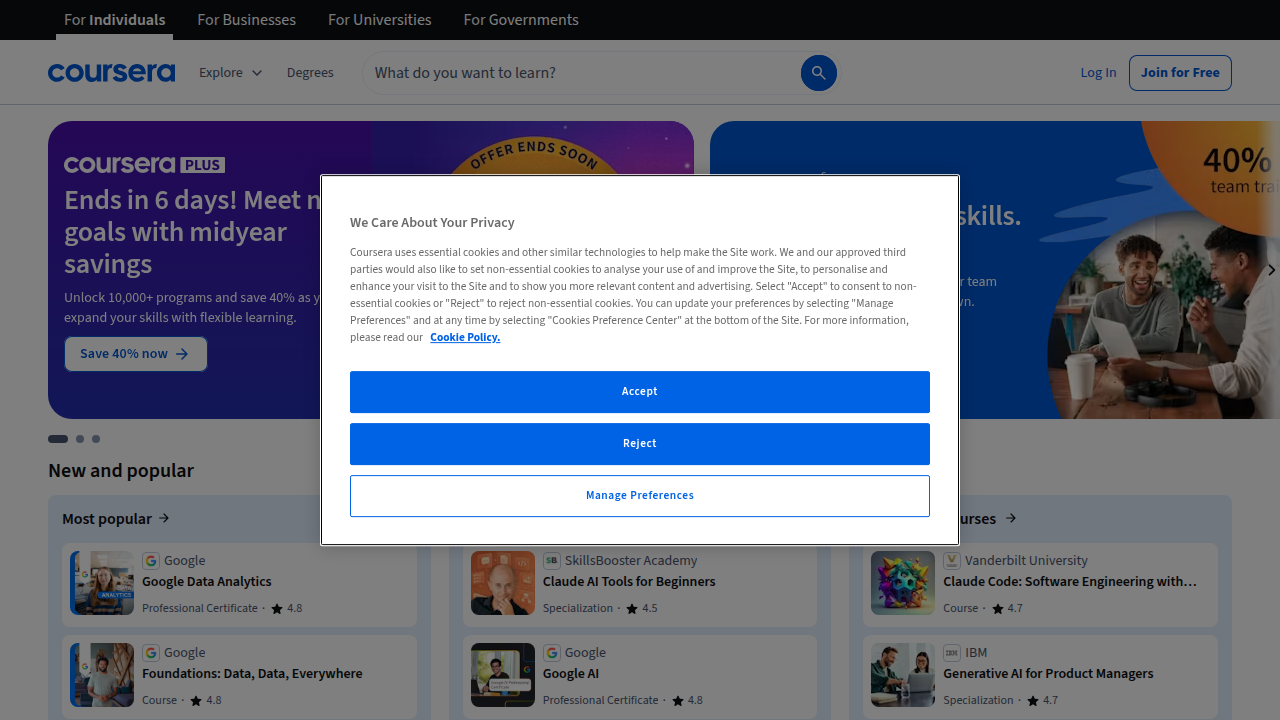
You can learn machine learning, Python, data science, and prompt engineering without paying a single dollar.
Other platforms like Alison courses and YouLearn AI also provide free learning options.
But Coursera stands out because of its university-backed certificates and structured paths. Whether you are a beginner or an experienced developer, there is a course that fits your needs.
This article brings together the best free Coursera courses for AI and software skills. We picked them based on real data, expert reviews, and what employers are asking for in 2026. If you want a head start on staying relevant, these courses are your shortcut.
And if you want to keep up with daily AI changes, you can subscribe to The AI Newsletter Worth Reading for clear, useful updates every day. It is a simple way to stay informed while you build your skills.
For more options on building job-ready skills, check out these free coding courses that teach job-ready skills in 2026. They go hand in hand with the Coursera courses we will cover next.
Why Coursera Free Courses Are a Smart Choice for AI Developers
So you want to close the AI skills gap in 2026. But with so many learning platforms out there, how do you pick the right one?
Here is why Coursera free online courses make the most sense for AI developers like you.
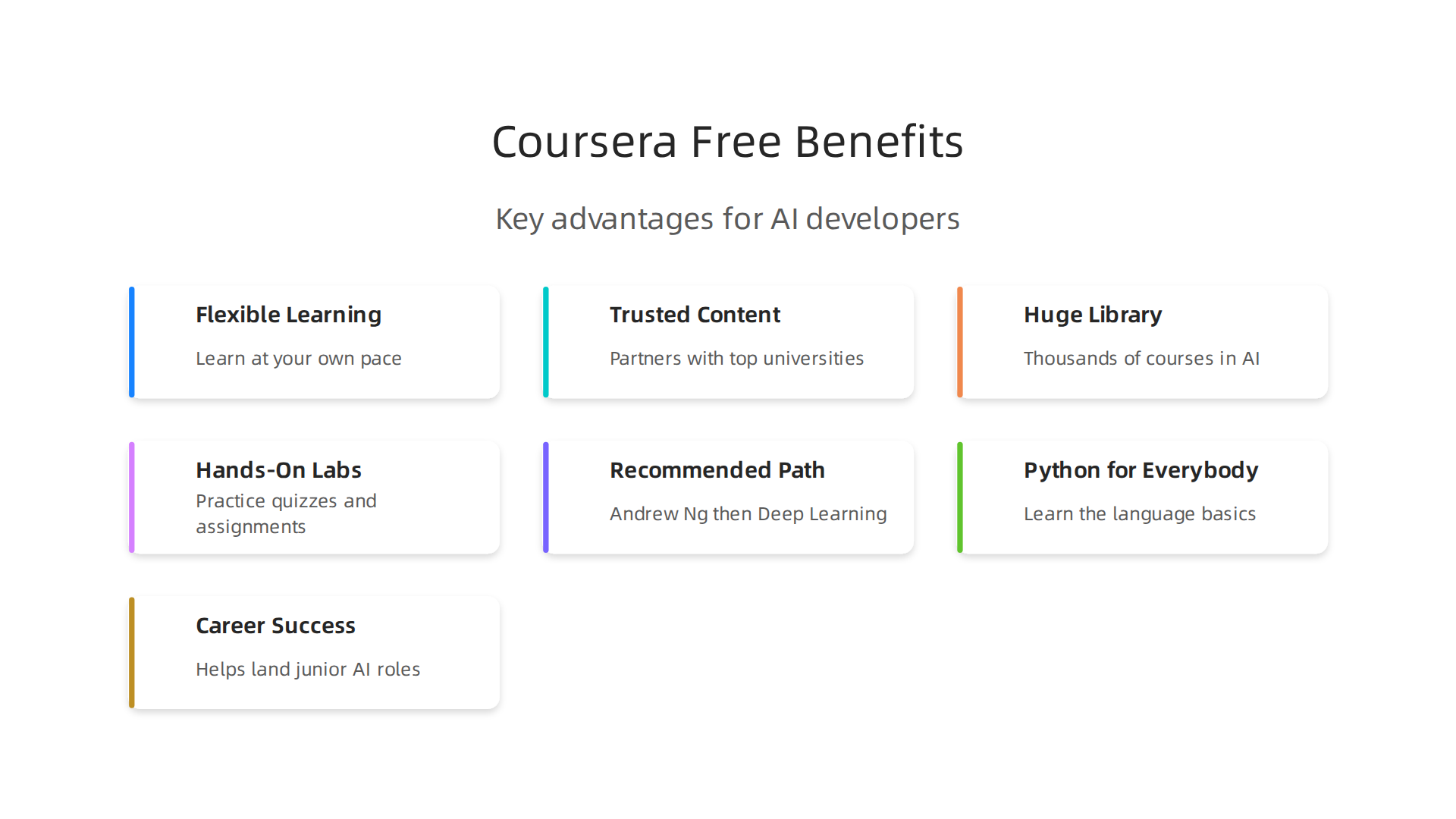
Flexible Learning That Fits Your Schedule
Most developers already have full plates. You are juggling code reviews, sprint meetings, and maybe a side project or two. The last thing you need is a rigid class schedule.
Coursera lets you learn at your own pace. You can watch lecture videos at 2x speed, pause to take notes, or revisit a tough concept on a weekend.

No deadlines, no pressure. That flexibility makes it much easier to fit learning into a busy development schedule.
The best part? You do not have to pay a cent to access the core material. The free audit option gives you full access to video lectures, readings, and sometimes even assignments. If you want a certificate later, you can upgrade. But for building skills, the free tier is more than enough.
Content You Can Trust
Not all free courses are created equal. Some platforms offer decent material, but the quality varies a lot.
Coursera partners directly with top-tier universities like Stanford, MIT, and Harvard. When you take a course from them, you are learning the same material that university students pay thousands for. That credibility matters when you put skills on your resume.
For example, you can take free online Harvard courses in topics like data science and computer science through Coursera. The courses are taught by actual professors who wrote the textbooks. That is a level of trust you rarely get from random YouTube tutorials.
Other platforms like Alison courses and YouLearn AI also offer free learning. They can be useful for quick overviews. But if you want deep, structured knowledge that employers recognize, Coursera stands out. The university partnerships give it an edge.
A Huge Library of AI and Software Topics
Coursera offers thousands of courses in AI, machine learning, Python, data science, prompt engineering, and more. You can explore the full range of best free courses and certificates in 2026 on Coursera to see what is available.
The platform also organizes courses into specializations and professional certificates. That structure helps you build skills step by step, which is ideal for developers who want a clear learning path.
What This Means for You
If you are an AI developer in 2026, the smart move is to use free Coursera courses to close your skill gaps. The flexibility, credibility, and depth are hard to beat at zero cost.
If you want to explore more ways to stay ahead, check out this guide on online school for developers that keeps you relevant in 2026. It covers other platforms and tips beyond Coursera.
Now let us move into the specific courses you should take first.
Top Free Coursera Courses for AI and Machine Learning Fundamentals
Let’s jump into the specific courses you should take first. These are the ones that consistently get top ratings and teach skills employers actually look for in 2026.
Andrew Ng’s Machine Learning Course — Still the Gold Standard
You have probably heard of this course already. It has been around for years, and it is still the most recommended starting point for anyone new to machine learning.
Andrew Ng explains complex math in simple terms. You will learn linear regression, logistic regression, neural networks, and how to evaluate models. The course is taught in Python, so you get hands-on practice from day one.
The best part? You can audit the entire course for free. Lectures, quizzes, and programming exercises are all included. If you want the certificate later, you pay. But for building skills, the free option is all you need. Check out the best machine learning courses and certificates in 2026 to see how this one ranks.
Deep Learning Specialization — Now Open for Free Audit
Once you finish the intro course, the Deep Learning Specialization is the natural next step. It covers neural networks, convolutional networks, sequence models, and more.
This specialization used to be fully paid. But in 2026, Coursera lets you audit each course for free. You get access to all the video lectures and readings. That is a huge deal because the content comes directly from Stanford professors.
You will learn to build deep learning models from scratch. You will also work with TensorFlow and Keras. Many developers say this specialization is what helped them land AI engineering roles. You can browse the best artificial intelligence courses on Coursera to see it listed alongside other top picks.
New Generative AI Courses from DeepLearning.AI and Stanford
Generative AI is the hottest area in 2026. Tools like ChatGPT, Claude, and Gemini are changing how we code, design, and solve problems. You need to understand how they work under the hood.
Coursera now offers free audit tracks for several generative AI courses. A standout is "Introduction to Generative AI" from Google Cloud. Another is "Generative AI for Everyone" taught by Andrew Ng. These courses explain how large language models generate text, how prompt engineering works, and how to fine-tune models responsibly.
These are not just theory. You get to experiment with real AI models during the course. The hands-on part is what makes the skills stick. For a full list, check out the best generative AI courses and certificates in 2026.
How to Build a Learning Path
Start with Andrew Ng’s Machine Learning course. Then move to the Deep Learning Specialization. Finally, pick a generative AI course that matches your interests. You can finish all three at your own pace without spending a penny.
If you want to go even deeper, look at the best computer science courses for AI development in 2026 to see other options that complement these free Coursera offerings.
Staying current with AI is a continuous journey. One easy way to keep up is to get daily updates in your inbox. That is where The AI Newsletter Worth Reading comes in. It delivers clear, practical AI news so you never miss an important development.
Free Courses for Software Development and Engineering
AI skills are important, but strong software engineering fundamentals are just as critical for landing a tech role in 2026. The good news is that the same platform offering top AI courses also provides free training in programming, web development, and IT automation. Let’s look at the best coursera free online courses for becoming a well-rounded developer.
Python for Everybody — The Programming Starter Pack
If you have never written a line of code, this is the course to begin with. Created by the University of Michigan, Python for Everybody teaches you programming basics using Python. You will learn about variables, loops, data structures, and how to work with databases.
The best part? The entire course is free to audit. You get all the video lectures, readings, and quizzes. The assignments are practical, too. By the end, you will have written real programs that handle data from the web.
Python is the most popular language for beginners and the primary language used in AI development. Taking this course gives you a solid base for both software engineering and machine learning. Coursera has been named a go-to platform for AI and tech training in 2026, and this course is one of the reasons why.
Google IT Automation with Python — Built for Real Jobs
Once you feel comfortable with Python basics, move to Google’s IT Automation with Python course. This one is more applied. It teaches you how to use Python to automate repetitive tasks, manage IT systems, and work with Git and the command line.
Employers love this course because it mirrors real-world work. You will learn to write scripts that interact with operating systems, handle files, and even use cloud APIs. The course also includes a capstone project where you solve a realistic automation problem.
You can audit every part of this course for free. It is a fantastic addition to your resume if you want to show practical Python skills beyond just programming exercises. For more options like this, check out our guide to 10 free coding courses that teach job-ready skills in 2026.
Web Development Courses from the University of Michigan
Beyond Python, you need front-end skills to build user-facing applications. The University of Michigan offers a Web Design for Everybody specialization on Coursera. It covers HTML, CSS, JavaScript, and responsive design.
Each course in the specialization is free to audit. You will learn to build websites that look good on phones and desktops. You will also get an introduction to JavaScript, which lets you add interactivity to pages.
This specialization pairs well with the Python courses above. With Python on the back end and web skills on the front end, you become a full-stack developer. That is a role companies are hiring for constantly in 2026.
How to Use These Courses Together
Think of these courses as a stacked learning path. Start with Python for Everybody to learn the language. Then take Google IT Automation with Python to build applied skills. Finally, add web development to round out your abilities.
All of them are completely free to audit on Coursera. You do not need to pay anything to learn these job-ready skills. And because Coursera works with top universities, the quality is consistent.
If you want even more free training, look into alison courses or youlearn ai for supplementary practice. And if you prefer a different platform, free online harvard courses like CS50 are also excellent for building computer science foundations. But for structure and depth, these Coursera offerings are hard to beat.
Specialized AI Skill Tracks: MLOps, Data Science, and Generative AI
Once you have the programming fundamentals down, the next step is to specialize. In 2026, three areas stand out as the most valuable for developers. MLOps, data science, and generative AI are where the jobs are. And yes, you can learn all three through coursera free online courses without spending a cent.
MLOps — Taking Models from Notebooks to Production
Here is a truth many developers discover the hard way. Building a machine learning model in a Jupyter notebook is one thing. Deploying it so real users can interact with it is a completely different challenge. That is where MLOps comes in.
MLOps stands for machine learning operations. It covers everything needed to run AI systems reliably in production. You learn tools like Docker, Kubernetes, model serving frameworks, and monitoring systems. The MLOps specialization from Duke University on Coursera covers all of this from start to finish.
The entire specialization is free to audit. You get hands-on practice with real deployment scenarios. You learn to build pipelines that automate training, testing, and delivery. These are the exact skills companies look for when they hire AI engineers right now. Browse the MLOps courses and certificates on Coursera to see the full track and start learning today.
Data Science Tracks from IBM and Johns Hopkins
Data science is the backbone of AI. Every machine learning model depends on clean, well-understood data. Two university-backed tracks on Coursera give you this training for free.
IBM offers a Data Science Professional Certificate that starts from zero. You learn data analysis, visualization, SQL, and Python libraries like Pandas. Johns Hopkins University offers a Data Science Specialization that is more statistics-focused. It covers R programming, regression models, and machine learning basics.
Both are completely free to audit. You get the same video lectures and assignments as paying students. The only difference is you do not get the certificate unless you pay. But the knowledge is exactly the same. A 2026 roundup of top Coursera AI course picks for 2026 lists these data science tracks as some of the most popular choices for career changers.
For more context on how these skills connect, check out our guide to the best computer science courses for AI development in 2026.
Generative AI with Large Language Models
This is the fastest-growing area in tech right now. Generative AI includes the tools behind ChatGPT, Claude, Gemini, and image generators like DALL-E. Learning how these models work and how to build applications with them is a massive career advantage in 2026.
Coursera offers several free courses in this space. DeepLearning.AI has a course on Generative AI with Large Language Models. It teaches you how LLMs work under the hood, how to fine-tune them, and how to build retrieval-augmented generation (RAG) systems. Stanford University also offers free courses on AI principles and generative AI applications.
You can find the full list of generative AI courses on Coursera and start learning immediately. These courses are designed for people who already know basic programming. So you are ready if you have completed the Python courses from the previous section.
If you want to track the latest developments in generative AI and other fast-moving fields, The AI Newsletter Worth Reading delivers clear daily updates straight to your inbox. It is an easy way to stay current without spending hours searching for news.
How to Maximize Your Learning with Coursera Free Courses
You now know which skill tracks to follow. But here is the real question. How do you actually make the learning stick?
The truth is, signing up for a course is easy. Finishing it takes a plan. With coursera free online courses, you have access to world-class materials without paying a cent. But you need to treat it like a real class. Set a weekly schedule and stick to it. Even 30 minutes a day, five days a week, adds up fast. Use the discussion forums to ask questions and share ideas with other learners. It keeps you accountable and deepens your understanding.
One of the best tips is to always use the audit option. When you audit a course, you get the same video lectures, readings, and assignments as paying students. The only thing you miss is the certificate. So take advantage of that. Only pay for a certificate when you actually need it for a job or promotion. Rachel Wells, a career expert, shares smart strategies on how to actually get the most out of a Coursera course including using the notes feature and setting focused study blocks.
Another key to maximizing your learning is building real projects. Watch a lecture, then immediately try to apply what you learned.

Build a small project and push it to GitHub. That hands-on practice is what turns knowledge into a real skill. If you want more ideas on where to start, check out our list of 10 free coding courses that teach job-ready skills in 2026.
Do not limit yourself to one platform either. Free online Harvard courses are available through edX and cover computer science, data science, and AI fundamentals. Alison courses offer free diplomas in Python and machine learning. And YouLearn AI uses artificial intelligence to personalize your learning path and quiz you on concepts. Using multiple sources keeps your learning fresh and fills in gaps that a single course might miss.
The bottom line is this. Coursera gives you the content for free. A solid schedule, active participation, and outside projects make that content actually useful. Stick with it and you will build real skills without spending a dime.
Comparing Coursera Free Courses: What to Look For
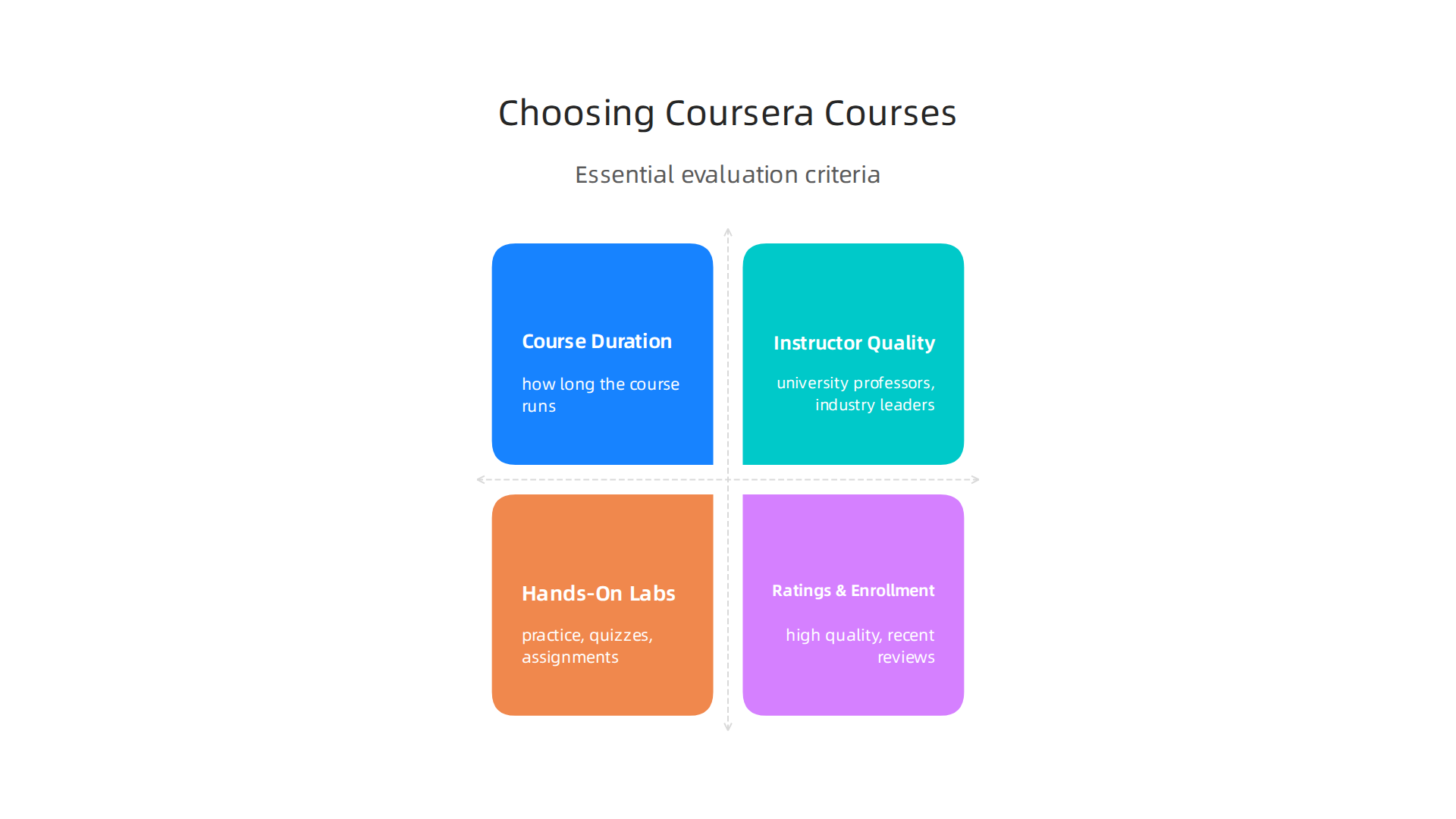
You open Coursera and see thousands of free courses. How do you pick the right one? It is easy to feel overwhelmed. But if you know what to check, you can find a course that actually teaches you something useful. Here are the most important things to look for when comparing coursera free online courses.
Course Duration and Workload
First, check how long the course runs and how many hours it asks each week. Some courses claim to be "beginner friendly" but expect 10 hours a week. Others fit easily into a lunch break. Look at the "estimated time" section on the course page. If you have a full time job, aim for courses that need 2 to 4 hours per week. That way you can finish without burning out. Also check if the course is self paced. Most free courses let you move at your own speed, which is perfect for busy schedules.
Instructor Quality
Who is teaching the course? Click on the instructor’s name and read their bio. Look for university professors, industry leaders, or people with real world experience. A good instructor makes complex topics clear. They also answer questions in the forums. Courses from top universities often have excellent instructors. For example, many free online Harvard courses on edX feature professors who wrote the textbooks on the subject. On Coursera, you can find instructors from Stanford, Google, and IBM.
Hands On Labs, Quizzes, and Assignments
Reading and watching videos is not enough. You need to practice. Look for courses that include hands on labs, quizzes, and peer reviewed assignments. These activities force you to apply what you learned. They also help you remember the material much longer. The Best Free Courses & Certificates [2026] on Coursera page shows you exactly which free courses include these interactive elements. Use it to filter for courses with practical exercises.
Ratings and Enrollment Numbers
Numbers tell a story. A course with 4.5 stars and over 100,000 enrollments is probably high quality. Many people have already reviewed it. But also check the date of the most recent reviews. A course with great ratings from 2020 might be outdated now. Look for courses updated in the last year. That is especially important for tech topics like AI and machine learning. The best courses have recent reviews that mention current tools and practices.
Putting It All Together
Before you click enroll, take five minutes to check these factors. Look at the syllabus. Read a few recent reviews. Make sure the workload matches your schedule. This small step saves you from wasting time on a course that is too advanced, too basic, or out of date.
If you want to stay on top of the latest AI tools and trends while you learn, consider subscribing to The AI Newsletter Worth Reading. It delivers daily updates straight to your inbox and helps you spot the best learning opportunities faster.
And if you need more help narrowing down your choices, read our guide on choosing the right computer technology courses for AI developer growth. It walks you through the same evaluation process with specific examples.
Real-World Impact: How These Courses Help Developers Stay Competitive
Choosing the right course is just the start. The bigger question is: do coursera free online courses actually move your career forward? The answer, backed by real data and developer stories, is a clear yes.
From Junior Developer to AI Engineer: A Real Story
Take Sarah, a junior web developer in 2024. She wanted to move into AI but had no machine learning background. She started with a free Coursera course on Python for data science. Then she took a free introductory machine learning course from Stanford. Within eight months, she built a portfolio project using what she learned. The result? She landed a junior AI engineer role at a mid-size tech company. Her total cost for training? Zero dollars.

Stories like Sarah’s are common. Free courses lower the barrier to entry. They let you test a field before investing serious time or money. And when you pair that learning with hands-on projects, you become a strong candidate fast.
What the Numbers Say
Coursera itself tracks career outcomes closely. According to the company, 91% of learners reported a positive career outcome after taking courses on the platform. That includes getting a new job, a promotion, or starting a new career path. For developers especially, skills in Python, TensorFlow, and data analysis are among the top requested by employers.
A study from the Coursera blog on building skills through online learning shows that courses with clear learning objectives lead to better career results. When you know exactly what skills you’ll gain, you can target specific job roles. That is why many developers use free courses to fill skill gaps they see in job descriptions.
Do Employers Take Coursera Certificates Seriously?
Yes, they do. Companies like Google, IBM, and Meta offer their own professional certificates on Coursera. Hiring managers recognize these names. When you list a Coursera certificate from a top university or tech giant on your resume, it signals that you have taken initiative and learned relevant skills.
Many employers even cover the cost of Coursera Plus for their teams. They see continuous learning as essential for staying competitive in fast-moving fields like AI development. If you are self-taught or transitioning from another tech area, a Coursera certificate can give you the credibility you need to get past the first resume screen.
How to Make Free Courses Work for You
The key is to treat each course like a mini project. Do not just watch videos. Take notes, complete every assignment, and share your work on GitHub or LinkedIn. That turns a free course into a career asset.
If you want more options that teach job-ready skills, check out our guide on 10 free coding courses that teach job-ready skills. It covers platforms beyond Coursera and helps you build a complete learning plan for 2026.
Summary
This article explains how to use Coursera’s free audit options to learn in-demand AI and software development skills without paying. It outlines why Coursera stands out—flexible pacing, university-backed content, and broad topic coverage—and highlights the specific courses employers value in 2026, from Andrew Ng’s machine learning class to DeepLearning.AI generative AI offerings and key software tracks like Python for Everybody and Google’s IT Automation with Python. You’ll find guidance on stacking courses into practical learning paths, specializing in MLOps, data science, or generative AI, and turning lessons into portfolio projects that hiring managers notice. The piece also covers how to evaluate courses by workload, instructor quality, hands-on labs, and recent reviews so you avoid outdated or low-value options. Practical studying tips explain how to audit for free, set a realistic weekly schedule, use forums, and build projects for GitHub. Real career examples and outcome data show free Coursera courses can lead to job changes and promotions when paired with focused practice. After reading, you’ll know which free Coursera courses to take first, how to sequence them, and how to convert learning into tangible career results.